Section 102 stock options in Israel
The general guide to Section 102: the routes, the trustee and the holding period.
Read moreWe use essential cookies to make the site work. With your consent, we also use measurement and advertising cookies from Google and Microsoft to understand how the site is used, improve it and measure our advertising. We never sell your data.
You can change your choice at any time via “Cookie settings” at the bottom of every page.

Log in to your account, or sign up in a minute.
Pick whatever works for you · we're here.
Everything about NETO · transparent and available
Pick a convenient time · we'll confirm by phone/email
Holding stock options or RSUs from a company abroad while you work from Israel? The tax depends mainly on one question: who your official employer in Israel is, and whether that employer is related to the company granting the shares. Here is which regime applies, when the tax is due, and what shows up on your payslip.
The short answer: the tax on a foreign company's stock options or RSUs depends mainly on how you are employed in Israel. If you are employed by an Israeli company that is related through control to the company granting the shares, such as its subsidiary, Section 102 is possible, provided the company filed a plan and chose that route. If you are employed by an EOR, or by any other employer that is not related to the granting company, Section 3(i) applies and Section 102 does not.
What this means in practice: under Section 3(i), the tax on an option that is not publicly traded is deferred until exercise, and the benefit is generally taxed as employment income at your regular income tax rates. For RSUs, the taxable event is the day the shares are issued to you. Selling the shares later is a separate taxable event, for capital gains. You can ask to spread the income over up to six years. When NETO is the official employer, it includes this income in the payslip and withholds the tax under Section 3(i) and applicable law, based on data from the company's plan administrator.
Whether Section 102 applies depends mainly on how you are employed in Israel, not on the type of instrument. Three questions are enough to see the picture.
The Israel Tax Authority (ITA) has said so explicitly. ITA Circular 9/2025 (11 November 2025), section 1.5: income from exercising an option over shares of a company that is not an employing company "will be taxed under the tax arrangement set out in Section 3(i), and the provisions of Section 102 will not apply to it" (our translation). Full circular (Hebrew, PDF)
And in the same circular, section 1.2: the tax rate under Section 102 "varies according to the tax route chosen by the company" (our translation). In other words, even when Section 102 applies, the employee does not choose the route.
| Who employs you in Israel | What applies | What else you should know |
|---|---|---|
| An Israeli subsidiary of the granting company, or another company related to it through control | Section 102 is possible, if the company filed a plan and chose a route | The company chooses the route (Circular 9/2025, section 1.2, Hebrew). Ask HR which route was chosen |
| An EOR that is not related to the granting company, such as NETO | Section 3(i) | Tax at exercise, generally as employment income. The law does not expressly settle the classification in this structure |
| The foreign company itself, through a branch or permanent establishment in Israel | Section 102 is possible only if the company has a permanent establishment or an R&D center in Israel and the Director of the Israel Tax Authority approved it | Apply through the ITA's green track (Form 952, Hebrew). Without such approval, Section 3(i) generally applies |
| No employer: you are a service provider and issue invoices | Section 3(i) | Tax at exercise, generally as business income under Section 2(1) (Section 3(i)(1)(b), Hebrew) |
For an employee hired through an EOR, no official source has expressly settled whether the income is employment income or income under Section 2(1). It mainly affects National Insurance and withholding duties. Check with a tax adviser.
Answer a few short questions about how you are employed. You will see which regime generally applies in that situation, and what to check. No figures and no tax calculations.
In general: if you are employed in Israel by an EOR, or by another company that is not related to the company granting the shares, Section 3(i) applies. If you are employed by an Israeli subsidiary of the granting company, Section 102 is possible, depending on what the company chose. Service providers are taxed under Section 3(i), generally as business income.
The employer's name appears at the top of the payslip.
For example: the granting company holds at least 10% of your employer, your employer holds at least 10% of it, or the same person controls both.
Your employer is related through control to the granting company, so the granting company can qualify as an "employing company" (Section 102(a), Hebrew). If the company filed a Section 102 plan, your tax depends on the route it chose. Under the trustee capital gains route, the capital gain is taxed at 25% (plus the surtax under Section 121B, where it applies), provided the trustee holds the shares for at least 24 months from the date they were allotted and deposited with the trustee (Section 102(a), "end of the period"). Under the other routes, the tax is at your regular income tax rates (Circular 9/2025, section 1.2, Hebrew).
What to check: ask HR or the plan administrator whether a Section 102 plan was filed and which route was chosen. Full explanation of the routes: the Section 102 guide.
Your employer is not related to the granting company, so the granting company is not an "employing company" with respect to you, and Section 102 does not apply (Circular 9/2025, section 1.5, Hebrew). For an option that is not publicly traded, the tax is deferred until exercise. For RSUs, the tax applies on the day the shares are issued to you. The benefit is generally taxed as employment income at your regular rates, and selling the shares later is a separate capital gains event.
What to check: that your employer receives the exercise data from the plan administrator on time, and that you know you can ask to spread the income. Details further down this page.
Section 102 applies only to employees, including officers. Options received by a service provider who is not a director, such as a supplier or consultant, fall under Section 3(i): the tax is deferred until exercise, and the withholding required from the company is deferred to the same date (Professional Circular 01/2024, section 2.1.1, Hebrew). When the options come from someone you provide services to, the income is generally classified under Section 2(1), as business income (Section 3(i)(1)(b), Hebrew).
What to check: how the income will be reported in your annual tax return, and whether self-employed National Insurance contributions apply. Talk to your accountant.
A foreign company counts as an "employer" for Section 102 only if it has a permanent establishment or a research and development center in Israel and the Director of the Israel Tax Authority approved it (Section 102(a), Hebrew). A request can be filed through the ITA's green track, on Form 952 (Israel Tax Authority, Hebrew). Without such approval, Section 3(i) generally applies.
What to check: ask HR whether the company has such an approval, and whether a Section 102 plan was filed.
Check your payslip to see who your employer is. Then ask HR two questions: is your employer related through control to the company granting the shares, and was a Section 102 plan filed for your grants? With those two answers, the table above will show you what applies.
The self-check gives a general picture based on your answers and is not tax advice. What actually applies depends on the plan, the documents and the circumstances.
Under Section 3(i), for an option that is not publicly traded, the tax generally does not apply on the day you receive it, but later. Here is how it looks on a timeline.
The company grants you options or RSUs. For an option that is not publicly traded, there is generally no tax at this stage.
Generally no taxYour rights vest on the schedule set in the plan. For options, vesting alone does not create a tax.
Options: no taxConverting the option into a share, or selling the option itself, whichever comes first. For RSUs: the day the shares are issued to you.
Generally employment incomeA separate taxable event, on the difference between the value on the exercise date and the sale price.
Capital gain or lossThis explanation covers Section 3(i). When Section 102 applies, the timing and the rate of the tax depend on the route the company chose. See the Section 102 guide.
The income taxed at exercise is the "benefit value". This is how the Israel Tax Authority calculates it (Circular 9/2025, section 2.4, Hebrew):

Enter your own figures, all in the same currency. The calculator only applies the Israel Tax Authority's formula shown above. It does not calculate tax, and the figures stay in your browser.
Enter the number of options or RSUs and the market value of the share on the exercise date.
The market value is not higher than what you paid, so in this example there is no benefit value at exercise.
Spreading is limited to six years ending in the year of exercise, so the calculator used six parts (Section 3(i)(2)).
How it was calculated:
The tax itself depends on your other income and on the regular brackets, so we do not show it here. You can see the brackets in the Israel income tax and National Insurance brackets calculator. This illustrates the formula and is not tax advice.
A large amount of income in a single year can push you into a higher tax bracket. That is why Section 3(i)(2) lets you ask to spread it. In the words of the section, as quoted in the circular: "at the taxpayer's request, the tax on the difference upon exercise of such a right shall be computed as if it were income received in equal annual parts, their number being the number of years from the day the right was granted until it was exercised, but not more than six years ending in the year of exercise" (our translation; Circular 9/2025, section 4.2, Hebrew; Section 3(i)(2), Hebrew).


On tax coordination in general: Tax coordination in Israel: an employee guide.
According to the National Insurance Institute of Israel, options under the capital route (allotments after 1 January 2003) are exempt from contributions, while options under the ordinary income route are "chargeable income" (Employee income exempt from contributions, Hebrew, PDF). Income under Section 3(i) is not under the capital gains route of Section 102, so it is expected to be subject to National Insurance and health insurance contributions.
If the income is classified as employment income, the contributions are generally paid as an employee, through the employer. If it is classified as business income, it is closer to self-employed status. The final classification depends on the circumstances.
According to the Israel Tax Authority, the place where income from exercising options is derived depends on where you worked during the vesting period. The gain is allocated by your workdays in each country, out of all the days from the start of vesting to its end (Circular 9/2025, section 2.5, Hebrew).
If you moved to Israel holding options or RSUs that you received while you were a foreign resident, Circular 9/2025 sets out a detailed arrangement for you, including an exemption for certain parts and a credit for foreign taxes (sections 4.3-4.6). It is worth reading the circular or speaking with a tax adviser.

When NETO is your official employer in Israel, the options are still granted by the company you work for, in its own shares. NETO handles the payroll side.

Working for a foreign company and want to be employed properly in Israel? Refer your employer to NETO.
Employer registrationGranting stock options or RSUs to people in Israel? The employment structure you choose determines how they are taxed.

These are official Israeli sources and are published in Hebrew.
The binding text is the official version published in the Israeli Official Gazette and by the Israel Tax Authority.
The general guide to Section 102: the routes, the trustee and the holding period.
Read moreWhy there is no Section 102 through an EOR that is not related to your company, and what to do instead. Includes a decision tool for employers.
Read moreStart with NETO, open a subsidiary, and move the employees. What happens to equity at each stage.
Read moreIf you are employed by an Israeli company related through control to the granting company, Section 102 is possible, under the route the company chose. If you are employed by an EOR or another employer that is not related to it, Section 3(i) applies: tax at exercise, or for RSUs on the day the shares are issued, generally as employment income, and a separate capital gains event on sale. You can ask to spread the income over up to six years, and the income is expected to be subject to National Insurance.
NETO is the official employer in Israel: a payslip, full statutory rights, and option income handled through payroll. Refer your employer to us, or talk to us.
 YC
Every section, organized by topic. Browse the full hierarchy or jump straight in.
Adjust the site to your needs
Here you can ask to see the data we hold about you, correct it, delete it, withdraw consent you gave, or stop receiving our emails and alerts. We reply within 30 days, and handle removal requests within 7 business days. Privacy policy
Barkat I.T Ltd · trading as NETO · is a licensed manpower company (license 1565), supervised by the Israeli Ministry of Labor.
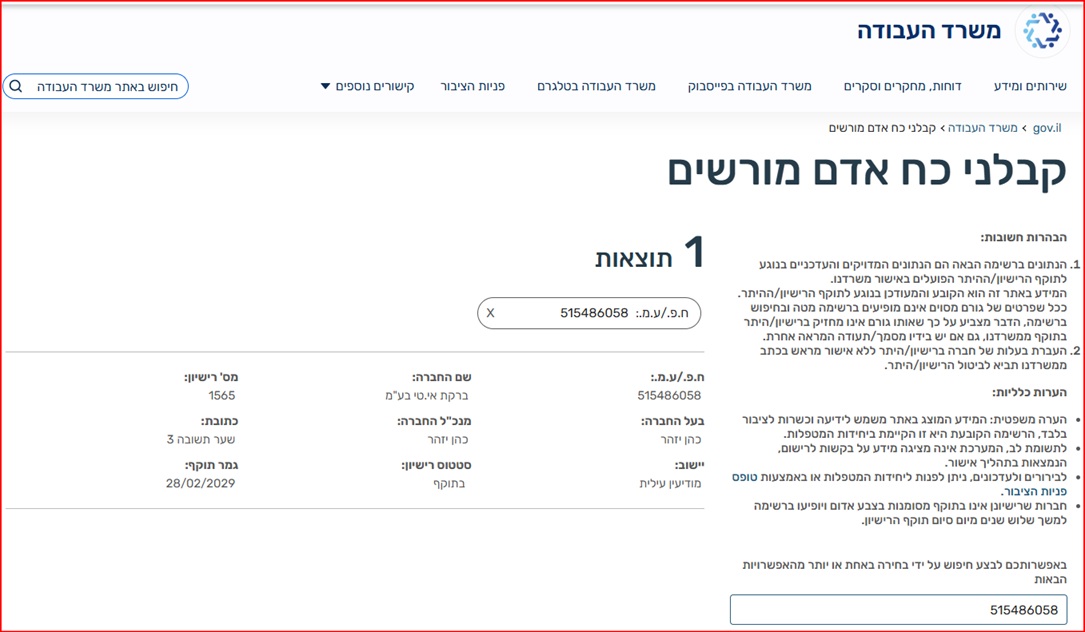 Verify the license on the Ministry of Labor website
Full details · Manpower contractor license page →