
Employer of Record (EOR)
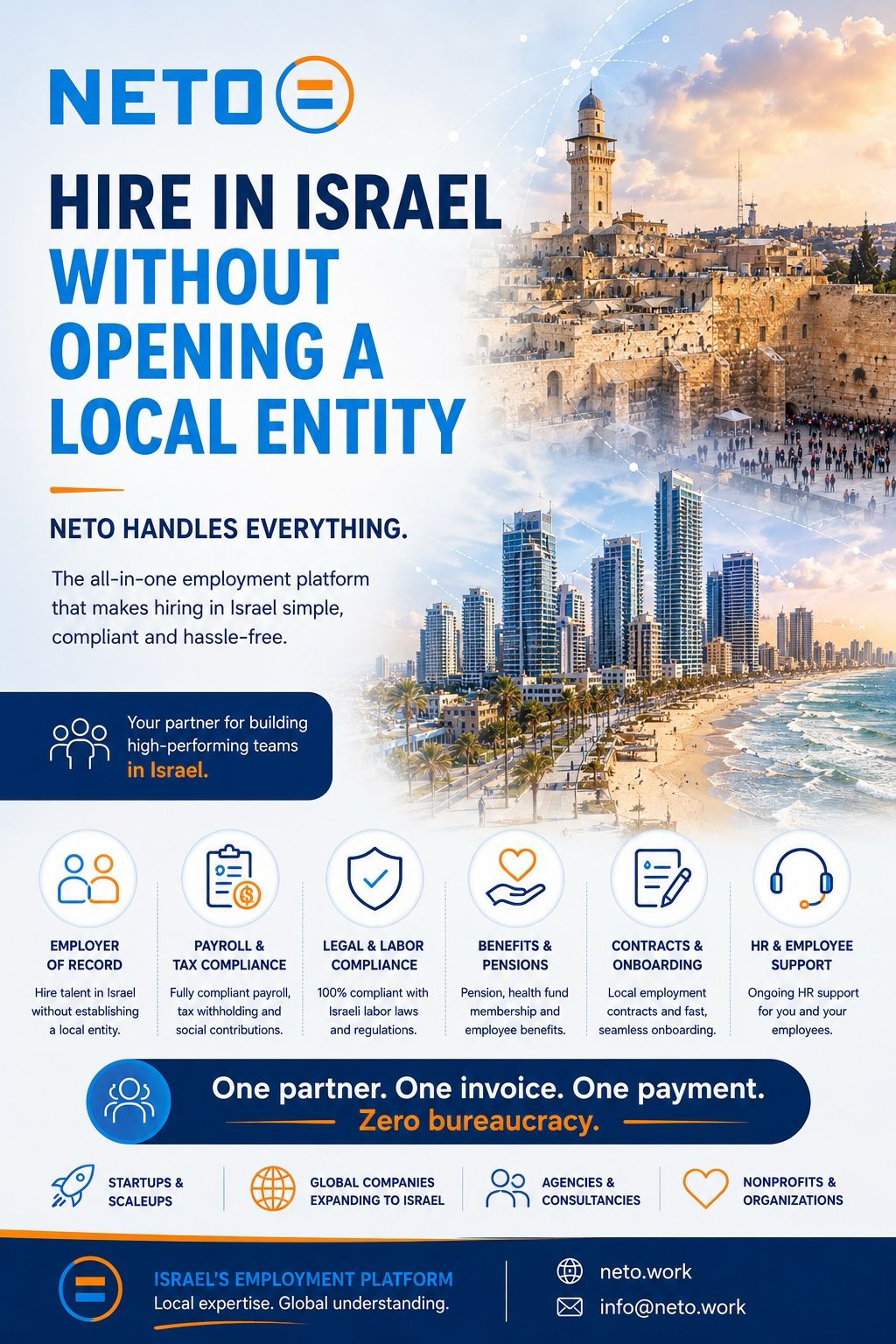
Hire in Israel without opening a local entity · NETO handles everything.
Read moreWe use essential cookies to make the site work. With your consent, we also use measurement and advertising cookies from Google and Microsoft to understand how the site is used, improve it and measure our advertising. We never sell your data.
You can change your choice at any time via “Cookie settings” at the bottom of every page.

Log in to your account, or sign up in a minute.
Pick whatever works for you · we're here.
Everything about NETO · transparent and available
Pick a convenient time · we'll confirm by phone/email
Tap into one of the world's strongest engineering talent pools · without opening a local entity. NETO becomes the legal employer, runs payroll and keeps you fully compliant under manpower license 1565.
This guide explains how to hire Israeli software developers without opening a local entity, with NETO as the Employer of Record under manpower license 1565. It covers why Israeli developers are worth hiring, the 2026 market, and where to source candidates. It also frames how much Israeli developers cost in 2026 for budgeting. NETO handles the contract, payroll, and compliance locally.
Israel earned its "Startup Nation" reputation for a reason: a deep bench of software engineers trained in elite military technology units, world-class universities and a dense startup ecosystem. The hard part was never finding the talent · it was employing them legally from abroad. Israeli payroll, income tax, National Insurance, pension and severance are complex, and getting them wrong is costly. NETO removes that barrier: you choose your developer, and NETO becomes the official Employer of Record · issuing the contract, running payroll and handling every employer obligation under manpower license 1565. No local company. No bureaucracy. One invoice.
Hiring Israeli software developers from abroad in 2026 typically costs $50K-$150K base salary (junior to staff level) plus 22-25% in employer obligations · Bituach Leumi (National Insurance), pension, severance fund and Keren Hishtalmut (study fund). You have three legal paths: (1) open an Israeli Ltd. · ~$20K and 6 weeks of setup, worth it past 8-12 hires; (2) use a global EOR platform, typically priced at a fixed monthly fee per employee; or (3) use an Israel-specialist EOR. NETO holds Israeli Manpower Contractor License #1565 and runs payroll for foreign companies hiring 1-12 Israeli developers at a fraction of global-EOR pricing. Tel Aviv carries a ~15% wage premium over Jerusalem and Haifa. The market: 9,000+ Israeli tech companies, 182,000+ programmers, 7.79% annual industry growth, and a structural shortage of ~10,000 engineers.

A small country with an outsized engineering output · and a talent pool global tech companies keep coming back to.
Many engineers come up through specialized military technology units before moving into industry.
A dense startup ecosystem produces builders who ship fast and own problems end to end.
Strength in cybersecurity, AI, fintech, chip design and cloud · not just generalist coding.
Strong working English and a time zone that overlaps both Europe and the US East Coast.
Two minutes that show exactly what happens from signup to payslip · before you commit to anything.
Israeli developer salaries in 2026 sit inside the European range · higher than Eastern Europe, meaningfully below San Francisco, and roughly on par with London and Berlin for senior engineers. The figures below are gross annual base salary in USD for full-time Israeli employees. Employer cost on top runs another 22-25%.
| Level | Years | Gross base / year | Total cost to employer (+ 22-25%) |
|---|---|---|---|
| Junior | 0-2 | ~$50,000 | ~$61,000-$62,500 |
| Mid-level | 2-5 | ~$75,000 | ~$91,500-$93,750 |
| Senior | 5-10 | ~$110,000 | ~$134,000-$137,500 |
| Staff / Principal | 10+ | ~$150,000 | ~$183,000-$187,500 |
| Role | Gross base / year |
|---|---|
| Frontend (React / Vue) | ~$70,000 |
| Backend (Node / Python / Go) | ~$78,000 |
| Full-stack | ~$78,000 |
| DevOps / SRE | ~$92,000 |
| ML / AI engineer | ~$105,000 |
| Mobile (iOS / Android) | ~$95,000 |
Tel Aviv carries roughly a 15% premium over Jerusalem and Haifa for the same role and experience level. Herzliya (just north of Tel Aviv, home to many enterprise R&D centers) sits within a few percent of Tel Aviv. Be'er Sheva, with its Ben-Gurion University ecosystem, runs 10-15% below Tel Aviv but with a smaller senior talent pool.
Israeli labor law mandates several employer contributions on top of the gross salary. For a 2026 hire, these typically add up to 22-25% of gross:
For deeper detail on each line item, see our mandatory benefits in Israel guide and the Israel payroll guide for foreign companies.
The mandatory pension extension order obliges every employer to contribute 6% of salary to the severance component, and section 14 of the Severance Pay Law applies to that money automatically. NETO contributes the full severance component by default · 8.33% · so the ongoing contribution replaces severance pay in full and no top-up is due when the employment ends. An employer contributing less than 8.33% must top up severance at the end of the employment relationship.
A worker who declares they have no active pension fund, in a one-off engagement · there the contribution obligation begins only after six months of work. A worker with an active pension arrangement is entitled from day one, with contributions made retroactively after three months or at the end of the tax year, whichever is earlier.
General information · not legal advice. The binding text is the statute and the extension order themselves.
"Startup Nation" is shorthand for a real, quantifiable concentration of software engineering talent. The 2026 numbers worth knowing before you start hiring.
Per the Israel Innovation Authority · startups plus multinational R&D centers.
Highest engineer density per capita of any OECD country.
Tech-sector growth rate · outpacing the wider Israeli economy by roughly 3x.
Unfilled roles industry-wide · competition for senior talent is intense.
The structural shortage is the part foreign employers most often underestimate. Israel produces a steady stream of CS graduates from Technion, Tel Aviv University, Hebrew University and Ben-Gurion University, plus thousands of military-trained engineers from Unit 8200, Mamram and Talpiot every year. But demand from Israeli unicorns and multinational R&D centers (Google, Meta, Apple, Microsoft, Intel and NVIDIA all have major Israeli presences) absorbs most of the senior tier within weeks. The practical implication: junior and mid-level hiring is doable on US-equivalent timelines; senior hiring almost always involves competing offers. Building a relationship through an Israeli partner who already knows the candidate pool is usually faster than running a cold US-style recruiter search.
Three things show up consistently in foreign employers' debriefs after hiring Israeli engineers · all observable in the resumes and the work output, not marketing claims.
Most male Israeli engineers (and a growing share of female engineers) spend 3 years in technical military units before university. Unit 8200 is Israel's signals-intelligence corps, comparable in scope to the US NSA. Mamram is the IDF's centralized software-engineering school. Talpiot is a small, highly selective program combining a physics/CS degree with an extended commitment. Engineers from these tracks usually arrive at 22-23 with 3+ years of full-time experience on production systems with real users.
Israeli engineers operate in English daily · almost every Israeli tech company writes code, runs standups and ships documentation in English. The cultural distance to a US/UK team is small. Communication is direct (sometimes blunt) and consensus-skipping; expect engineers to push back in design reviews rather than nod silently.
Israel runs UTC+2 (UTC+3 in summer). A Tel Aviv 8am standup is 1am New York and 10pm Pacific the night before; a Tel Aviv 8pm is 1pm New York. Israeli mornings overlap with the EU workday in full; Israeli afternoons overlap with US East Coast morning. Near-zero friction for European companies, and the most workable overseas time zone for US East Coast teams.
The Israeli hiring channels foreign employers should know about, ranked by typical effectiveness.
For senior roles, the highest-yield channel by far is still referrals from existing Israeli engineers on your team. If you don't have any yet, the first hire opens the door to the next five.
Finding a great Israeli engineer is the easy part. Employing them legally from abroad is where most companies get stuck.

From the candidate you chose to a fully compliant Israeli employee · in days, not months.
Bring your own candidate or recruit one · you stay in control of who you hire.
Set the role, salary, scope and start date. NETO confirms the total employer cost up front.
NETO issues the compliant contract and becomes the legal Employer of Record.
You manage the work; NETO runs payroll, compliance and contributions · billed as one invoice.
NETO operates as a licensed manpower contractor under license 1565, supervised by the Ministry of Labor.
Contract, payroll, payslips, tax, National Insurance, pension and severance · all handled for you.
No payroll system to run. You pay a single invoice that covers the agreed employer cost.
No company to register. Once terms are agreed, employment can start in days.
Full-time, part-time, contract or project-based · scale your dev team up or down.
Local labor-law compliance and secure salary payments from day one.
You keep the professional relationship and direct the work. NETO sits in the background as the legal and payroll employer, turning Israeli employment into a single, predictable invoice.
| What matters when hiring a developer | Hire via NETO | Open a local entity | Global EOR platform |
|---|---|---|---|
| Local entity required | None needed | Must register | None needed |
| Time to first hire | Days | Months | Days to weeks |
| Israeli labor-law expertise | Local specialist | You build it | Often via a partner |
| Licensed in Israel | License 1565 | Varies | |
| Ongoing accounting overhead | None on you | Permanent | |
| Single invoice | Internal payroll | ||
| Direct, local point of contact | In Israel | Global support |
You can't legally pay an Israeli employee from a US or EU entity directly. The salary needs to come from an Israeli payroll source, with Israeli tax withheld, Bituach Leumi remitted monthly, pension funded, and a kosher tlush sachar (payslip) issued every month. There are three ways to get there.
The honest framing: for 1-3 Israeli engineers, going through any EOR is dramatically faster and cheaper than opening an entity. For 8+ engineers, the entity math usually wins. For 4-7, it depends on whether you plan to add Israeli ops/finance staff (open the entity) or stay engineering-only (stay on EOR). See also contractor vs employee in Israel.
Standard onboarding from signed offer to first payroll is 7 working days. License #1565 means NETO is on the Ministry of Labor's public registry of approved Israeli manpower contractors · a verifiable trust signal that global EORs operating through resellers don't carry. For more on the full setup, see how to hire Israeli employees.
Payroll, statutory compliance and secure payments from day one · the same back office whether you hire one developer or a whole team.

Israel is one of the strongest engineering talent pools in the world: 9,000+ active tech companies, 182K programmers, the highest engineer density of any OECD country, and a structural shortage of roughly 10,000 engineers. The talent is real · the friction is legal employment.
The bottom line: choose your engineer, and let NETO carry the legal and payroll side. You manage the work; we are the compliant Israeli employer in the background. For deeper detail see our Employer of Record in Israel and Israel payroll guides.
Choose your engineer and let NETO handle the contract, payroll and compliance · no local entity, no payroll operation, just one invoice.
Hire in Israel without opening a local entity · NETO handles everything.
Read more

 YC
YCEvery section, organized by topic. Browse the full hierarchy or jump straight in.
Adjust the site to your needs
Here you can ask to see the data we hold about you, correct it, delete it, withdraw consent you gave, or stop receiving our emails and alerts. We reply within 30 days, and handle removal requests within 7 business days. Privacy policy
Barkat I.T Ltd · trading as NETO · is a licensed manpower company (license 1565), supervised by the Israeli Ministry of Labor.
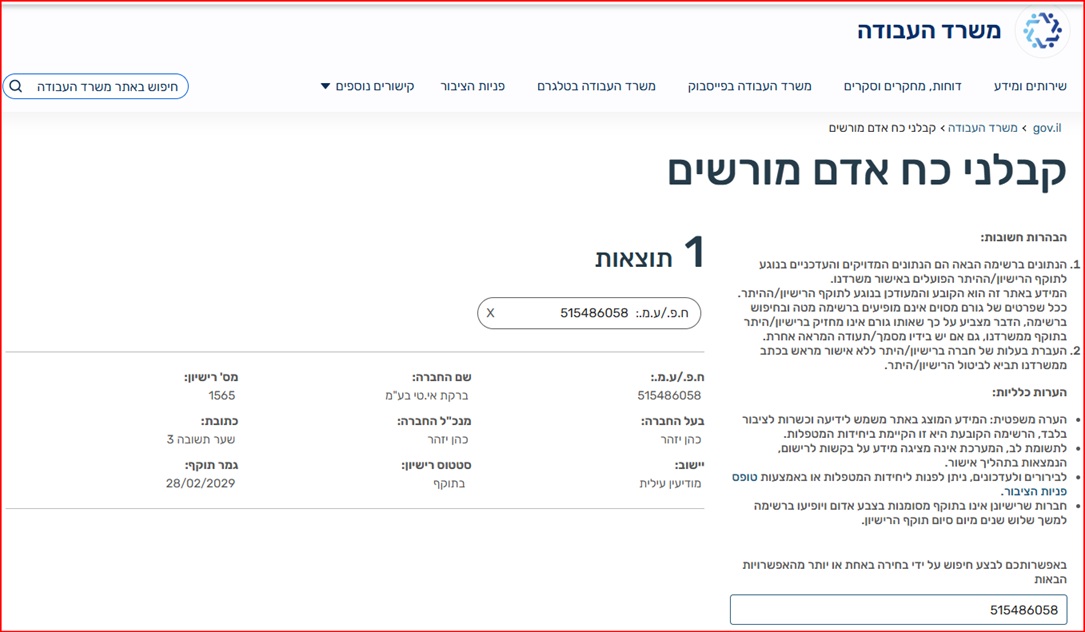 Verify the license on the Ministry of Labor website
Full details · Manpower contractor license page →
Verify the license on the Ministry of Labor website
Full details · Manpower contractor license page →