
Tax coordination & National Insurance refund
Who needs tax coordination with National Insurance, how it is done and how to claim a refund.
Read moreWe use essential cookies to make the site work. With your consent, we also use measurement and advertising cookies from Google and Microsoft to understand how the site is used, improve it and measure our advertising. We never sell your data.
You can change your choice at any time via “Cookie settings” at the bottom of every page.

Log in to your account, or sign up in a minute.
Pick whatever works for you · we're here.
Everything about NETO · transparent and available
Pick a convenient time · we'll confirm by phone/email
Working several jobs at once? Israel's National Insurance has clear criteria for determining the primary and secondary employer. At the secondary employer, contributions are deducted starting immediately from the second bracket · so it is important to update Form 101 correctly and avoid overpaying.
When you work several jobs, Israel's National Insurance rules decide which employer is primary and which is secondary. This is set out on Section E of Form 101, and the guide explains the criteria plus special cases like an early pension or self-employment alongside a salary. Getting it right matters for tax coordination so you do not overpay. The page also covers what to update to keep it accurate.
How do you determine the primary employer?
The primary (main) employer is the permanent workplace where your salary is stable and higher · in that order of priority. All other workplaces are considered secondary, and at those the National Insurance contributions are deducted starting immediately from the second bracket. Once you have determined which is primary and which is secondary, mark in Section E of the secondary employer's Form 101 that you have other income. Part of this information is drawn from the National Insurance Institute website.
The National Insurance Institute has several criteria for determining the main employer, and you should follow them · and update Form 101 accordingly. If you work as a salaried employee in several workplaces, the one considered the main employer is the workplace that meets the following conditions, in this order:
The first priority is a permanent workplace · not temporary or one-off.
A workplace where the salary is stable · with no unusual change from month to month.
Among the workplaces · the one where you earn a higher salary than the rest.

Please note: once you have made a decision regarding the main and secondary employer, you must mark in Section E of the secondary employer's Form 101 that you have other income. Form 101 is filled in at the start of employment and at the start of each year.

Every salaried employee must submit Form 101.
When submitting Form 101 to the employer, you must attach a copy of your ID card with the appendix. You should also attach documents, certificates and forms as detailed in the relevant places on the form.
The completed form must be submitted to the employer together with the relevant documents within 7 days of starting work. In addition, the form must be filled in, signed and resubmitted at the start of each tax year.
Note: the form is also used to carry out tax coordination. Tax coordination is done when the employee works at an additional workplace or has income from other sources.
The workplace where you are employed as a salaried worker is considered the main employer, and the pension payer is the secondary employer.
Please note · you must mark in Section E of the pension payer's Form 101 that you have other income. Form 101 is filled in at the start of employment and at the start of each year.

If you work both as a salaried employee and as self-employed · the workplace where you are salaried is considered the main employer. The self-employed portion of your income is reported and paid separately to National Insurance.
Here too, if you have more than one income source, it is worth checking tax coordination to make sure the deductions are correct · no more and no less than required.
Correctly determining the primary and secondary employer sets how National Insurance contributions are deducted. At the secondary employer the deduction starts immediately from the second bracket, so an incorrect update can lead to overpaying National Insurance · or to a debt if too little was deducted.
If too much was deducted, you can carry out a tax coordination and National Insurance refund · the next article explains who needs it and how it is done.
For NETO support and customer service · contact support, get in touch, or call +972-8-976-1874.
Two minutes that show exactly what happens from signup to payslip · before you commit to anything.
The primary employer is the permanent workplace where your salary is stable and higher · in that order of priority. All other workplaces are secondary, and at those the National Insurance contributions are deducted starting immediately from the second bracket.
On the secondary employer's Form 101 you must mark in Section E that you have other income. The form is filled in at the start of employment and each tax year, and submitted to the employer within 7 days of starting work.
The workplace where you are employed as a salaried worker is the main employer, and the pension payer is the secondary employer. Mark in Section E of the pension payer's Form 101 that you have other income.
The workplace where you are employed as a salaried worker is the main employer. The self-employed portion of your income is reported and paid separately to National Insurance.
A correct update prevents overpaying or underpaying National Insurance. If too much was deducted you can carry out a tax coordination and refund, and if too little was deducted a debt may arise.
Every salaried employee submits the form to the employer within 7 days of starting work, together with a copy of their ID card and appendix, and fills it in again at the start of each tax year.
NETO handles payment, deductions and reporting to National Insurance for you · you receive a proper tax invoice and we take care of the rest.
Who needs tax coordination with National Insurance, how it is done and how to claim a refund.
Read more
What the law sets out, what it requires of manpower contractors and what to know about it.
Read moreWhat every salaried employee should know about National Insurance contributions and Form 101.
Read moreWhen to do tax coordination, who needs it and how it saves you from paying excess tax.
Read moreThe government license behind the service · what it requires and why it matters to you.
Read more
What every employer should know about their obligations and rights toward workers and the authorities.
Read moreWho needs tax coordination with National Insurance, how it is done and how to claim a refund.
Read moreWhat the law sets out, what it requires of manpower contractors and what to know about it.
Read moreWhat every salaried employee should know about National Insurance contributions and Form 101.
Read moreWhen to do tax coordination, who needs it and how it saves you from paying excess tax.
Read moreThe government license behind the service · what it requires and why it matters to you.
Read moreWhat every employer should know about their obligations and rights toward workers and the authorities.
Read more YC
YCEvery section, organized by topic. Browse the full hierarchy or jump straight in.
Adjust the site to your needs
Here you can ask to see the data we hold about you, correct it, delete it, withdraw consent you gave, or stop receiving our emails and alerts. We reply within 30 days, and handle removal requests within 7 business days. Privacy policy
Barkat I.T Ltd · trading as NETO · is a licensed manpower company (license 1565), supervised by the Israeli Ministry of Labor.
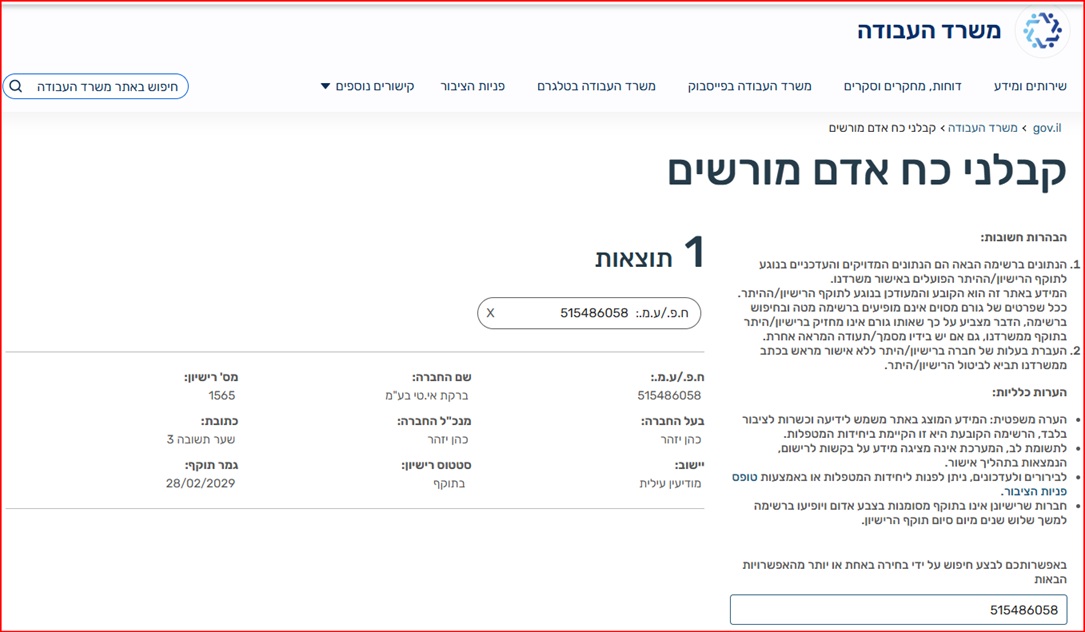 Verify the license on the Ministry of Labor website
Full details · Manpower contractor license page →
Verify the license on the Ministry of Labor website
Full details · Manpower contractor license page →