
Our manpower licence 1565
What the licence means, why it matters, and how to verify it yourself in the public registry.
Read moreWe use essential cookies to make the site work. With your consent, we also use measurement and advertising cookies from Google and Microsoft to understand how the site is used, improve it and measure our advertising. We never sell your data.
You can change your choice at any time via “Cookie settings” at the bottom of every page.

Log in to your account, or sign up in a minute.
Pick whatever works for you · we're here.
Everything about NETO · transparent and available
Pick a convenient time · we'll confirm by phone/email
Getting paid through an "invoice service" (cheshbonit lashachir) is lawful in Israel · provided the company doing it is a licensed manpower contractor. The licence is the whole story: it is what the law requires, it is publicly verifiable, and it is what protects your rights. This page explains the legal basis, your rights, the risks to watch, and how to check any provider.
Yes · working through an invoice service in Israel is lawful when the company is a licensed manpower contractor. Under the Employment of Employees by Manpower Contractors Law (1996), no one may operate as a manpower contractor without a licence from the Ministry of Labor · and a licensed contractor must lodge bank guarantees against workers' wages. In this model the company employs you as a salaried worker, issues the tax invoice to your client in its own name, and pays you a salary with a payslip, so you are registered with Income Tax, National Insurance and VAT. The single most important thing to verify in any provider is that licence. NETO holds Manpower Contractor Licence no. 1565, verifiable in the public government registry.
This summary is based on the content of this page
Is it legal to work through an invoice service company in Israel?
Yes · provided the company is a licensed manpower contractor. Israeli law (the Employment of Employees by Manpower Contractors Law, 1996) states that no one may operate as a manpower contractor without a licence from the Minister, and that a licensed contractor must deposit bank guarantees against workers' wages. A provider that meets those requirements employs you as a salaried worker, issues the invoice to your client, and registers you with Income Tax, National Insurance and VAT. The legality turns on one thing · the licence. NETO holds licence no. 1565 and it can be verified in the public registry.
An invoice service · in Hebrew cheshbonit lashachir, an "employee invoice" · lets you get paid for work without opening an Osek file. The company employs you as a salaried worker for the engagement, issues the tax invoice to your client in its own name, collects the payment, and pays it to you as a salary with a payslip. Because it is your legal employer, it withholds tax, reports to National Insurance, and handles VAT.
The reason this is not simply "billing on someone else's behalf" · which would raise fictitious-invoice concerns · is the employment relationship and the licence behind it. A licensed manpower contractor is a recognised, regulated employer, not a pass-through.
The model's legality rests on primary legislation · the Employment of Employees by Manpower Contractors Law, 1996 · not on any single case. Four points matter:
Bottom line: the question "is it legal?" is really the question "is the provider licensed?". With a licensed manpower contractor, the model sits on statute and on a guarantee you can verify · not on interpretation. More on Licence 1565 and how to check it.
Because you are employed as a salaried worker · not billing as an unregistered individual · the provider handles your statutory registration and reporting:
You receive a lawful payslip for each payment, with the deductions the law requires.
You are reported and paid for as an employee · not left outside the system.
Pension and severance provisions are calculated as for any employee, per the engagement.
Eligibility for any specific benefit is assessed individually by the National Insurance Institute.
NETO states what it does · employs you lawfully, issues a payslip, deducts and reports as required · and never promises a particular benefit outcome. Entitlement to any specific right is determined individually by the National Insurance Institute.
Freelancers and occasional earners who want to invoice lawfully without becoming self-employed: designers, consultants, developers, tutors, therapists, sales agents, and people earning on the side of a salaried job. If you invoice steadily at scale, opening an Osek may suit you better · the honest comparison is on our invoice-without-a-business guide.
The model is lawful, but not every provider is. This is where to look:
Because you are paid as a salary, tax is withheld at source and reported by the provider · you do not file self-employed returns for this income. If you also hold a salaried job, the combined income affects your marginal rate; it is worth reading about tax on a second income in Israel and, where relevant, arranging tax coordination. Your client receives a proper tax invoice and can deduct input VAT as usual.
Two minutes that show exactly what happens from signup to payslip · before you commit to anything.
Yes, when the company is a licensed manpower contractor. Israeli law requires a licence to operate as one, and a licensed contractor lodges bank guarantees against wages and employs you as a salaried worker with a payslip. Verify the licence before you start.
You are employed as a salaried worker, so you receive a payslip, and National Insurance, pension and severance provisions are calculated and reported per the engagement. Entitlement to any specific benefit is assessed individually by the National Insurance Institute.
NETO's fee is 5% of the invoice, before VAT · derived from the amount your client pays. No subscription, no minimum, no commitment.
No. You are not exempt · you are paid as a salary with tax withheld at source and reported. What changes is that you avoid self-employed filing for this income, because the provider handles it.
Ask for the manpower contractor licence number and look it up in the Ministry of Labor's public registry. NETO is no. 1565 (Bareket I.T Ltd, company no. 515486058) · check it here.
Opening an Osek makes you self-employed, with your own registration, bookkeeping and returns. Through a licensed invoice service you stay a salaried employee for the engagement and the provider carries the paperwork. The full comparison is on the invoice-without-a-business guide.
NETO holds Manpower Contractor Licence 1565, is supervised by the Ministry of Labor, and lodges guarantees against wages. Invoice your client lawfully, and get paid with a payslip.
What the licence means, why it matters, and how to verify it yourself in the public registry.
Read more
The complete guide to the employee-invoice model · how it works, what it costs and the law.
Read more
Pension, leave, sick days and recuperation pay · what every employee is entitled to by law.
Read more
Everything a freelancer needs · invoices, a payslip, social rights and full support.
Read moreThe mandatory pension extension order obliges every employer to contribute 6% of salary to the severance component, and section 14 of the Severance Pay Law applies to that money automatically. NETO contributes the full severance component by default · 8.33% · so the ongoing contribution replaces severance pay in full and no top-up is due when the employment ends. An employer contributing less than 8.33% must top up severance at the end of the employment relationship.
A worker who declares they have no active pension fund, in a one-off engagement · there the contribution obligation begins only after six months of work. A worker with an active pension arrangement is entitled from day one, with contributions made retroactively after three months or at the end of the tax year, whichever is earlier.
General information · not legal advice. The binding text is the statute and the extension order themselves.
 YC
YCEvery section, organized by topic. Browse the full hierarchy or jump straight in.
Adjust the site to your needs
Here you can ask to see the data we hold about you, correct it, delete it, withdraw consent you gave, or stop receiving our emails and alerts. We reply within 30 days, and handle removal requests within 7 business days. Privacy policy
Barkat I.T Ltd · trading as NETO · is a licensed manpower company (license 1565), supervised by the Israeli Ministry of Labor.
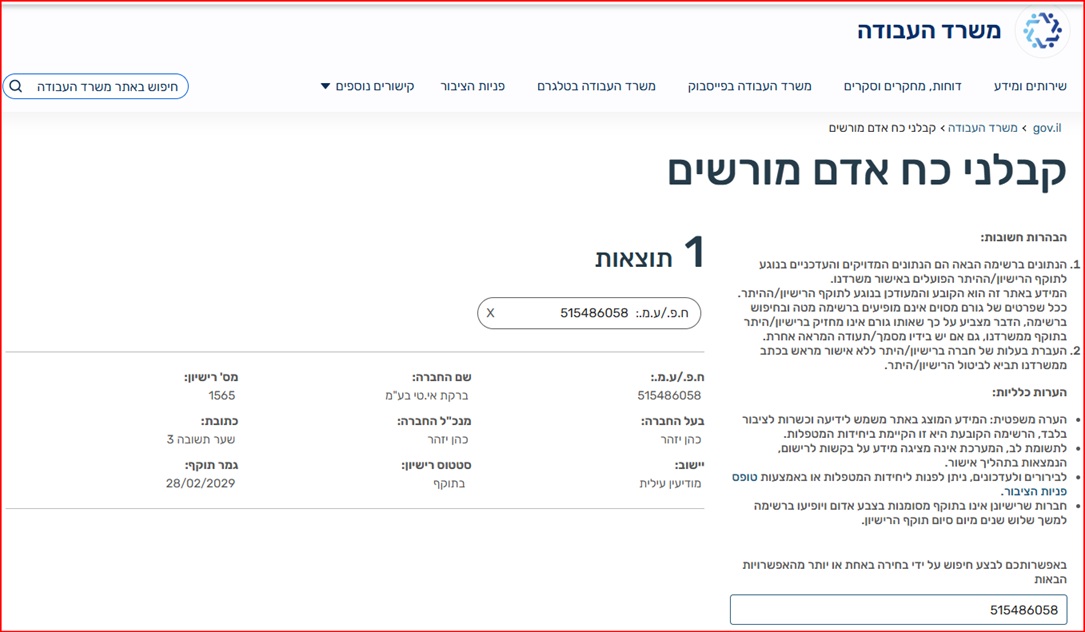 Verify the license on the Ministry of Labor website
Full details · Manpower contractor license page →
Verify the license on the Ministry of Labor website
Full details · Manpower contractor license page →