Rights of a Worker Employed via a Manpower AgencyNational Insurance, the Classification of Insured Persons Order and the Manpower Contractors Law
Is a worker at a manpower (staffing) agency entitled to full employee cover from National Insurance? An in-depth analysis of the triangular employment relationship · the tests, the orders and the laws that protect the worker's rights, and the practical conclusion.
AI summary A smart digest of this page · click hereClick to read the page summary
A worker employed through a manpower agency is in a triangular employment relationship · partly with the manpower company and partly with the client that uses the service. The starting point in the case law and literature is that they are entitled to employee cover from National Insurance, including unemployment insurance and cover against the employer's insolvency. Three main sources anchor this: the Classification of Insured Persons Order (section 11), which widens the circle of insured persons as employees; the Employment of Employees by Manpower Contractors Law, 5756-1996, which provides that the worker who performs the labour is an employee of the contractor; and the extension order in the manpower-services sector. That said, in certain cases the Institute examines the pattern of employment · so it matters that the worker knows the tests and documents how they are employed.
This summary is generated from the page content and the linked sources · the full detail follows below.
On this page
- Key points
- Triangular employment · the background
- Does National Insurance recognise the rights?
- The tests the Institute applies
- The Classification of Insured Persons Order · the core protection
- How the rights are preserved in practice
- The letter of the law · manpower contractors and the extension order
- Conclusion and the author's view
- Summary table · employee, self-employed and manpower worker
- Frequently asked questions
- Related guides
- Summary
Key points
- A manpower worker is an employee: under the Manpower Contractors Law, the worker who performs the labour is an employee of the contractor · with all the rights that follow.
- Employee cover is better: it includes unemployment insurance and cover against the employer's insolvency · protections a self-employed person does not have.
- The Classification of Insured Persons Order widens the protection: a person referred to work and paid by a body whose occupation is referring workers · is entitled to employee cover.
- There are edge cases: a worker who is also self-employed in parallel may face a status inquiry with the Institute · it matters to document the pattern of employment.
Triangular employment · the background
Rights of a worker employed via a manpower agency · is there even such a thing? On this page we try to understand how the rights of a worker are preserved in a pattern of triangular employment under National Insurance, and we examine what a manpower-company worker is entitled to at the National Insurance Institute.
The starting point is that employee cover is preferable to self-employed cover, because it provides insurance protection against loss of earnings · that is, unemployment insurance and cover against the employer's bankruptcy. Unemployment insurance has been discussed at length in relation to the self-employed, and there is broad public consensus on the need for a similar cover adapted to the self-employed.
We are discussing a special case here: a worker who performs work while employed through a manpower contractor. As is well known, a worker employed through a manpower company is in a complex employment relationship · partly with the manpower company and partly with the client that uses the service. Through NETO · a licensed manpower contractor · a foreign employer that engages an Israeli worker relies on NETO as the legal employer, so these very rights are guaranteed and the compliance burden sits with NETO.
Does National Insurance recognise the worker's rights?
The practical question is: can the National Insurance Institute deny such a worker part of their rights as an employee, and require them to meet certain conditions before they receive their full employee rights?
The reality of triangular employment has been discussed in the literature and case law, where the effect of these complex relationships on the rights owed to the worker by their employers has been examined at length. It seems the starting point has always been that such a worker is entitled to employee cover from the National Insurance Institute · so much so that one might think the question is redundant.
Yet in practice, in certain cases · for example when a worker turns to the Institute with a claim after a work accident · the Institute begins to check whether that triangular relationship really meets, in its view, the conditions it requires of "ordinary" employees.
The tests the Institute applies · and what can go wrong
Take an example: a "courier" employed as a manpower worker under the express definition in the extension order for manpower workers. If that courier, as bad luck would have it, also provides an independent service at weekends · the Institute may argue that their actual work, a courier on an hourly wage two hours an evening three times a week through the manpower company, should be treated as part of their income as a self-employed person. Such a characterisation could jeopardise their right to compensation in a work accident.
What does that mean in practice?
Here the worker can find themselves at the centre of a question that has not yet been examined in relation to the complex reality of their employment terms · and any reading not in their favour means losing rights. In these cases it is likely the worker will not embark on a legal journey and will give up their rights · and so the question never reaches a court for discussion and resolution.
The Classification of Insured Persons Order · the core protection
Several cumulative arguments strengthen the claim that every manpower-company worker should be regarded as entitled to employee cover from the National Insurance Institute. The strongest of them is a substantive reading of the Classification of Insured Persons Order · section 11.
The order provides that any person who performed work in one of the tasks listed in it · services, industry and commerce, in practice almost any work · and was also referred to that work by someone whose main occupation is referring workers to work, and where that referring body is also the one who pays them · then that worker, the one performing the labour, is entitled to be insured under employee cover.
The purpose of the order · to widen the insurance cover
The Classification of Insured Persons Order prevails over a narrow reading, and National Insurance has no power to change it or defeat its purpose · because its purpose is to enlarge the circle of insured persons beyond what existed in law up to that order. A substantive review shows that in most cases a manpower-company worker also falls under this definition, on top of being defined as an employee under the Manpower Contractors Law.
What did the legislator intend? The order shows that where a third party maintains a relationship with the worker performing the labour · that worker becomes entitled to employee cover. This intent connects to the reason why a self-employed person is not entitled to employee cover: employee cover grants, beyond self-employed cover, insurance against loss of income due to dismissal and due to the employer's bankruptcy. These covers were withheld from the self-employed for two main reasons: first, a person who controls their own sources of income cannot in practice "be dismissed", since their income depends on many clients; and second, a self-employed person could in theory manipulate the scale of income over time in order to lodge an insurance claim that is not genuine.
How do you check whether a dismissal is authentic? In the commercial market there is no tracking of the dates work was performed, so it is hard to prevent false claims. The Classification of Insured Persons Order bypasses these concerns: it gives the third party · the referring and paying body · the "power" to compel the Institute to insure the worker, by the very fact of being involved in sending the worker to the work. The very act of referring the worker to work confers on them the right to later claim unemployment benefit, because third parties whose main occupation is "dispatching and referring workers" are involved here · and there is no concern that they would want to be party to a fraud against the Institute.
How are the rights preserved in practice?
It is common that manpower companies, in many cases, are not the ones who referred the worker to the work · but rather "inherited" the worker by virtue of a tender or of commercial agreements with companies that sometimes were the ones who actually recruited the workers. From this the Institute can argue, on the one hand, that it was not the manpower company that was responsible for referring the worker · and on the other, that the worker performing the labour, as the Institute defines it, is not an "employee".
What emerges from the case law?
From rulings given about manpower companies that the National Insurance Institute itself operated · where it was the Institute that referred the worker to register with one of the manpower companies with which it had signed agreements · it emerges that if the "who referred" test were the decisive test, the burden of proof would make it hard for many insured persons to have their claims accepted. The conclusion: it is enough that a third party collects the consideration for performing the work and is the body paying the worker performing the labour, to create a sufficient link to make National Insurance liable for employee cover.
The letter of the law · manpower contractors and the extension order
Unofficial English translation
Unofficial translation"Manpower contractor" · a person whose occupation is providing the manpower services of its employees for work with another, including a private employment bureau within the meaning of the Employment Service Law, 5719-1959, that also engages in providing manpower services.Binding text: the Hebrew original as published in Reshumot (a consolidated version is on Nevo).
The binding version is the one published in Reshumot · see also the overview of the law on Kol-Zchut and the manpower contractor framework on our site.
The plain-language explanation
The law defines the contractor as someone who supplies another with manpower · that is, "labour". The worker who supplies that labour thereby becomes an employee of the contractor. The contractor is obliged to provide the worker with an engagement agreement · and this is precisely the condition that defines the worker performing the labour as an employee of the contractor, with all the rights that follow.
What does the extension order add? The work performed is also examined under the extension order for manpower workers, where the worker is expressly defined as a person who works in one of the tasks specified in it, such as a courier. The definition is deliberately simple: there is a presumption that if a manpower contractor hired a worker to perform work for another · that worker is regarded as its employee.
And what does that mean for National Insurance? This definition comes to make the contractor liable to grant the worker rights, and from there one can infer that it also makes National Insurance liable to grant the worker rights · as a like inference. Had the legislator wanted to qualify the worker's rights in National Insurance, it would have had to say so expressly. A manpower contractor has no option but to insure its workers with National Insurance under the law · and it follows that the worker is its employee, since the Manpower Contractors Law applies to them, and so the circle of workers entitled to National Insurance rights was widened.
Conclusion: a worker employed via a manpower agency has rights
A manpower worker will be regarded as an employee for the purposes of the National Insurance Law too. As with the order on the classification of employers, National Insurance is required to widen the circle of its insured persons and to insure the worker performing the labour under employee cover · by the very comparison of its definitions of "employee" to the definition of a worker in the Manpower Contractors Law. It is not reasonable to impose on a manpower contractor duties as to social and pension terms for someone who does not meet the definition of an employee for the purposes of other laws · unless that worker performing the labour is regarded as an "employee" under those laws too.
The author's view
It is only right that the National Insurance Institute, entrusted by the state with providing social rights to citizens, should bear at least those social duties toward employees that the Manpower Contractors Law imposed on the contractor. Can it be that what is decreed on the contractor the state will not decree on itself? The contractor would then argue a breach of the right to equality before the law · and so the rights of the worker performing the labour would be harmed twice over. And if these arguments are not enough, one can turn to a case-by-case examination of the employment patterns that have already gathered consensus, describing the situations in which triangular employment relationships exist · whether optimal or accepted after the fact.
Summary table · employee, self-employed and manpower worker
The main differences in insurance cover at National Insurance, as analysed on this page:
| Type of cover | Employee | Self-employed | Manpower-company worker |
|---|---|---|---|
| Unemployment benefit | Insured | Not insured | Insured · as an employee of the contractor |
| Rights on the employer's bankruptcy or liquidation | Insured | Not insured | Insured · as an employee of the contractor |
| Work injury | Insured | Insured (subject to registration) | Insured · important to document the pattern of employment |
| Who is responsible for the social rights | The direct employer | The worker themselves | The manpower contractor · under the Manpower Contractors Law |
Frequently asked questions
Is a manpower-company worker entitled to employee cover?
The starting point in the literature and case law is yes: a manpower-company worker is an employee of the contractor under the Manpower Contractors Law, 5756-1996 · and is therefore entitled to employee cover, including unemployment benefit and cover in the event of the employer's insolvency.
What is the difference between employee cover and self-employed cover?
Employee cover includes protection against loss of earnings · unemployment benefit and cover in the event of the employer's bankruptcy or liquidation · which are not available to a self-employed person. That is why classification as an employee carries great weight for one's rights.
What is the Classification of Insured Persons Order?
An order providing that a person who performed work for a client, was referred to it by a body whose main occupation is referring workers, and is paid by that body · is entitled to be insured as an employee. The purpose of the order is to widen the circle of insured persons.
Who is a manpower contractor under the law?
Under section 1 of the Employment of Employees by Manpower Contractors Law: a person whose occupation is providing the manpower services of its employees for work with another. The worker performing the labour is an employee of the contractor · and the contractor owes them an agreement and full rights. More detail on the manpower contractor page.
What does the extension order for manpower workers provide?
The extension order in the manpower-services supply sector expressly defines the worker employed in one of the tasks listed in it, and reinforces the presumption that a person hired by a contractor to work for a client is its employee. See the full extension order.
What do you do if the Institute disputes the worker's status as an employee?
Document the pattern of employment · who referred them to the work, who pays the wage, payslips · and rely on the Classification of Insured Persons Order, the Manpower Contractors Law and the extension order. If needed, consult a lawyer. The information here is general only and is not legal advice.
Summary
- A worker employed through a manpower agency is in a triangular employment relationship · but is an employee of the contractor under the law.
- The Classification of Insured Persons Order, the Manpower Contractors Law and the extension order · three sources that anchor entitlement to employee cover.
- Employee cover includes unemployment benefit and cover against the employer's insolvency · protections the self-employed do not have.
- In edge cases · for example a worker who is also self-employed · the Institute may examine status. Documenting the pattern of employment is the best protection.
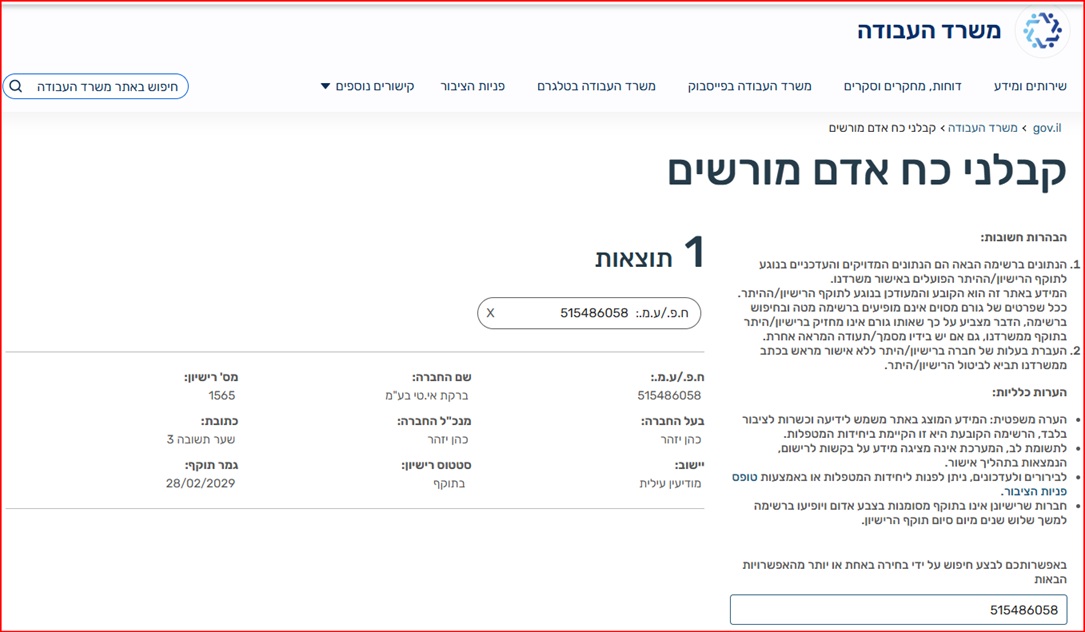
- Through NETO · a licensed manpower company (licence #1565) · the worker receives a payslip with full rights, including National Insurance as an employee.
Disclaimer: The information on this page, as throughout NETO's labour-law section, is for general enrichment only and should not be treated as legal advice. The binding version of the law is the one published in Reshumot and on the official authority websites. Consult a lawyer, tax adviser, accountant or other professional as needed.
The law requires 6% · at NETO it is 8.33%
The mandatory pension extension order obliges every employer to contribute 6% of salary to the severance component, and section 14 of the Severance Pay Law applies to that money automatically. NETO contributes the full severance component by default · 8.33% · so the ongoing contribution replaces severance pay in full and no top-up is due when the employment ends. An employer contributing less than 8.33% must top up severance at the end of the employment relationship.
A worker who declares they have no active pension fund, in a one-off engagement · there the contribution obligation begins only after six months of work. A worker with an active pension arrangement is entitled from day one, with contributions made retroactively after three months or at the end of the tax year, whichever is earlier.
General information · not legal advice. The binding text is the statute and the extension order themselves.