Severance Pay Law in Israel · Who Qualifies, How It's Calculated & the Section 14 Alternative (2026)
One month's last salary per year of service, 8.33% monthly Section 14 deposits, the 15-day payment deadline, and what happens when an employee resigns · with worked examples.
Every statute, extension order, ruling and current figure · in one place, each with its source.
The law requires 6% · at NETO it is 8.33%
The mandatory pension extension order obliges every employer to contribute 6% of salary to the severance component, and section 14 of the Severance Pay Law applies to that money automatically. NETO contributes the full severance component by default · 8.33% · so the ongoing contribution replaces severance pay in full and no top-up is due when the employment ends. An employer contributing less than 8.33% must top up severance at the end of the employment relationship.
A worker who declares they have no active pension fund, in a one-off engagement · there the contribution obligation begins only after six months of work. A worker with an active pension arrangement is entitled from day one, with contributions made retroactively after three months or at the end of the tax year, whichever is earlier.
General information · not legal advice. The binding text is the statute and the extension order themselves.
What actually lands in your account?
Drag the gross and watch the real take-home. Credit points move the answer more than anything else, which is why they are here.
More tools to help you decide
AI summary · the Severance Pay Law in briefClick to read the page summary
The Severance Pay Law, 5723-1963 entitles an employee who worked one continuous year for one employer and was dismissed to one month's last salary for each year of service (Sections 1 and 12), roughly 8.33% of pay per year. The Law also defines when a resignation counts as a dismissal (ill health, parenthood, relocation, a material deterioration in conditions, and more), the Section 14 arrangement under which ongoing deposits to a fund replace the severance obligation, and the cases where entitlement can be reduced or denied. Below, each topic pairs an unofficial English translation of the statutory text with a plain-language explanation and a worked example.
- Qualifying period · one continuous year with an employer (Section 1).
- Amount · one month's salary per year for a salaried employee (Section 12) · about 8.33%.
- Resignation as dismissal · health, parenthood, relocation, worse conditions, and more.
- Section 14 · ongoing fund deposits in lieu of severance at termination.
- Statutory text · translated section by section, clearly marked as unofficial.
- Informational only · the binding text is the Hebrew original in the official records.

Quick summary · the law in five points
Israeli law entitles most employees to severance pay upon termination of employment · one of the most significant financial protections in the Israeli labor market. Under the Severance Pay Law, 5723-1963, employees who have worked for at least one year are entitled to compensation equivalent to one month's salary for each year of service (Sections 1 and 12).
- Entitlement: requires at least 1 year of continuous employment (Section 1).
- Amount: one month's last salary per year of service (Section 12); the 8.33% arrangement mirrors this monthly.
- Section 14: ongoing deposits to a fund fully replace the severance obligation (Section 14).
- Scope: applies to dismissal (Section 1); resignation may entitle to severance in special cases (Section 11).
- Deadline: severance is due when employment ends; if unpaid, delay compensation accrues after 15 days under the Wage Protection Law.
- Overview of the Severance Pay Law
- Who is entitled (Section 1)
- When resignation counts as dismissal
- How much: the amount (Section 12)
- The Section 14 arrangement
- Death, deposits & protected funds
- When severance can be reduced or denied
- Test your knowledge
- For employers: automating severance
- Frequently asked questions
- Related guides
Overview of the Severance Pay Law
The Severance Pay Law, 5723-1963 grants dismissed employees with at least one year of continuous employment the right to severance pay (Section 1), amounting to one month's last salary for each year of service (Section 12). Understanding severance entitlements is essential both for employees who may face dismissal and for employers who must plan for this legal obligation · it sits at the heart of Israeli labor law, alongside employee rights such as pension contributions, working hours, and leave.
Who is entitled to severance pay
Entitlement is built on three things: one continuous year of service, the interruptions that do not break that continuity, and protection against dismissal timed to avoid paying. Each is set out in a section below · the statutory text first, then a plain explanation.
Section 1 · Entitlement to severance pay(a) A person who has been employed continuously for one year · or, in the case of a seasonal employee, for two seasons in two consecutive years · by one employer or at one place of employment, and is dismissed, is entitled to receive severance pay from the employer who dismissed them. "Season", for the purposes of this Law, means three consecutive months in a year during which the employee worked at least 60 days.
(b) An employee who moved from one workplace to another with the same employer, and where the employers at the current workplace changed, is entitled to severance pay from the previous employer for the period of employment with them, as if dismissed on the day of the change of employers; where the new employer has assumed, by a written undertaking to the employee, responsibility for the severance pay the employee was entitled to receive from the previous employer, the previous employer is exempt and the employee's period of service with the previous employer is treated as if it were at the current workplace.
Anyone who worked one continuous year (or, for a seasonal worker, two seasons across two consecutive years) for the same employer or at the same workplace and was dismissed is entitled to severance. Subsection (b) keeps the right alive when the employer at a workplace changes: the outgoing employer pays for its own period, unless the incoming employer took over the liability in writing.
Example: a receptionist employed for 14 continuous months who is then let go qualifies · the one-year threshold was crossed. Someone dismissed at 10 months does not qualify under Section 1.
Section 2 · Continuity of employmentFor the purposes of Section 1, employment is regarded as continuous even where it was interrupted on account of –
- military service and partial service under the Discharged Soldiers (Return to Work) Law, 5709-1949, and reserve service under the Reserve Service Law, 5768-2008;
- the weekly rest day or a holiday on which no work is done, whether by law, custom or agreement, and May 1st;
- annual leave;
- paid leave or furlough granted to the employee by law or with the employer's consent;
- unpaid leave or furlough granted to the employee by law or with the employer's consent;
- a strike or lockout;
- an accident or illness;
- days of family mourning on which, for reasons of religion or custom, the employee did not work;
- a temporary interruption without severing the employment relationship, or an interruption severing it that does not exceed six months;
- training for labor service under the Emergency Labor Service Law, 5727-1967.
These interruptions do not reset the clock on seniority. Reserve duty, the weekly rest and holidays, paid or unpaid leave, a strike or lockout, accident or illness, mourning days, and a short break of up to six months all leave the year of service intact.
Section 3 · When dismissal does not prejudice the rightDismissal shortly before the end of the first year of employment shall be regarded · unless the contrary is proved · as having been made with the intention of evading the obligation to pay severance pay, and such dismissal does not prejudice the right to severance pay.
A dismissal just before the first year closes is presumed to be an attempt to dodge severance · so it does not defeat the entitlement. The burden is on the employer to prove the timing was for another reason.
Example: an employee dismissed at 11.5 months, with no other explanation, is generally still treated as entitled to severance.
The figures you have to know
Amounts and deadlines in force today · each with its effective date and source.
When a resignation counts as a dismissal
A resignation usually ends the right to statutory severance. The Law lists specific situations where it does not · here are the main ones, each with the statutory wording and a short explanation. See also the termination process in Israel.
Section 6 · Resignation on account of ill healthWhere an employee resigned on account of their own state of health or that of a family member, and, in light of the medical findings, the working conditions and the other circumstances of the matter, there was sufficient cause for the resignation · the resignation is regarded, for the purposes of severance pay, as a dismissal. In this section, "family member" means a family member prescribed by regulations approved by the Knesset Labor Committee.
Resigning because of your own or a family member's health, where the medical findings and working conditions gave sufficient cause, is treated as a dismissal for severance purposes. "Family member" is defined in regulations.
Section 7 · Resignation of a parent(a) Where a female employee resigned within nine months of giving birth in order to care for her child · her resignation is regarded, for the purposes of this Law, as a dismissal; and the same applies to a female employee for whom one of the following is met: (1) she received a child under 13 for adoption and, within nine months of receiving the child, resigned to care for the child; (2) she received a child into her custody as an intended parent under the Surrogacy Agreements Law, 5756-1996, and within nine months resigned to care for the child; (3) she received a child up to age ten into her home as a foster parent under the Foster Care for Children Law, 5776-2016, and within nine months resigned to care for the child, provided the foster-care supervisor confirmed the resignation was required for the child's welfare.
(b) The provisions of subsection (a) apply, with the necessary changes, to a male employee, provided one of the following is met regarding him (broadly: his partner was an employee or self-employed and did not stop working to care for the child, or the child is in his sole care).
A parent who resigns within nine months to care for their child · whether after birth, adoption, receiving a child as an intended parent (surrogacy) or as a foster parent · is treated as dismissed. It applies to fathers too, under the conditions in subsection (b).
Example: a mother who resigns seven months after giving birth to care for the baby is entitled to severance as if dismissed.
Section 8 · Resignation on account of relocationFor the purposes of this Law, the resignation of an employee on account of relocating their place of residence shall be regarded as a dismissal –
- upon their marriage · to the locality in Israel where their spouse resided, under conditions prescribed by regulations approved by the Knesset Labor Committee;
- to an agricultural locality from a non-agricultural one, or to a locality in a development area from one outside it, under conditions prescribed by regulations approved by the Knesset Labor Committee;
- for other reasons prescribed by regulations, approved by the Knesset Labor Committee, as reasons justifying the relocation of the employee's residence.
Resigning because you moved home counts as a dismissal in the defined cases · moving to a spouse's locality on marriage, moving to an agricultural locality or a development area, and other reasons set in regulations.
Section 11 · Other resignations treated as dismissal(a) Where an employee resigned on account of a material deterioration in their working conditions, or on account of other circumstances in employment relations affecting that employee such that they cannot be required to continue their employment · the resignation is regarded, for the purposes of this Law, as a dismissal.
(b) Where a seasonal employee resigned after working at least three consecutive seasons at the same workplace because continuous work at that workplace was not assured · they are regarded as dismissed.
(c) An employee who resigned shortly before, and because of, enlistment to regular service, civilian service or national-civilian service (subject to the minimum periods stated) is regarded as dismissed.
(e) Where an employee resigned after reaching retirement age, as defined in the Retirement Age Law, 5764-2004, the resignation is regarded, for the purposes of this Law, as a dismissal; amounts paid to the employee from a provident fund on account of the employer's payments and intended to serve as, or replace, severance pay may be credited against it.
This is the central "resignation as dismissal" section. The best-known limb is subsection (a): a material deterioration in working conditions, or circumstances in which the employee cannot reasonably be expected to continue · known as constructive dismissal. It also covers seasonal workers not assured continuous work, enlistment to service, and resignation after retirement age.
Example: an employee whose pay is unilaterally cut and role stripped, who then resigns, may claim full severance under Section 11(a) as if dismissed.
How much: one month per year of service
Section 12 fixes the rate; Section 13B sets a floor. The formula in plain terms is last monthly salary × number of years of service. If a Section 14 arrangement is not in place, this is what the employer owes at termination.
Section 12 · Rate of severance pay(a) The rate of severance pay is: one month's wage for each year of employment for an employee paid on a monthly basis (a "salaried employee") with an employer or at one place of employment, and two weeks' wage for each year of employment for an employee paid otherwise (a "wage employee"); a part of a year following a full year of employment entitles the employee to proportionate severance pay, and for a seasonal employee a part of a year entitles them to proportionate severance pay even if the periods of employment do not add up to a full year. For this purpose, "salaried employee" means an employee the main part of whose remuneration is paid on the basis of a month or a longer period; "wage employee" means an employee who is not a salaried employee.
(b) The Minister of Labor may, after consulting the Minister of Finance and with the approval of the Knesset Labor Committee, increase by regulations the rate of severance pay for a wage employee.
A salaried (monthly) employee receives one month's wage per year of service; a wage employee is entitled to one month's wage per year as well, for employment from 1 August 1983 onward, under the 1983 regulations made pursuant to s.12(b). The two-week rate in s.12(a) applies only to employment before that date. A part-year after the first year is paid pro rata. "One month per year" is roughly 8.33% of annual pay. Not to be confused with prior notice: the "two weeks" many people remember · 14 days in the second year of employment, rising to a full month after three years · comes from a different statute, the Prior Notice for Dismissal and Resignation Law, 5761-2001 (s.4), and it is counted in days of advance warning, not in money. Severance pay, by contrast, is a sum of money, and for a wage employee it is one month's wage for each year of employment from 1 August 1983 onward · as the National Labour Court held in Labour Appeal (LabA) 44824-03-16 (4 June 2017), where an employee paid on an hourly or daily basis was found entitled to severance pay at the rate of one month's wage for each year of employment.
Section 13B · Minimum-wage floor for the calculationNotwithstanding the provisions of Section 13, the wage taken into account for the purpose of calculating severance pay shall not be less than the minimum wage, as defined in Section 1 of the Minimum Wage Law, 5747-1987, according to the scope of the position.
The wage used to compute severance cannot drop below the minimum wage for the position's scope · a floor that protects low-paid and part-time workers.
Example 1 · dismissal after 5 years, no Section 14
Dana worked at the same company for 5 full years. Her last monthly salary was 12,000 ILS. She was dismissed, and no Section 14 arrangement was ever signed.
12,000 ILS × 5 years = 60,000 ILS
This is due when her employment ends; if left unpaid, delay compensation accrues after 15 days under the Wage Protection Law (its own statute, not the Severance Pay Law).
The Section 14 arrangement: 8.33% every month
Section 14 is the legal basis for the common arrangement in which ongoing fund deposits replace the lump-sum severance obligation. The statutory text is short; the practice built on it is everywhere.
Section 14 · Severance pay and provident-fund paymentsA payment to a provident fund, a pension fund or a similar fund shall not be in lieu of severance pay, unless so provided by the collective agreement applicable to the employer and the employee and to the extent so provided, or unless such payment was approved by the Minister of Labor and to the extent approved.
Fund deposits replace severance only where a collective agreement provides for it or the Minister of Labor approved it. In practice, under the general approval, the employer deposits 8.33% of salary each month (one twelfth, mirroring Section 12's one-month-per-year rate). When the arrangement applies, the accumulated fund passes to the employee at the end of employment regardless of the reason · including resignation.
The employer deposits 8.33% of the employee's salary each month into a severance fund, alongside the regular pension contributions.
The monthly deposits fully replace the statutory severance obligation · no additional payment is due at termination when the arrangement is properly in place.
The accumulated fund is released to the employee on termination for any reason · including resignation · a major advantage over the default rules.
Example 2 · Section 14 deposits over 4 years
Yoav earns 10,000 ILS per month and signed a Section 14 arrangement on day one. His employer deposits 8.33% of his salary into the severance fund every month.
Over 4 years (48 months): 48 × 833 ILS = 39,984 ILS in deposits
For comparison, full statutory severance would be 10,000 ILS × 4 years = 40,000 ILS · the 8.33% monthly rate is designed to mirror one month's salary per year.
Whatever has accumulated in the fund (deposits plus the fund's performance over the years) is transferred to Yoav when he leaves · whether he is dismissed or resigns.
Continue from here
Three ways to go deeper · pick what fits you now.
Death of a party, deposit deadlines & protected money
The Law also handles what happens when an employer or employee dies, by when severance money must be deposited, and how deposited funds are protected from creditors.
Section 4 · Death or insolvency of the employerAn employee whose employment ceased on account of the death or bankruptcy of the employer · and, in the case of a corporation, its winding-up or striking-off · is entitled to severance pay as if dismissed.
If the job ends because the employer died, went bankrupt, or the company was wound up or struck off, the employee is entitled to severance as if dismissed · no dismissal letter needed.
Section 5 · Death of the employee(a) Where an employee has died, the employer shall pay severance pay to their survivors as if the employer had dismissed them. "Survivors" for this purpose means the employee's spouse at the time of death, including a common-law partner living with them, and a child of the employee who is a dependent for the purposes of benefits under Chapter 3 of the National Insurance Law; and, in the absence of such a spouse or children · children and parents whose main livelihood was on the deceased, and siblings who lived in the deceased's home for at least twelve months before the death and whose entire livelihood was on the deceased.
(c) Severance pay paid to the survivors of a deceased employee is not regarded as part of the estate.
If the employee dies, the employer pays severance to their survivors as if it had dismissed them. That money is not part of the estate.
Section 25 · Deposit deadlineAmounts required to be deposited pursuant to a deposit order shall be deposited within 42 days after payment of the wage for that period of employment; the Minister of Labor, or a person authorized by them, may extend that period by a period not exceeding three months.
Where a deposit order applies, the amounts must be deposited within 42 days of paying the wage for that period, extendable by up to three months by the Minister.
Sections 26 & 27 · Protected funds and priority26(a). Amounts paid in lieu of severance pay under Section 14, or deposited under Sections 20 or 21, or paid to a provident fund for the payment of severance pay or for an annuity, are not recoverable, transferable, chargeable or attachable (subject to the conditions in the section), and are not part of the employer's assets in the event of death, bankruptcy or winding-up, to the extent that employees' claims under this Law have not been settled.
27. For the purpose of collecting debts which must be settled before all others under the Bankruptcy Ordinance, 1936, or the Companies Ordinance, severance pay is treated as wages to be settled first, provided that severance pay and wages together so settled do not exceed 150% of the maximum amount of preferred wages under those Ordinances.
Money set aside for severance (including Section 14 deposits) is ring-fenced · it cannot be clawed back, assigned or seized, and it sits outside the employer's assets in insolvency. In bankruptcy or winding-up, severance ranks as preferred wages, up to 150% of the preferred-wage ceiling.
When severance can be reduced or denied
Entitlement is not absolute. A collective agreement or a labor court can justify dismissal without severance, or with only part of it · and settlements over severance must meet strict form requirements.
Section 16 · Dismissal without severance under a collective agreementAn employee shall not be entitled to severance pay, or shall be entitled only to partial severance pay, as the case may be, if dismissed under circumstances which · under the collective agreement applicable to the employer and the employee, or, absent such an agreement, under the collective agreement applicable to the largest number of employees in that industry · justify dismissal without severance pay or with partial severance pay only.
A collective agreement can define misconduct that justifies dismissal with reduced severance or none. This is the usual route to denial · it depends on the applicable agreement.
Section 17 · Denial by a labor courtIn an industry that has no collective agreement, the Regional Labor Court may determine that an employee's dismissal was under circumstances justifying dismissal without severance pay, or with partial severance pay as it determines; in ruling on this matter the Regional Labor Court shall be guided by the rules of the collective agreement applicable to the largest number of employees.
Where no collective agreement exists, the Regional Labor Court decides whether the circumstances justified full or partial denial · guided by the most widely applicable collective agreement.
Sections 28 & 29 · Wage-inclusive severance and settlements28. An agreement between an employer and an employee expressly stating that severance pay is included in the wage, and approved by the Minister of Labor, replaces the provisions of this Law on severance · provided no collective agreement applicable to them requires payment of severance pay.
29. A compromise regarding severance pay, and a release acknowledgment, shall have no effect unless made in writing and unless it is expressly stated therein that they relate to severance pay.
Building severance into the wage only works if the Minister approved it and no collective agreement requires separate payment. Any waiver or settlement of severance must be in writing and expressly about severance · to prevent accidental waiver.
Example 3 · same employee, three different endings
Noa has worked for 3 full years at a last monthly salary of 15,000 ILS. Here is what she receives under each scenario:
| Scenario | Severance entitlement | Calculation | Amount |
|---|---|---|---|
| Dismissed · no Section 14 (Sections 1, 12) | Full statutory severance | 15,000 ILS × 3 years | 45,000 ILS |
| Resigned · no Section 14, ordinary resignation | Generally none | · | 0 ILS |
| Resigned · constructive dismissal (Section 11) | Full severance, as if dismissed | 15,000 ILS × 3 years | 45,000 ILS |
| Any exit · Section 14 in place | Accumulated fund released | 15,000 ILS × 8.33% = 1,249.50 ILS/mo × 36 months in deposits | 44,982 ILS + fund performance |
Check what you know · the Severance Pay Law
Five quick questions on the essentials. Pick an answer for each · you get instant feedback and the relevant section.
1 After how much continuous service does the right to severance generally arise?
Correct · under Section 1, an employee who worked one continuous year for one employer or at one workplace and was dismissed is entitled to severance.
2 What is the rate for a salaried (monthly) employee under Section 12?
Correct · one month's wage per year for a salaried employee (about 8.33% of pay). A wage employee is entitled to the same one month per year for employment from 1 August 1983, under the 1983 regulations.
3 In which case does a resignation count as a dismissal for severance?
Correct · Section 6 treats resignation on account of the employee's or a family member's ill health as a dismissal, where there was sufficient cause.
4 What does Section 14 establish?
Correct · under Section 14, a payment to a provident or pension fund replaces severance only where a collective agreement provides for it or the Minister of Labor approved it, and to that extent.
5 Under Section 13B, the wage used for the calculation cannot fall below…
Correct · Section 13B sets the minimum wage (for the position's scope) as the floor for the wage taken into account.
Automate severance deposits with NETO
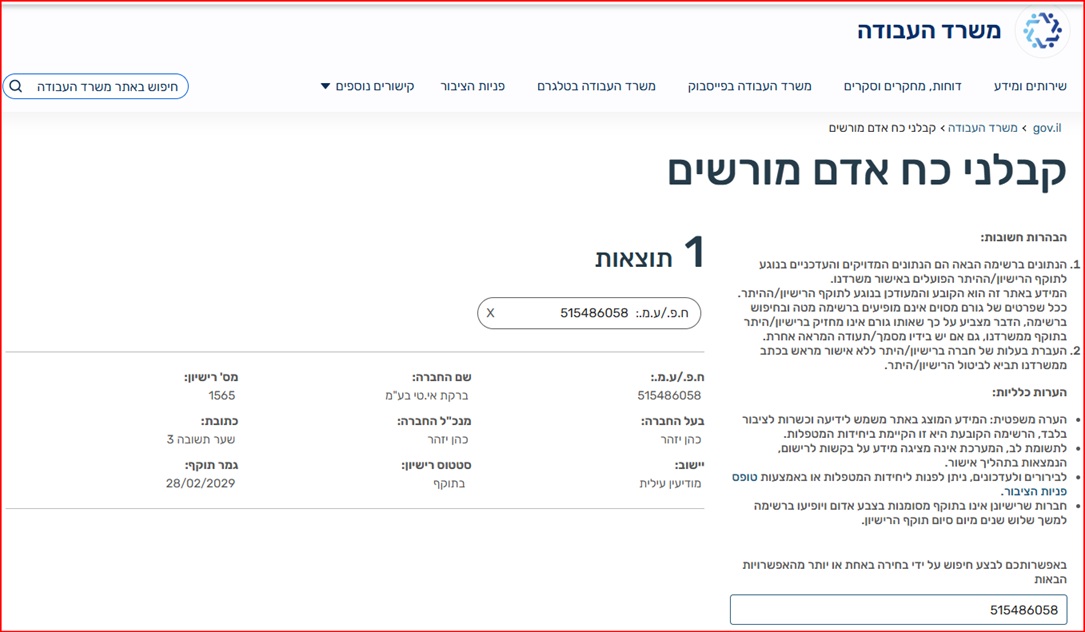
NETO · a licensed manpower contractor (#1565) supervised by the Ministry of Labor and operating since 2016 · automatically manages Section 14 contributions and ensures all severance and pension obligations are met on time, for the employers and workers we serve. The service costs the client company a simple 5% commission on the invoice (pre-VAT) · the worker never pays it. It covers payroll, payslips, and every mandatory benefit, whether you hire locally or as a foreign company through an Employer of Record in Israel.
NETO employer guide · how to pay workers in Israel (2 min)
Watch · in under 2 minutes, see how simple it is to pay a worker in Israel · including severance and pension · through NETO.
Freelancers: are your pension & severance rights protected?
When you work through NETO's EOR model, you receive full pension contributions including severance components · just like a permanent employee. No more uncertainty about your financial future, and no paperwork on your side: see how the freelance payroll solution works and what it means to invoice without opening a business.

Frequently asked questions
Who is entitled to severance pay in Israel?
How is severance pay calculated?
What is the Section 14 arrangement?
Is a resigning employee entitled to severance?
When must severance pay be paid?
How does NETO handle severance obligations?
Severance obligations, handled for you
Join thousands of freelancers and employers who trust NETO for payroll, invoicing, and employment in Israel · Section 14 deposits, pension contributions, and every mandatory obligation handled automatically by a licensed manpower contractor (#1565).
Related guides on Israeli labor law
 Israeli Labor Law OverviewEmployee rights and employer obligations in one guide.Read more
 Termination Process in IsraelHearings, notice periods, and final settlements.Read more
 Pension ContributionsEmployer and employee pension rates, explained.Read more
 Employee Rights in IsraelEvery mandatory right, from pension to sick pay.Read more
 Hours of Work and Rest LawThe 42-hour week, overtime rates, and mandatory rest.Read more
 Wage Protection LawPayslip rules, pay dates, and what may be deducted.Read more
Mandatory Benefits in IsraelPension, convalescence, leave, and everything required.Read more
Wage Protection LawPayslip rules, pay dates, and what may be deducted.Read more
Mandatory Benefits in IsraelPension, convalescence, leave, and everything required.Read more
 Employer Cost in IsraelWhat an Israeli employee really costs beyond gross salary.Read more
 Israel Payroll GuidePayslips, withholding, and reporting in Israel, explained.Read more
Temporary Employee RightsThe rights of temps and agency workers in Israel.Read more
Israel Payroll GuidePayslips, withholding, and reporting in Israel, explained.Read more
Temporary Employee RightsThe rights of temps and agency workers in Israel.Read more
 Travel ReimbursementThe mandatory travel allowance and how it works.Read more
 Employer of Record in IsraelEmploy in Israel without a local entity · the full guide.Read more
Test yourself
Five questions from NETO's labour law compendium. Every answer comes with an explanation and a link to the full item.
Need a labour law lawyer?
Tell us briefly what happened. We will understand the picture and connect you with a specialist. There is no commitment, and this is not legal advice from us.
Received · thank you
Your request is saved. We will be in touch to connect you with a suitable lawyer. If it is urgent · +972-8-976-1874.
General information · not legal advice. The binding text is the statute and the ruling themselves.
Before you move on
The information on this page is correct as of the verification date below, and is general by nature. The outcome in a concrete case turns on seniority, sector, the applicable collective agreement and the exact wording of the contract · details a page cannot verify for you.
Every statute, ruling and figure in one place
This statute is one item in a full compendium · statutes, extension orders, leading rulings and current figures, each with an official source and a verification date, read from both the employer's and the worker's side.
Open the labour law centre