Tax on Working with Foreign Clients · what Israeli freelancers should knowWorking with clients abroad can be a strong opportunity · but the tax, VAT and reporting path should be organized before the money arrives
The goal is not to avoid tax · it is to document the work correctly and choose a responsible payment route. A foreign client does not automatically make the work tax-free or VAT-free. NETO helps freelancers organize the payment path, the documents and the records, so the engagement is easy to explain to clients, accountants, banks and authorities.

AI summary · Tax on foreign-client workClick to read the page summary
This guide sets out what Israeli freelancers should check on tax when working with foreign clients: documents, VAT checks and the payment route. A foreign client does not automatically make the work tax-free or VAT-free · the freelancer's Israeli status, the type of service, the client location, social security and the documentation all matter. A reduced or export VAT treatment may apply only when the legal criteria are met and documented. It offers four checks before you receive foreign-client income, a quick decision table and a safe workflow. NETO supports the payment path, documents and records so foreign-client income is handled responsibly, operating under manpower contractor license 1565 (Bareket I.T Ltd, company id 515486058). This page gives general information only and is not legal, accounting or tax advice.
Tax on work with foreign clients · the short answer
Tax on work with foreign clients depends on the freelancer's Israeli status, the type of service, where the client is located, the payment route, VAT rules, social security obligations and the documentation kept for the transaction. A foreign client does not automatically make the work tax-free or VAT-free.
In some cases the VAT treatment may differ when services are exported · but only when the legal criteria are met and documented. NETO helps freelancers and companies organize the payment path, documents and records so the engagement is easier to explain to clients, accountants, banks and authorities. This page gives general information only. It is not legal, accounting or tax advice, and every concrete case should be reviewed according to its facts.
Four checks before you receive foreign-client income
A short, repeatable review to run before the payment arrives · so the facts, documents and route line up.
Scope and location
Define the service, the client country, the delivery location and who uses the work product. This helps determine what documents the client needs and which Israeli reporting questions must be reviewed.
VAT treatment
Do not assume a special VAT result just because the client is abroad. VAT treatment depends on legal conditions · if a reduced or zero treatment is considered, keep the professional basis and the supporting evidence.
Payment and currency
Match the payment amount, currency, transfer route and document wording. Banks and clients often need consistent details across the agreement, the invoice or payment document and the receipt.
Record keeping
Keep the agreement, approvals, payment confirmation and professional advice together. A clean record reduces friction later if an accountant, bank or authority asks why a route was chosen.
Documented payment route
NETO helps organize the payment path, documents and records so the engagement is easier to explain to clients, accountants, banks and authorities · a route that holds up when it is reviewed.
Professional review
NETO supports the operational workflow · it does not replace an accountant. Tax and VAT conclusions should be reviewed with a qualified professional according to the facts of your case.
How to proceed safely · in four steps
You keep the commercial relationship with the client · this is simply the order in which to organize the facts, documents and payment route.
- Collect the facts first. Client name, country, contract, service type, expected frequency, amount and currency · gathered before you accept payment.
- Check the documentation route. Decide which document the client needs and which Israeli reporting path fits the facts of the engagement.
- Separate sales from compliance. Close the commercial terms, but do not promise a tax or VAT treatment before it has been checked and documented.
- Keep a defensible file. Save the decision basis, the documents and the proof of payment in one place, so the route can be explained later.
Common situations · and the responsible next step
The same principle in four everyday cases · document the facts, and check the treatment before you assume it.
| Situation | Risk if ignored | Responsible next step |
|---|---|---|
| One-time foreign project | Informal payment can leave gaps in reporting and proof of service. | Document the scope, client, amount and payment path before accepting payment. |
| Ongoing monthly service | Recurring work can look different from a one-time transaction and may need a stronger structure. | Review whether a NETO payment route, payroll route or business file is the right fit. |
| Possible export service VAT treatment | Wrong VAT assumptions may create exposure or later correction work. | Check the criteria with a qualified professional and keep the written basis. |
| Client requests English paperwork | A mismatch between document and agreement can delay payment. | Use consistent English wording, currency and payment instructions. |
Preparing paperwork for a client abroad? See the guides on an English invoice for a foreign client and VAT treatment for export services.
A licensed, documented route · for cross-border work
Licensed and supervised
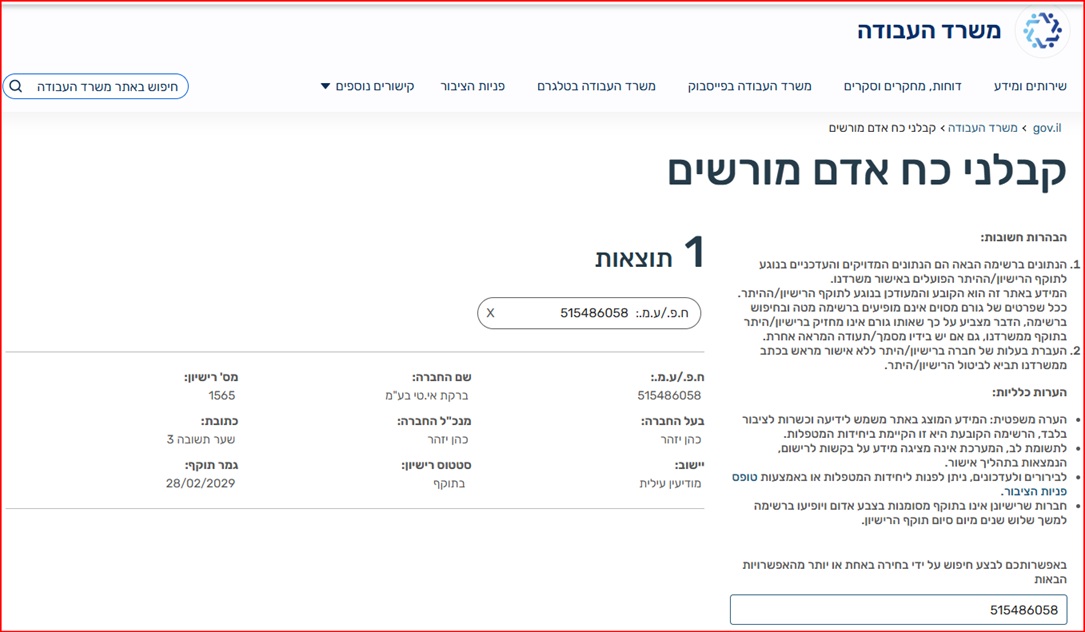
NETO operates lawfully through Bareket I.T Ltd (company id 515486058) under manpower contractor license 1565, supervised by the Ministry of Labor. That underpins a documented payment route you can stand behind.
- License 1565 · verifiable in the state database
- A documented, explainable payment route
- Operating since 2016 as an employment and payment platform
Organized and transparent
NETO is a digital platform that helps organize the payment path, documents and records · so the engagement is easier to serve, to receive payment for and to explain to clients, accountants, banks and authorities. It supports the workflow · it does not replace your accountant.
- One place for the agreement, documents and proof of payment
- Consistent English paperwork, currency and payment details
- Tax conclusions left to a qualified professional
You can verify NETO's license directly in the Ministry of Labor's manpower contractor database · a public register of every licensed manpower company in Israel.
Check the source · then keep the basis
When a tax or VAT question turns on the facts, go to the primary source and keep the written basis with your file. The two authorities most relevant to foreign-client income are the tax authority and the national insurance institute.

Foreign-client tax · questions and answers
Is income from a foreign client taxable in Israel?
Is VAT always zero for a foreign client?
Does a foreign client make my work tax-free?
Can NETO replace my accountant?
What should I prepare before asking NETO?
Is NETO's payment route a licensed one?
Getting paid by a client abroad?
Share the engagement details and NETO will help clarify the operational payment route, the documents and the workflow before the engagement expands · a documented route, operating since 2016 under manpower contractor license 1565.
In summary
Foreign-client work should be treated as a commercial opportunity that requires clean documentation. Tax on work with foreign clients depends on your Israeli status, the type of service, the client location, the payment route, VAT rules, social security and the documentation you keep · a foreign client does not automatically make the work tax-free or VAT-free. The better the facts, documents and payment route are aligned in advance, the easier it is to serve the client, receive payment and answer professional questions later. NETO supports the route under manpower contractor license 1565 (Bareket I.T Ltd, company id 515486058), and this page is general information only, not legal, accounting or tax advice.
- Not automatically tax-free · status, service, location and documents all matter.
- VAT is conditional · a reduced or export treatment applies only when the criteria are met and documented.
- Four checks first · scope, VAT, payment and currency, and records.
- A safe workflow · collect facts, check the route, separate sales from compliance, keep a file.
- A documented route · NETO organizes the payment path, documents and records.
- Licensed and supervised · license 1565, supervised by the Ministry of Labor.
Related guides for freelancers

English invoice for a foreign client
How to issue a clear English invoice that matches the agreement, currency and payment route.
English invoice for aInternational invoice from Israel
Sending an invoice abroad · consistent details across agreement, invoice and receipt.
International invoice
VAT treatment for export services
When a reduced or export VAT treatment can apply · and what has to be met and documented.
How to issue a one-time invoice in IsraelForeign currency payments
Receiving payment in another currency · matching amount, route and document wording.
Foreign currency paymentsPrivate invoice without a business file
Receiving income without opening a business file · when it fits and how it is documented.
Private invoiceManpower contractor license 1565
The license, the guarantees and the duties of a manpower company · what the law says.
Manpower Contractor License