



VAT treatment for services to foreign clients: criteria before conclusions
When an Israeli freelancer serves a foreign client, VAT handling must be based on the law and the facts. The right question is not “can I use zero VAT?” but “do the documented facts meet the criteria?”
NETO can help organize the payment workflow and the documents your client needs, while leaving tax conclusions to the correct professional review.
VAT treatment for foreign-client services: the short answer
VAT treatment for services to foreign clients in Israel depends on specific legal criteria. A client being located abroad is an important fact, but it is not enough on its own. You usually need to examine who receives the service, where it is used, what the agreement says, how the payment is made, what supporting documents exist and whether any Israeli beneficiary is involved. NETO helps freelancers structure the payment and documentation route so the invoice or payment document is consistent with the commercial facts. NETO does not promise a tax result and does not replace an accountant or tax adviser. If special VAT treatment may apply, it should be checked, documented and supported before relying on it.
Trust signal: NETO operates under Israeli license #1565
NETO operates in Israel under manpower contractor license #1565 issued by the Israeli Ministry of Labor. For employers and freelancers, this supports a documented payment route, subject to reviewing the actual work relationship, tax position and required documents before work begins.

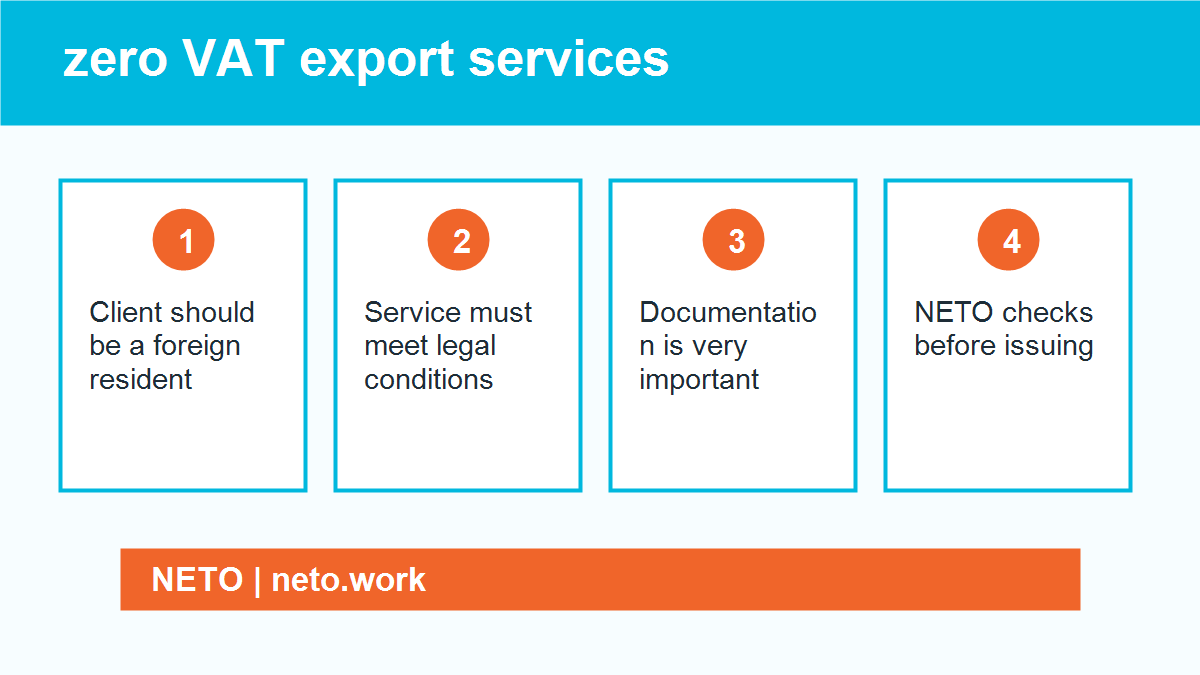
Before choosing VAT treatment, check the facts
Who receives the service?
Identify the legal client and any Israeli party that benefits from the service.
More detail
The real recipient matters. Procurement names, group companies and end users should not be ignored.
Where is the service used?
Document whether the service is consumed abroad, in Israel or by both.
More detail
The location and use of the service can affect the analysis and should be captured in the file.
What does the agreement say?
Make sure the agreement, scope and payment document tell the same story.
More detail
Mismatch between contract, invoice and actual work creates avoidable risk.
What proof is kept?
Keep agreements, client details, confirmations and professional advice together.
More detail
Good records are essential when a special VAT position is used.
Quick decision table
| Fact to verify | Why it matters | What to keep |
|---|---|---|
| Foreign client identity | Shows who contracted and who pays. | Legal name, address, country, contact and agreement. |
| Service recipient and use | Helps determine whether the service is truly foreign-facing. | Scope, delivery records and client confirmation where relevant. |
| Israeli involvement | Can change the risk profile and required review. | Notes on Israeli users, affiliates, agents or beneficiaries. |
| Professional review | Prevents unsupported VAT assumptions. | Written basis from accountant/tax adviser when needed. |
Recommended workflow
Related NETO guides
Official references
Frequently asked questions
+Does a foreign client automatically mean zero VAT?
No. The result depends on the full legal and factual picture.
+What documents should I keep?
Keep the agreement, client identity, scope, payment records and any professional review that supports the treatment used.
+Can NETO decide the VAT treatment for me?
NETO helps organize payment and documents. Final tax treatment should be confirmed with the appropriate professional where needed.
+What if the engagement changes?
Recheck the VAT and documentation position if the scope, recipient, location of use or payment frequency changes.
NETO can help build a cleaner workflow for foreign-client payments while keeping the tax review separate and documented.
Summary
VAT treatment for services to foreign clients is not a slogan. It is a documented conclusion based on the client, service, recipient, use and supporting records. A clean workflow protects the freelancer, helps the client pay faster and reduces avoidable questions later.