Extension Order for the Manpower Services SectorThe floor of rights for a worker employed through a manpower agency · 2004
The extension order broadens the general collective agreement in the manpower sector to every employer supplying manpower services in the business sector · setting a uniform floor of rights: working hours, sickness, leave, recuperation, holidays, wages and a pension arrangement. Here is the order text in an unofficial English translation, alongside a practical explanation.

AI summary · the manpower sector extension order in briefClick to read the page summary
The 2004 Extension Order in the manpower services supply sector broadened the general collective agreement (7003/2004) · signed between the manpower companies' organizations and the Histadrut · to all employers supplying manpower services in the business sector and their workers. The order sets a uniform floor of rights: a 43-hour work week (the order's wording; since 1 April 2018 the economy-wide work week has been 42 hours), 24 sick days per year (up to 130 accrued), annual leave and recuperation pay by seniority, holiday pay after 3 months, travel-expense reimbursement, a holiday gift twice a year, wages no lower than the schedules and the minimum wage, and a pension arrangement of at least 17.5%. Below, each topic pairs an unofficial English translation of the order text with a plain-language explanation.
- Who it applies to · agency workers placed in the business sector, except internal staff, nursing/caregiving, computing, and defense-rehabilitation roles (Section 4).
- Hours & sickness · a 43-hour week · 24 sick days per year, up to 130 accrued (Sections 8.2, 8.3).
- Leave, recuperation & holidays · by seniority, with holiday pay after 3 months (Sections 8.2, 8.4, 8.7).
- Pension · a pension fund of at least 17.5% (12% employer, 5.5% worker) or managers' insurance (Section 8.13).
- Wages & gift · no lower than the wage schedules and the minimum wage · a holiday gift twice a year (Sections 8.10, 8.12).
- The information here is for reference only · the binding text is the version published in the official records.
What is an extension order in the manpower sector?
An extension order is a legal instrument by which the Minister of Labor broadens the application of a particular collective agreement · so that it applies not only to members of the signatory organizations, but to all employers and workers in the sector. The Extension Order in the manpower services supply sector, signed in 2004, broadened the general collective agreement (7003/2004) · and applied it to all manpower contractors operating in the business sector and their workers.
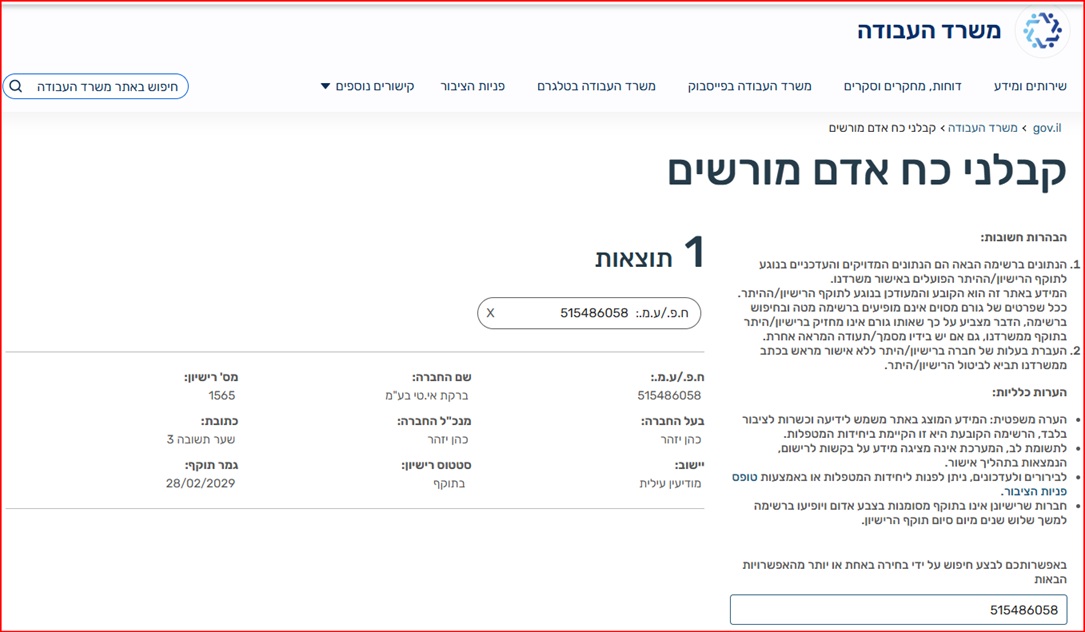
The purpose of the order is to protect the rights of manpower workers and to set a uniform floor of employment terms. This page presents the order text as published, alongside clearly marked blocks of practical explanation that are not part of the order text. NETO, a licensed manpower contractor (license #1565), upholds the full rights set out in the order.
- Sections 2 to 4 · definitions, general provisions and application of the order
- Section 5 · placement of workers with an actual employer (the client)
- Section 8 · terms of employment · the practical heart of the order
- Sections 9 to 10 · training and prohibition on strike-breaking

Summary table · the main rights in the order
Before diving into the order text · here is how the main rights of a manpower worker in the business sector break down, and which section anchors each one:
| Section | Topic | What it means in practice |
|---|---|---|
| 4 | Application | Applies to agency workers placed in the business sector · except internal staff, nursing/caregiving, computing and defense-rehabilitation roles. |
| 5 | Placement | Placement with a client only for roles that are temporary by nature · per the closed list in the order. |
| 8.2 | Hours & holidays | A 43-hour work week · holiday pay after 3 months of work. |
| 8.3 | Sickness | 24 paid sick days per year · up to 130 accrued days. |
| 8.4 · 8.7 | Leave & recuperation | Annual leave and recuperation pay by seniority · per the schedules in the order. |
| 8.10 · 8.12 | Wages & gift | Wages no lower than the schedules and the minimum wage · a holiday gift twice a year. |
| 8.13 | Pension | A pension fund of at least 17.5% (12% employer, 5.5% worker) or managers' insurance · in place of severance under Section 14. |
This table is our own summary for ease of orientation · it is not part of the order text. The governing text is presented further down the page.
The manpower sector extension order · the text as published
The order text is presented in an unofficial English translation of the published Hebrew. Dashed light-blue blocks labeled "Explanation" are our addition and are not part of the order text.
Under the Collective Agreements Law, 5717-1957.
By virtue of my authority under Section 25 of the Collective Agreements Law, 5717-1957, I hereby order that the provisions of the general collective agreement (7003/2004) · signed between the Organization of Human-Resource Services Supply Companies in Israel and the National Association of Human-Resource Companies affiliated with the Federation of Chambers of Commerce, and the New General Federation of Labor (Histadrut) and the National Federation of Labor, signed on 24 Shvat 5764 (16 February 2004) · be extended as set out in the appendix, and that those provisions shall apply to all employers engaged in the supply of manpower services in the business sector only and their workers, as set out in Section 4 of the extended provisions, and excluding a "public-service employer" as defined in those extended provisions.
Framework, definitions and application · Sections 2 to 4 Official source
In this agreement, the terms listed below shall have the meaning set beside them, unless the context requires otherwise:
"the Law" · the Employment of Employees by Manpower Contractors Law, 5756-1996, as in force at the time this agreement is signed and as it may be in force from time to time;
"the agreement" · this general collective agreement;
"collective agreement" · as defined in the Collective Agreements Law, 5717-1957;
"placement" (hashama) · positioning a worker to work at an actual employer for the purpose of examining their suitability for direct employment by the actual employer;
"company", "manpower company", "employer" · a manpower contractor as defined in Section 1 of the Law;
"month of work", "full-time position" · for the purpose of accruing social rights, a full month shall be considered a month of work of 175 hours;
"Minimum Wage Law" · the Minimum Wage Law, 5747-1987;
"client", "actual employer" · an "actual employer" as defined in Section 1 of the Law;
"business-sector employer" · one who is not a "public-service employer";
"public-service employer" · the state service, local authorities (including municipalities, local councils, regional councils, religious councils, town associations for firefighting, for water and sewage, for education, veterinary town associations, planning committees, planning and building committees), educational institutions as defined in Section 37A(4), (5) and (7) of the Settlement of Labor Disputes Law, 5717-1957, institutions of higher education, the National Insurance Institute, the Employment Service;
"second and third shift" · the working hours defined as second- and third-shift hours at the client; absent such a definition, a second shift shall be considered work of at least two hours within the range 17:00 to 23:45, and a third shift work of at least two hours within the range 22:00 to 06:00;
"worker" · any worker employed by a manpower company, unless it is determined that the agreement does not apply to them under Section 4 below;
"internal (manganon) staff" · workers who perform their work directly within the company, as distinct from workers placed to work at a client;
"monthly worker" · a worker whose wage is calculated on a monthly basis;
"daily worker" · a worker whose wage is calculated on a daily or hourly basis;
"wage", "salary" · the wage paid to the worker for ordinary working hours;
"pensionable salary" · as defined for the wage serving as the basis for calculating severance pay in Regulation 2 of the Severance Pay Regulations (Calculation of Compensation and Resignation Treated as Dismissal), 5724-1964, and including a shift supplement for workers regularly employed in shifts;
"maximum lawful employment period" · the maximum period during which a manpower contractor may continuously employ a worker under Section 12A(a) of the Law, and to the extent extended under Section 12A(b) of the Law, insofar as these sections are in force.
3.1 A worker shall be employed in the type of work, working hours, place of work and scope of work in accordance with the client's needs, following coordination with them; the worker has the right not to take on a task or role offered to them, but must complete the work or role they are performing at the client, provided there is no material deterioration in their employment terms.
3.2 Wages shall be paid to the workers at the time set in the Wage Protection Law, 5718-1958.
3.3 The employer shall deduct from the worker's salary all deductions required under any law and transfer them on time to the body for which they were deducted.
3.4 The employer shall provide the worker, each month and no later than the wage payment date, with a payslip containing a full breakdown of the wage components and the deductions.
4.1 The order shall apply to all workers, except internal (manganon) staff, workers employed in providing nursing/caregiving services, workers employed in computing roles as defined in the Law, and workers employed in the treatment of disabled persons of the defense establishment on behalf of the Rehabilitation Department of the Ministry of Defense.
4.3 The order shall apply to workers of manpower companies placed with actual employers in the business sector only.
Placement of workers with an actual employer · Section 5 Official source
5.1 A manpower company shall place a worker with an actual employer only for work that is temporary or periodic by nature (hereinafter · temporary roles).
5.2 Only the roles listed below shall be considered temporary roles:
- 5.2.1 replacing an employee on maternity leave;
- 5.2.2 replacing an employee on unpaid leave and/or on sick leave and/or due to a work accident and/or loss of working capacity for another reason;
- 5.2.3 staffing the manpower required to carry out a time-limited project (where the project period was estimated in advance);
- 5.2.4 temporary reinforcement of manpower due to seasonal or periodic needs;
- 5.2.5 unexpected workload;
- 5.2.6 placement (hashama);
- 5.2.7 staffing a new activity of the actual employer until it stabilizes and becomes an integral part of the employer's activity;
- 5.2.8 staffing positions requiring special qualifications in the fields of technology and science;
- 5.2.9* (1) workers in telephone service centers (Call Center); (2) checking-account clerks in banks ("tellers"), except checking-account clerks employed in the same branch; (3) promoters, sales representatives or sales promoters outside the employer's premises, at counters or stands, or door-to-door sales; (4) couriers.
* In accordance with the appendix to the agreement (decision of the monitoring committee in the temporary manpower sector).
Terms of employment · Section 8 Official source
For the avoidance of doubt, it is clarified that the terms of employment set out in the agreement refer to workers employed full-time; workers employed part-time shall be entitled to the terms of employment pro rata to the part-time scope; wherever this agreement sets out rights that depend on seniority, this means seniority at the same place of work and/or with the same client and/or in the company.
8.2.1 The work week is 43 hours; where a different work week is customary at the client, the work week for the employer's workers shall be as customary at the client.
8.2.2 The worker shall be employed at the client in accordance with the client's needs.
8.2.3 For work in overtime hours, the worker shall be entitled to overtime pay under the provisions of the Hours of Work and Rest Law, 5711-1951; notwithstanding the above, a worker shall be entitled to the same arrangements and payments applying to workers of an actual employer to whom a general (including sectoral) collective agreement applies that sets a different payment and/or arrangement for overtime pay than provided above.
8.2.4 For shift work, as its meaning is in a collective agreement (including sectoral) and/or an extension order applying to the client and its workers, the worker shall be entitled to payment in accordance with the provisions on this matter in that agreement or order.
8.2.6 A worker who has actually worked in the company for 3 full and consecutive months and did not absent themselves from work the day before and the day after a holiday, except with the client's permission, shall be entitled to payment for holidays that fell during their employment after that three-month period, provided that, but for the holiday, the worker would have been employed on that day. A daily worker shall be entitled to payment for a holiday as above according to that worker's average daily earnings in the preceding three months; for the avoidance of doubt, a daily worker shall not be entitled to payment for a holiday that falls on a Saturday.
8.2.7 Non-Jewish workers shall be entitled to be absent with pay, as set out in Section 8.2.6, also for their own holidays, but no more than 9 days; excess holiday days shall be deducted from the workers' wages, unless the worker requests that these days be deducted from their accrued leave days.
8.2.8 For the purposes of this section, holidays mean: Rosh Hashanah · two days, Yom Kippur, Sukkot · two days, Passover · two days, Independence Day, Shavuot, and one additional day coordinated between the client and the employer for the worker; where a general (including sectoral) collective agreement at the actual employer sets entitlement to additional holidays and/or special payment for holidays, the provisions of that collective agreement shall apply to the workers.
8.2.9 A worker who worked on a holiday shall be entitled, in addition to full wages for that day, to a payment equal to the payment for a leave day.
8.2.10 Notwithstanding Section 8.2.9, workers employed at a client who customarily pays its workers for holiday work under the provisions of Section 17 of the Hours of Work and Rest Law, 5711-1951, shall also be entitled to such payment.
8.3.1 A worker shall be entitled to 24 paid sick days based on the pensionable salary, for each year of work and, for part of a year of work, on a pro-rata basis, but no more than 130 accrued days, in accordance with the provisions of the Sick Pay Law, 5736-1976, and against the presentation of medical certificates.
8.3.3 Accrued sick days may not be redeemed for cash.
Every worker is entitled to paid annual leave according to their seniority at the employer; the number of leave days to which the workers are entitled is:
| Period of work at the company, in years | 6-day work week | 5-day work week |
|---|---|---|
| For the first to the fourth year | 13 | 11 |
| For the fifth year | 14 | 12 |
| For the sixth, seventh and eighth years | 19 | 17 |
| For the ninth year onward | 26 | 23 |
The days in the table above are stated in working days.
8.4.3 A year of work for the purpose of calculating leave shall be counted from the worker's start date at the company.
8.5.1 A worker, after 3 months of work, is entitled to be absent from work with pay on the day of their wedding, the day of their son's circumcision, the day of a daughter's birth, and a bar/bat mitzvah, provided that, but for the absence, the worker would have been employed on that day; where a collective agreement at the actual employer sets special leave for additional celebration days and/or special payment, those provisions of the collective agreement at the actual employer shall also apply to the workers.
8.5.2 A request for leave on celebration days shall be submitted to the employer a reasonable time before the event and, where possible, no less than two days before the event.
8.5.3 Every worker in mourning for the death of a first-degree relative (parent, sibling, spouse or child) is entitled to be absent from work in accordance with the laws of their religion; during such days of absence the worker shall be entitled to payment of their wages for the working days on which they were absent, but no more than 7 calendar days, provided that, but for the absence, the worker would have been employed on those days.
8.6.1 The employer shall contribute to the worker's travel expenses to and from work, in accordance with the provisions of the collective agreements signed from time to time between the Coordination Bureau and the New General Federation of Labor.
8.6.2 At workplaces where the client's workers benefit from transport to and from the workplace, the employer's workers shall also be entitled to use that transport; workers who are unable to use the transport, other than as a result of being late for it, shall be entitled to a full contribution to their public-transport travel expenses to and from work.
8.7.1 A worker who has completed a full year of work shall be entitled to payment of recuperation pay for the past year, as follows:
| For the year(s) | Recuperation days |
|---|---|
| First | 5 |
| Second and third | 6 |
| Fourth to tenth | 7 |
| Eleventh to fifteenth | 8 |
| Sixteenth to nineteenth | 9 |
| Twentieth onward | 10 |
8.7.2 The rules and conditions in the general collective agreement on recuperation and vacation participation, between the Coordination Bureau of the Economic Organizations and the New General Federation of Labor as updated from time to time, shall apply to the payment of recuperation pay; where the actual employer paid its workers recuperation pay according to the practice in the public service, that payment shall also apply to the workers.
8.8 Clothing · every worker shall be entitled to work clothing under the provisions of the general sectoral collective agreement and/or the extension order and/or the collective agreement applying to the client, and as required by workplace safety rules.
8.9 Meals · at workplaces where the client has a dining room for its workers' use, the company's workers shall also be entitled to use the dining-room services in accordance with the practice at the client, including a deduction from the workers' wages for the value of the meal at the level of the deduction from the actual employer's workers.
8.10.1 Every worker shall be paid wages according to their role, profession, experience and other relevant data; workers shall be assigned and promoted according to these criteria; every company shall act to advance workers' wages, having regard to the changing data in the labor market and to the agreements with the clients at whom the workers are placed to work.
8.10.2 The worker's wage shall be as agreed with the client following agreement with the worker, and shall not be lower than the wage range for the profession or sector in which the worker is employed under Appendix A to the agreement.
Appendix A · Wage schedule for professional workers (in new shekels)
| Type of workers | Wage range for a worker employed on an hourly basis | Wage range for a worker employed on a monthly-salary basis |
|---|---|---|
| Metalworkers (machinists, welders, etc.) | 18.87 – 30.60 | 3,509.82 – 5,691.60 |
| Para-engineering professions (practical engineers, draftsmen, etc.) | 19.89 – 35.70 | 3,699.54 – 6,640.20 |
| Engineering professions | 23.46 – 56.10 | 4,371.72 – 10,404 |
| Computer professionals (programmers, systems analysts, etc.) | 22.44 – 51.00 | 4,151.40 – 9,454 |
| Secretarial and computerized office work | 19.125 – 30.60 | 3,556.74 – 5,691.60 |
| Industrial and construction professions (intermediate levels) | 18.462 – 25.50 | 3,433.32 – 4,743 |
In sectors of the economy whose wage schedule was set and/or updated in a general (including sectoral) collective agreement in the last 3 years, and in sectors of the economy whose wage schedule will be updated in a general (including sectoral) collective agreement during the term of this agreement, the workers' wages shall not be lower than the rates set in the wage schedules in the collective agreements as noted above and as they may be updated from time to time.
8.10.3 Wages shall be updated by the cost-of-living increment rates set and/or to be set from time to time in the general collective agreement between the New General Federation of Labor and the Coordination Bureau of the Economic Organizations, from the set date, and in accordance with wage supplements paid to all workers in the economy by virtue of extension orders.
8.10.4 For the avoidance of doubt, a worker's wage shall not be lower than the wage set in the Minimum Wage Law, and as it may be updated from time to time.
The employer shall give every worker a holiday gift twice a year, on Passover eve and on Rosh Hashanah eve.
8.13.1 All workers shall be insured in a comprehensive, accumulating pension fund approved by the Ministry of Finance, Capital Market, Insurance and Savings Division, which shall be determined as set out in Section 8.13.4 (hereinafter · the fund or the pension fund), and this at the end of nine months of work in one company or one workplace or with one actual employer, all subject to the provisions of this section (hereinafter in this section · the waiting period).
8.13.2 For the avoidance of doubt, it is clarified that Section 8.13.1 shall also apply to a worker employed by a company at an actual employer to whom an agreement applies requiring it to insure its workers in a pension fund after a period exceeding nine months. Thus, a worker as described in this sub-section shall also be insured in a pension fund at the end of nine months of work with that actual employer.
8.13.3 For the avoidance of doubt, it is clarified that transferring a worker from one actual employer to another, during their period of work in the company including in their first months of work, shall not negate and/or interrupt their entitlement to pension-fund insurance from the company as set out in Section 8.13.1 after nine months of work in the company and/or upon the circumstances set out in Section 8.13.6. Thus, such a worker shall be entitled to continued contributions to the pension fund in any event, and the waiting period set out in Section 8.13.1 shall not apply to them.
8.13.4 For a worker employed at a workplace where pension insurance and/or a provident fund exists, the practice at that workplace shall be followed; where there is no pension insurance at the workplace · the worker shall choose the fund they see fit. A worker for whom a prior insurance arrangement exists, including with an insurance company under the arrangement known as "managers' insurance" (hereinafter · managers' insurance), shall be insured in that same fund or managers' insurance, unless they request the company, in writing, to be insured in the same fund in which the other workers are insured under this sub-section.
8.13.5 A worker who, at the start of their actual employment in the company, was insured under pension insurance, shall be insured by the company under that pension insurance after three months of work or after three months in which no insurance premiums were paid for the worker, whichever is shorter, provided that contributions as set out in Section 8.13.8 are made in their favor for that plan, before the end of the calendar year, unless the Income Tax Commission permits the company to contribute other than for the current year.
8.13.6 A worker for whom no prior insurance arrangement exists, and who requests the company in writing to be insured in managers' insurance, shall be insured in managers' insurance at the time stated in Section 8.13.1, provided that the contributions set out in Section 8.13.8 are made in their favor for that plan.
8.13.7 Workers placed to work at the actual employer who customarily insures all its workers, or workers of the type the company places with it, in managers' insurance, and where the client required the insurance of the workers placed with it in that managers' insurance, shall be insured at the time stated in Section 18.3.1 [sic in the official Hebrew text; presumably Section 8.13.1] in managers' insurance instead of insurance in the fund (insurance in the fund and managers' insurance shall together be referred to as "pension insurance"), provided that the contributions set out in Section 8.13.8 are made in their favor.
8.13.8 Contributions to pension insurance shall be calculated on the basis of the worker's pensionable salary, and shall be at the following rates: to the fund, no less than 17.5%, of which 12% at the company's expense (6% to benefits and 6% to severance) and 5.5% to benefits at the worker's expense; to managers' insurance, 13.33% at the company's expense, 5% to benefits at the worker's expense, plus a contribution of up to 2.5% of the wage at the employer's expense to cover loss of working capacity for compensation of 75% of the wage.
8.13.9 The company's contributions to pension insurance as above shall replace severance pay, in accordance with Section 14 of the Severance Pay Law, 5723-1963, and the general approval issued thereunder which shall form an integral part of this agreement, to the extent of 72% of the severance pay due for the period in which contributions were made to a pension fund and to the extent of 100% of the severance pay due for the period in which contributions were made to managers' insurance.
8.13.10 A worker who was insured in a fund and who ended their employment in circumstances in which, by law, they are entitled to severance pay, shall be entitled to a severance-pay top-up at the rate of 2.33% of their pensionable salary.
8.13.11 During the period until the worker's insurance under a pension arrangement, the worker shall be insured by the company under collective risk-type insurance granting the worker or their survivors, as applicable, fixed one-time compensation for disability due to a non-work accident or death, in the insured amounts set out below: for death, 100,000 new shekels; for loss of working capacity, to secure fixed compensation at the rate of 50% of the worker's wage, provided that the company's payment for loss of working capacity does not exceed 0.5% of the worker's wage; notwithstanding the above, if the company is required to pay more than 0.5% as stated, the rate of the worker's insured wage for which they are entitled to compensation for loss of working capacity shall be adjusted proportionally, unless they request to bear the additional cost of the insurance.
8.13.12 A worker employed at an actual employer to whom a collective agreement applies requiring it to contribute for its workers, in addition to pension-fund contributions, also to a provident fund for non-pension components (hereinafter · provident fund), shall be entitled, from the time of their entitlement to pension-fund contributions under this agreement, to contributions to a pension fund and a provident fund as follows: (a) a pension-fund contribution on all wage components on which the actual employer is required to contribute to a pension fund for its workers, if and to the extent these components are relevant to the worker; (b) a provident-fund contribution for all wage components on which the actual employer is required to contribute to a provident fund for its workers, if and to the extent these components are relevant to the worker.
8.14.1 In addition to Section 8.13, a company shall contribute for a worker to a study fund (keren hishtalmut), subject to Section 8.14.2, if the actual employer is required to contribute for its workers to such a study fund by virtue of a collective agreement.
8.14.2 The start date of contributions to the study fund shall be 6 months after the date set in the collective agreement applying to the actual employer (hereinafter in this section · the waiting period), and the study-fund contribution rates shall be as set in the collective agreement applying to the actual employer, all adjusted, among other things, to the type of work and the company worker's seniority at the actual employer.
8.14.3 For a worker entitled to contributions under Section 8.14.1, the practice on this matter at the actual employer shall be followed.
8.14.4 A worker who was entitled to a study-fund contribution under Section 8.14.1 and was transferred to another actual employer, and Section 8.14.1 continues to apply to them, shall have the company continue to contribute for them, without the need for an additional waiting period, to that same study fund; the worker may request the company, in writing, to move to the study fund in which the other workers of the actual employer accumulate their funds.
8.15 Advance notice of dismissal · the workers shall be entitled to advance notice in accordance with the provisions of the law.
Training and prohibition on strike-breaking · Sections 9 to 10 Official source
The company shall train its workers and arrange professional development from time to time, in accordance with its needs and professional considerations; such training and development shall be at the company's expense, but a company may require workers who undergo such training to be employed by the company for a reasonable period, having regard to the nature and duration of the training, after the training ends.
10.1 An employer shall not place workers to work at a client in place of striking workers, and under no circumstances shall the employer's workers take the place of striking workers at a client on whose premises a strike has been declared, nor shall they act to break a strike of the permanent workers at that workplace.
10.2 Company workers who were idled due to the declaration of a strike at the client as set out in Section 10.1 shall have, for all purposes, a status identical to that of the client's workers.
15 Av 5764 (2 August 2004) · Ehud Olmert · Minister of Industry, Trade and Employment.
How it works · a worker placed through a manpower agency
Suppose Ruth is placed by a manpower company with a client in the business sector, full-time (a month of work of 175 hours), from January · here is how the order translates into rights in practice:
Scenario · Ruth, a full-time agency worker
- Hours · Under Section 8.2.1, Ruth's work week is 43 hours, but since 1 April 2018 the economy-wide 42-hour week applies to her. If a shorter week is customary at the client · the client's customary week applies.
- Holidays · after 3 full and consecutive months (end of March) Ruth is entitled to payment for holidays that fall · provided she was not absent the day before and after the holiday without permission (Section 8.2.6).
- Sickness · Ruth accrues 24 sick days per year based on the pensionable salary, up to 130 accrued days, against a medical certificate (Section 8.3.1). Sick days may not be redeemed for cash.
- Pension · at the end of 9 months of work (September) pension insurance begins · at least 17.5% is contributed to a pension fund (12% at the company's expense and 5.5% at Ruth's expense). If she was previously insured · the wait is shortened to 3 months (Sections 8.13.1, 8.13.5, 8.13.8).
- Holiday gift · Ruth receives a gift twice a year · on Passover eve and Rosh Hashanah eve (Section 8.12).
- Recuperation and leave · after a full year of work Ruth is entitled to recuperation pay, and annual leave by seniority · per the schedules in Sections 8.7 and 8.4 of the order.
Quick quiz · manpower worker rights
Five questions on the essentials of the order · every answer is based on the order text above. Choose an answer and get an instant explanation.
1 What work week does the order set for a manpower worker (by default)?
2 How many sick days per year is the worker entitled to under the order, and what is the accrual cap?
3 When, as a rule, does a manpower worker's pension insurance begin under the order?
4 What is the total contribution rate to a pension fund under the order?
5 How many times a year does the employer give a holiday gift, and when?
Employing through a manpower agency? Let NETO carry the obligations.
NETO · a licensed manpower contractor (#1565) supervised by the Ministry of Labor and operating since 2016 · manages the full obligations of the order for you: payslips, pension contributions, recuperation, leave and every mandatory right under the law. Whether you hire locally or as a foreign company through an Employer of Record in Israel, the compliance is handled · payroll, mandatory benefits and reporting included.

Frequently asked questions · the manpower sector extension order
What does the 2004 manpower sector extension order establish?
Who does the order apply to?
What rights does the order grant a manpower worker?
What is the pension arrangement under the order?
How many working hours per week and how many sick days?
Do the pension contributions replace severance pay?
The order's obligations, handled for you
NETO is a licensed manpower contractor (#1565) supervised by the Ministry of Labor · we manage the full obligations of the order for the employers and workers we serve · payslips, pension contributions, recuperation, leave and every mandatory right under the law.
Summary · the manpower sector extension order, 2004
The extension order turned the collective agreement in the manpower sector into a binding floor of rights for all workers of manpower companies in the business sector. The essentials:
- The order applies to agency workers placed in the business sector · except internal staff, nursing/caregiving, computing and defense-rehabilitation roles.
- A 43-hour work week, 24 sick days (up to 130 accrued), leave and recuperation by seniority, and holiday pay after 3 months.
- A pension arrangement of at least 17.5% (or managers' insurance) · in place of severance under Section 14, with risk insurance during the waiting period.
- Wages no lower than the schedules and the minimum wage, a holiday gift twice a year, and a prohibition on strike-breaking.
Further reading: employing workers via a manpower agency · employee rights in Israel · the manpower contractor license · the Hours of Work and Rest Law · the Severance Pay Law · travel-expense reimbursement. Sources: the consolidated order text on Nevo · the official order on gov.il.
Last updated: 9 July 2026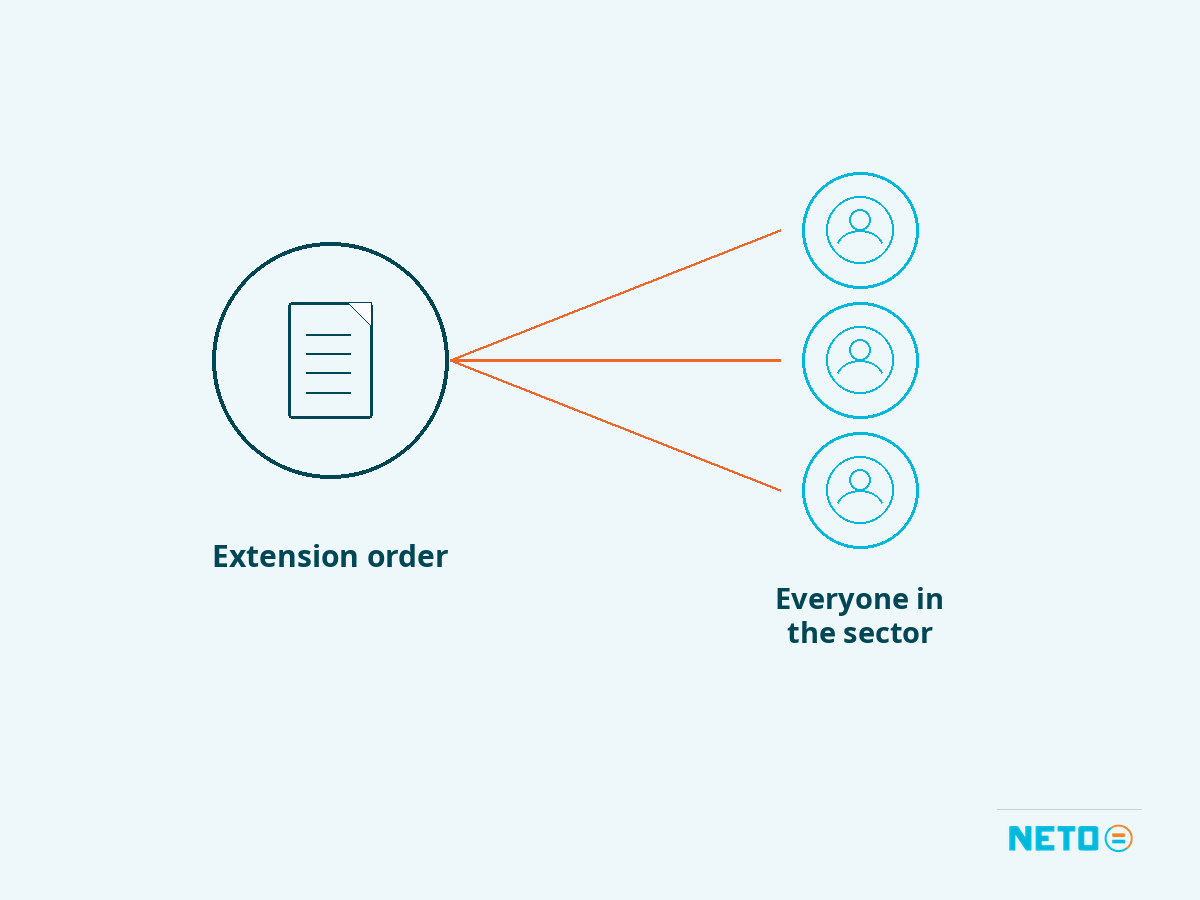
The law requires 6% · at NETO it is 8.33%
The mandatory pension extension order obliges every employer to contribute 6% of salary to the severance component, and section 14 of the Severance Pay Law applies to that money automatically. NETO contributes the full severance component by default · 8.33% · so the ongoing contribution replaces severance pay in full and no top-up is due when the employment ends. An employer contributing less than 8.33% must top up severance at the end of the employment relationship.
A worker who declares they have no active pension fund, in a one-off engagement · there the contribution obligation begins only after six months of work. A worker with an active pension arrangement is entitled from day one, with contributions made retroactively after three months or at the end of the tax year, whichever is earlier.
General information · not legal advice. The binding text is the statute and the extension order themselves.