
Hours of Work and Rest Law, 1951Working hours, weekly rest, breaks and overtime pay of 125% and 150%
The law sets the working day, the working week, the weekly rest day, the breaks, and the pay for overtime. We have gathered every relevant section here in full · and NETO, an automated employment system, makes sure every hour is calculated and paid correctly on every payslip.
Every hour countedovertime, automatically
A payslip each monthclear and in order
Labour law centre
Open the centre →
Every statute, extension order, ruling and current figure · in one place, each with its source.
Unofficial English translation · the Hebrew text is legally authoritativeThe sections quoted on this page are our own plain-English translation of the Hebrew statute, written to stay faithful to the original wording. On any legal question, only the official Hebrew version published in the Reshumot governs · not this translation.
Hebrew text · Nevo
Hebrew page on NETO
AI summary · Hours of Work and Rest LawClick to read the page summary
The Hours of Work and Rest Law, 5711-1951 provides that a working day shall not exceed eight hours (seven on night work and on the day before the rest or a holiday), that a working week shall not exceed 45 hours, and that the weekly rest is at least 36 consecutive hours. Overtime is paid at not less than 125% for the first two hours and 150% thereafter (section 16), and work during the weekly rest at not less than 150% (section 17). The law also sets breaks (section 20), supervision, penalties and exemptions. Further down this page · next to each section we give a faithful English translation of the statutory text, followed by a plain-language explanation with an example, two worked calculations and a short knowledge check.
- Working day · up to 8 hours, 7 on night work and the day before rest or a holiday (section 2).
- Working week · up to 45 hours (section 3).
- Weekly rest · at least 36 consecutive hours (section 7).
- Overtime · 125% then 150% (section 16).
- Work on the weekly rest · at least 150% (section 17).
- This page is informational only · the binding text is the Hebrew published in the Reshumot.
Working hours and rest · at a glance
Working day
8 hours a day · 7 on night work and the day before rest or a holiday
Section 2 · night work is work of which at least two hours fall between 22:00 and 06:00.
Working week
45 hours a week (at most)
Section 3 · in practice extension orders make the customary week shorter; the statutory ceiling stays 45.
Weekly rest
36 consecutive hours at least · minimum 25 by regulation
Section 7 · for a Jew it includes the Sabbath; for others, the Sabbath, Sunday or Friday as accepted by them.
First two overtime hours
125% of the regular wage
Section 16 · 1¼ of the regular wage for the first two overtime hours on the same day.
Overtime hours after that
150% of the regular wage
Section 16 · 1½ of the regular wage for each overtime hour after the first two.
Break in a workday
¾ hour at least from 6 hours of work · including a consecutive half-hour
Section 20 · between one working day and the next · a break of at least 8 hours (section 21).
Hours of Work and Rest Law · the framework of working time
The Hours of Work and Rest Law, 5711-1951, was enacted shortly after the establishment of the State of Israel and regulates the employee's rights and the employer's obligations regarding working time · the length of the working day and week, the weekly rest, breaks, overtime pay · and who the law does not apply to.
How this page is built: each topic is shown in two parts · first a faithful English translation of the relevant section (inside a marked frame), and immediately after it a plain-language explanation with an example (in a teal block tagged “Explanation”). The blocks tagged “Explanation” are our addition and are not part of the statutory text. The translation was prepared from the Hebrew and cross-checked against the consolidated Hebrew text on Nevo. Where translation and original differ, the Hebrew original prevails.
How NETO protects these rights: all the rules of the law have been coded into software, so every hour is calculated correctly · regular hours, overtime at 125% and 150%, work during the weekly rest, breaks and rest between shifts. An automated system has no interests of its own and cuts no corners, so the rights of the employee and the employer are kept in full.
Working day and working week · sections 1 to 6
How many hours may an employee work per day and per week, what counts as night work, and when the limits may be changed · next to each section is the translated text, followed by an explanation.
Section 2 Working dayEnglish translation
(a) A working day shall not exceed eight working hours.
(b) On night work, and on the day preceding the weekly rest and on the day preceding a holiday on which the employee does not work, whether by law or by agreement or custom, a working day shall not exceed seven working hours.
Explanation · not part of the statute
A regular working day is up to 8 hours. On night work, and on the day before the weekly rest (usually Friday) or the day before a holiday · the ceiling drops to 7 hours. Every hour beyond the daily ceiling is an overtime hour that earns increased pay (section 16).
Example: an employee who started at 08:00 and finished at 16:30 with a half-hour break worked 8 hours · a full working day. Had they finished at 17:30, the ninth hour would already count as overtime.
Section 1 Definition of night workEnglish translation
“Night work” means work of which at least two hours fall within the range of hours between 22:00 and 06:00.
Explanation · not part of the statute
It is enough that two hours of the shift fall between 22:00 and 06:00 for the whole shift to count as night work · and then the ceiling for the working day is 7 hours instead of 8.
Example: a shift from 21:00 to 05:00 includes more than two hours after 22:00 · so it is night work, and its ceiling is 7 hours.
Section 3 Working weekEnglish translation
A working week shall not exceed forty-five working hours.
Explanation · not part of the statute
The statutory ceiling for the working week is 45 hours. In practice, through extension orders and collective agreements, the workweek customary in the economy is shorter · but the statutory ceiling remains 45. Hours beyond the weekly ceiling count as overtime.
Example: five working days of 9 hours add up to 45 hours · exactly the weekly ceiling under the law.
Section 6 Prohibition of overtime employmentEnglish translation
Employment of an employee in overtime is prohibited, unless it is permitted under section 10, or unless it has been authorized under section 11.
Explanation · not part of the statute
Overtime employment is not the default · it is permitted only where the law allows it (section 10) or where a permit is granted by the Minister of Labor (section 11). The Minister may also prescribe by regulation, or approve in a collective agreement, a longer day or week, provided the average does not exceed 10 hours a day and 45 a week (sections 4 and 5).
Example: shift employment of up to one overtime hour a day is permitted under section 10, provided the three-week average does not exceed 45 hours per week.
Weekly rest · sections 7 to 9
The length of the weekly rest, the rest days by religion, and the prohibition on employing during it without a permit · next to the translated text.
Section 7 Hours of the weekly restEnglish translation
(a) At least thirty-six consecutive hours per week are the employee's weekly rest.
(b) The weekly rest shall include ·
- for a Jew · the Sabbath day;
- for a non-Jew · the Sabbath day, or the first day, or the sixth day of the week, all according to what is accepted by them as their weekly rest day.
Explanation · not part of the statute
Every employee is entitled to a continuous weekly rest of at least 36 hours. For a Jewish employee it includes the Sabbath; for a non-Jewish employee · the Sabbath, Sunday or Friday, according to the rest day accepted by them. Work during the weekly rest earns special pay (section 17).
Example: an employee who finished on Friday at 14:00 and whose rest runs until Saturday night receives a continuous stretch of more than 36 hours of rest, as required.
Section 8 Change of the weekly rest hoursEnglish translation
The Minister of Labor may prescribe, by regulations, for certain kinds of work, a weekly rest of less than thirty-six hours, but not less than twenty-five consecutive hours. A weekly rest prescribed by regulations under this section has the same status as the weekly rest under section 7.
Explanation · not part of the statute
For certain kinds of work the Minister of Labor may prescribe by regulation a shorter rest · but never less than 25 consecutive hours. This is the floor that may not be gone below.
Example: in industries with a special continuity of work a rest of 30 hours might be set · still above the minimum of 25 consecutive hours.
Section 9 Prohibition of employment during the weekly restEnglish translation
Employment of an employee during the weekly rest is prohibited, unless it has been permitted under section 12.
Explanation · not part of the statute
The default is that employing during the weekly rest is prohibited. Such employment is possible only where a permit is granted under section 12 · for example in essential services, or where stopping the work would cause serious harm. An employee who declines to work on the Sabbath on religious grounds is protected from discrimination (sections 9c to 9g).
Example: a hospital receives a permit to employ nurses on the Sabbath · the work is permitted and earns 150% pay plus substitute rest under the permit.
The figures you have to know
Amounts and deadlines in force today · each with its effective date and source.
ILS 6,443.85
Monthly minimum wage
For an adult employee in a full-time post (182 hours). Hourly ILS 35.40 · daily ILS 297.41 on a five-day week · ILS 257.75 on a six-day week.
In force from 1 April 2026
ILS 451.50
Recuperation day rate · private sector
Recuperation year 2026 (1.7.2025 to 30.6.2026). The public-sector rate is ILS 511.60. The number of days derives from seniority, and entitlement arises after one year of work.
In force from 1 July 2025
ILS 22.60
Daily travel reimbursement cap
The cap derives from the extension order on employer participation in travel costs. Reimbursement follows actual travel cost or a monthly pass, up to the cap.
1.5 days per month
Sick day accrual
Up to a maximum of 90 days. Day 1 unpaid, days 2 to 3 at 50%, full pay from day 4.
125% then 150%
Overtime premium
125% for the first two overtime hours in a day, 150% from the third hour onward (s.16). Work during the weekly rest also pays 150% (s.17).
36 consecutive hours
Weekly rest
Employment during the weekly rest requires a permit and pays 150% (s.17).
By the 9th of the month
Wage payment date
Wages for a month are paid by the 9th of the following month. Late payment creates exposure to delayed-wage compensation.
Within 30 days
Notice of employment terms
A written document with role, pay, scope and terms; 7 days for a minor. A written update on every change.
42 hours
The work week
The extension order shortened the work week from 43 to 42 hours as of 1.4.2018. The monthly-to-hourly divisor is 182 hours per month.
In force from 1 April 2018
16 days
Annual leave days
In years 1 to 5. Year 6: 18 days; year 7: 21; from year 8 one more per year up to 28 (s.3). Calendar days.
One month
Prior notice after one year
For a salaried employee, a full month after one year. In the first year, one day per month worked; from month 7, six days plus 2.5 per month (s.3).
9 months
Placement with one actual employer
Beyond 9 consecutive months the worker is deemed an employee of the actual employer (s.12A). The minister may extend to 15 months in total.
One month per year
Severance pay
For a salaried employee, one month's wage per year of service; for a wage employee, two weeks per year (s.12). Entitlement arises after one continuous year.
6% by law · 8.33% at NETO
Severance component of the pension contribution
The extension order obliges the employer to contribute 6% of salary to the severance component, and section 14 of the Severance Pay Law applies to it automatically. NETO contributes the full severance component · 8.33% · so the contribution substitutes for severance in full and no top-up is due at the end of employment. An employer contributing less than 8.33% must top up severance when the employment ends.
In force from 1 January 2014
Immediately · or after 6 months
When the pension obligation begins
An employee with an active pension arrangement is entitled from day one, with contributions made retroactively after three months of work or at the end of the tax year, whichever is earlier. An employee with no active pension arrangement becomes entitled only after six months with that employer.
Overtime and pay · sections 16 to 19
How much is paid for an overtime hour, and what “regular wage” the pay is calculated on · next to the translated text.
Section 16 Overtime payEnglish translation
(a) Where an employee has been employed in overtime, the employer shall pay them, for the first two overtime hours on that day, wages of not less than 1¼ of the regular wage, and for each additional overtime hour thereafter not less than 1½ of the regular wage. Where the employee's wage is by output, the employer shall pay for each unit produced during the first two overtime hours not less than 1¼ of the wage per unit, and for a unit produced during overtime beyond two hours · not less than 1½.
(b) Where the employee's wage is on a monthly basis or a longer period, the employer may, in the work specified in section 4(a)(2) and section 4(b), grant, instead of payment, rest of at least one hour and a quarter for each of the first two overtime hours, and rest of at least one hour and a half for each additional overtime hour thereafter.
Explanation · not part of the statute
For the first two overtime hours on the same day, at least 125% of the regular wage is paid (1¼), and for each overtime hour after that, at least 150% (1½). The same applies to output-based pay · per unit. These are minimum rates · more may be paid, not less.
Example: an employee who worked 11 hours in a day (3 hours beyond 8): hours 9 and 10 are paid at 125%, and the 11th hour at 150%. A full numeric example appears further down the page.
Section 18 Regular wageEnglish translation
For the purposes of sections 16 and 17, “regular wage” includes all the supplements that an employer pays to their employee.
Explanation · not part of the statute
A critical point on the payslip · the pay for overtime and for work during the weekly rest (sections 16 and 17) is calculated on the “regular wage”, which includes all the supplements the employer pays the employee, not only the base wage. Calculating on the base alone unlawfully reduces the pay.
Example: a base wage of ILS 40 per hour plus a fixed supplement of ILS 10 · the regular wage for calculating an overtime hour is ILS 50, so an hour at 125% is worth ILS 62.5.
Work during the weekly rest · and two worked examples
The pay for work during the weekly rest under section 17, followed by two numeric examples for illustration · daily overtime, and work on the Sabbath.
Section 17 Pay for work during the weekly restEnglish translation
(a) Where an employee has been employed during the hours of the weekly rest or part of them ·
- the employer shall pay them, for those hours, wages of not less than 1½ of their regular wage. Where the wage is by output · not less than 1½ of the wage per unit;
- the employer shall grant them, in place of the rest hours during which they worked, rest hours of the number and at the time prescribed in the permit under which they were employed.
(b) Where the wage is on a monthly basis or a longer period · the employer may, instead of the compensation under paragraph (1), grant rest of at least one hour and a half for each hour of the weekly rest during which they worked.
Explanation · not part of the statute
Work permitted during the weekly rest earns two things together · pay of at least 150% of the regular wage, and also substitute rest hours under the permit. On a monthly wage the employer may grant, instead of the cash addition, rest of one and a half hours for each hour worked on the Sabbath.
Example: an employee called to work 5 hours on the Sabbath is paid 150% for those hours, and in addition receives a substitute rest day under the permit.
Example 1 · overtime in a working day
An employee whose regular wage is ILS 40 per hour worked 11 hours on a regular working day. The regular working day is 8 hours (section 2), i.e. 3 overtime hours. Here is how the daily pay is calculated under section 16:
8 regular hours
ILS 3208 × 40 (100%)
Hours 9 & 10 (125%)
ILS 1002 × 50 (1¼ × 40)
Hour 11 (150%)
ILS 601 × 60 (1½ × 40)
Total for the day
ILS 480instead of 440 without premiums
Illustrating the calculation under section 16 alone · “regular wage” includes all the supplements the employer pays (section 18).
Example 2 · work during the weekly rest
An employee whose regular wage is ILS 50 per hour was called, under a permit, to work 6 hours on the Sabbath (the weekly rest). Here is how the pay is calculated under section 17:
Regular wage
ILS 50per hour (100%)
Weekly-rest rate
150%1½ · section 17
6 hours on the Sabbath
ILS 4506 × 75 (1½ × 50)
In addition to pay
Substitute restunder the permit
Work during the weekly rest earns both 150% and substitute rest hours (section 17). With NETO the calculation is done automatically on every payslip.
The examples are for illustrating the method of calculation only. The regular wage, the supplements and the rates are set by the law and regulations · in any specific case the precise figures should be checked.
Breaks and rest between days · sections 20 to 22
The break for rest and a meal, when it counts as a paid working hour, and the rest between one working day and the next · next to the translated text.
Section 20 BreaksEnglish translation
(a) On a working day of six hours or more, work shall be interrupted for rest and a meal for ¾ of an hour at least, including one consecutive break of at least half an hour; on the day preceding the weekly rest and on the day preceding a holiday the break shall be at least half an hour.
(b) A break under subsection (a) shall not exceed three hours.
(c) During a break lasting half an hour or more, the employee may leave the place where they work, unless their presence at the workplace is essential to the work process or the operation of the equipment and the employee is required by their employer to remain at the workplace, in which case the break time shall be counted as part of the working hours.
(d) An employee may pray during their working day in accordance with the requirements of their religion; the prayer time shall be set at the workplace in accordance with the needs and constraints of the work, taking into account the requirements of the employee's religion.
Explanation · not part of the statute
On a working day of six hours or more a break of at least ¾ of an hour must be given, including one consecutive stretch of half an hour. As a rule the break is not counted as a working hour · but if the employee is required to remain at the workplace for the work process, the break is counted and paid (section 20(c)). In addition · the employee has the right to a toilet break as needed (section 20a) and to pray according to their religion.
Example: a production-line operator required to stay by the machine during the lunch break · the half hour counts as a working hour and is paid.
Section 21 Break between one working day and the nextEnglish translation
Between one working day and the next there shall be a break of at least eight hours.
Explanation · not part of the statute
Between the end of one working day and the start of the next there must be a rest of at least 8 hours. In addition, in a plant that operates in shifts, an employee shall not be employed in night work for more than one week within a two-week period (section 22).
Example: an employee who finished a shift at 23:00 will not be called for the next shift before 07:00 the following morning · at least 8 hours of rest between them.
Supervision and penalties · sections 24 to 27
The duty to keep an hours ledger, the penalties for a violation, and the liability of managers · next to the translated text.
Section 25(a) Working hours ledgerEnglish translation
An employer must keep a ledger of working hours, weekly rest hours, overtime hours, overtime pay and pay for work during the weekly rest, in which the particulars prescribed by regulations shall be recorded.
Explanation · not part of the statute
The employer must record the hours actually worked · regular hours, weekly rest, and overtime and the pay for it. The recording is done on an ongoing basis, and where it is not electronic · it is signed by the employee and approved by a responsible person. A lack of records may shift the burden of proof to the employer in an overtime claim.
Example: a digital time clock that records entry and exit each day satisfies the duty to keep an hours ledger.
Section 26 PenaltiesEnglish translation
(a) A person who employed in contravention of this law, or not in accordance with the regulations or the permit issued thereunder · is liable to a fine of up to fifty lirot for each employee so employed, or imprisonment of up to one month, or both penalties together.
(b) A person who obstructed a labor inspector, refused to answer a question they are obliged to answer, or failed to present a permit under section 15(b) · is liable to a fine of up to fifty lirot or imprisonment of up to two weeks, or both penalties together.
(c) A person who contravenes the provision of section 9a · is liable to a fine of 1,000 lirot.
Explanation · not part of the statute
A violation of the law is a criminal offense, and the lira fines in the original text were updated by later legislation. In addition to the criminal penalty, an employee whose rights were harmed may sue for the pay owed to them in the Labor Court.
Example: an employer who failed to pay overtime is exposed both to a criminal proceeding and to a civil claim by the employee to recover the payment.
Section 27 Liability of members of management and managersEnglish translation
(a) Where a company, cooperative society or any other body of persons has employed in contravention of the law · every member of management, manager or officer is also regarded as liable for the offense, and may be prosecuted and punished as if they themselves committed the offense, unless they prove one of these two: (1) that the offense was committed without their knowledge; (2) that they took all reasonable measures to ensure that the provisions of the law were observed.
Explanation · not part of the statute
Liability does not fall on the entity alone · a manager, member of management or responsible officer may also bear personal liability, unless they prove they did not know of the offense and took all reasonable measures to comply with the law.
Example: a manager who expressly ordered employment in prohibited overtime may be personally liable · and not only the company.
Continue from here
Three ways to go deeper · pick what fits you now.
Application and preservation of rights · sections 30 to 37
Who the law does not apply to, the principle that no more favorable right is derogated from, and the commencement · next to the translated text.
Section 30 Application of the lawEnglish translation
(a) This law does not apply to the employment of ·
- police officers in the Israel Police and anyone belonging to the Prison Service;
- state employees whose position requires them to be available for work also outside regular working hours;
- seafarers and fishing workers;
- air crew members;
- employees in management positions or in positions requiring a special degree of personal trust;
- employees whose conditions and circumstances of work do not enable the employer any supervision over their working and rest hours.
(b) Where a dispute arises as to whether an employee belongs to one of the categories to which the law does not apply · the employee, the employer, the workers' committee at the place or a labor inspector may request the determination of the Labor Court within the meaning of the Labor Court Law, 5729-1969.
Explanation · not part of the statute
The law does not apply to certain groups · police and prison officers, certain state employees, seafarers and air crew, as well as holders of a management position or a position requiring a special degree of personal trust, or those whose working hours cannot be supervised. In a dispute · the Labor Court decides. Important · not everyone called a “manager” is excluded · the personal-trust test is substantive, not just the job title.
Example: a “shift manager” who works to a fixed roster and is supervised most of the time is not necessarily excluded · they may be entitled to overtime pay.
Section 35 Preservation of rightsEnglish translation
This law does not come to derogate from any right granted to an employee by law, collective agreement, employment contract or custom.
Explanation · not part of the statute
The law sets only the minimum floor. If a collective agreement, contract or custom is more favorable to the employee than the law · the more favorable arrangement prevails. The law may not be contracted out of to the employee's detriment, but it may be improved upon.
Example: an agreement that pays 200% for work on the Sabbath is more favorable than the 150% in the law · so the agreement prevails.
Section 37 CommencementEnglish translation
This law takes effect from the 27th of Elul 5711 (28 September 1951).
Passed by the Knesset on the 9th of Iyar 5711 (15 May 1951). Moshe Sharett · Foreign Minister and Acting Prime Minister · Pinchas Lavon · Minister of Agriculture and Acting Minister of Labor · Chaim Weizmann · President of the State.
Explanation · not part of the statute
The law has been in force since September 1951 and has since been amended dozens of times · among other things updating the hour ceilings, the pay, the protection against discrimination over Sabbath observance and the ledger provisions. The text on this page reflects the updated wording in the official source.
Example: the working-week ceiling has been updated over the years · so it is always important to rely on the current wording in the Reshumot.
Legal disclaimer. The statutory text in the marked frames is an unofficial English translation provided for information and ease of reading only · it is not legal advice and must not be relied on as such. The translation was prepared from the Hebrew and cross-checked against the consolidated Hebrew text on Nevo and the Hebrew page on NETO. The binding text is the Hebrew published in the Reshumot · later amendments and updates may exist. For any legal use, consult the official Hebrew text and a lawyer.
Test your knowledge · working hours and rest
Five short questions on the essentials of the law. Choose an answer for each · the system marks it immediately and shows the relevant section.
1 What is the maximum length of a regular working day under section 2?
Correct · under section 2, a working day shall not exceed eight hours (seven on night work and on the day before the weekly rest or a holiday).
2 What is the minimum pay for the first two overtime hours in a day (section 16)?
Correct · the first two overtime hours are paid at least 1¼ (125%), and each overtime hour after that at least 1½ (150%).
3 What is the minimum length of the weekly rest under section 7?
Correct · the weekly rest is at least thirty-six consecutive hours (section 7). Regulations may set a shorter one, but not less than 25 hours (section 8).
4 What is an employee who worked, under a permit, during the weekly rest entitled to (section 17)?
Correct · work during the weekly rest is paid at least 1½ (150%), and in addition substitute rest hours are granted under the permit.
5 What is overtime pay calculated on under section 18?
Correct · under section 18, the “regular wage” for calculating the pay includes all the supplements the employer pays the employee, not only the base wage.
The quiz is for illustration and learning only and does not constitute legal advice. In any specific case, check the statutory text and regulations and consult a professional.
Want every hour calculated and paid correctly?
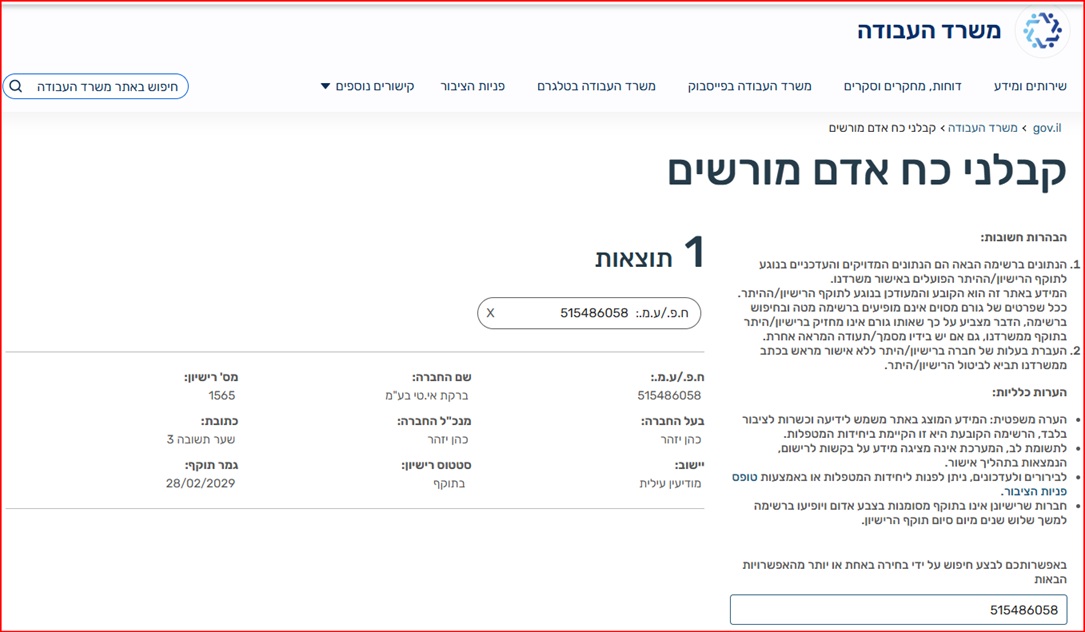
NETO is an automated employment system operating under manpower contractor license number 1565. Regular hours, overtime at 125% and 150%, work during the weekly rest and breaks · all calculated automatically and shown on a clear monthly payslip, with no corners cut.
FAQ
Hours of Work and Rest Law · questions and answers
How long is a working day under the Hours of Work and Rest Law?
Under section 2, a working day shall not exceed eight working hours. On night work, on the day before the weekly rest and on the day before a holiday on which the employee does not work · up to seven working hours. Night work is work of which at least two hours fall between 22:00 and 06:00.
How long is a working week under the Hours of Work and Rest Law?
Under section 3, a working week shall not exceed forty-five working hours. In practice, through extension orders and collective agreements, the customary week is shorter, but the statutory ceiling stays 45. Hours beyond the weekly ceiling count as overtime.
How is overtime paid under the Hours of Work and Rest Law?
Under section 16, for the first two overtime hours on the same day not less than 1¼ of the regular wage is paid (125%), and for each overtime hour after that not less than 1½ of the regular wage (150%). For this purpose, “regular wage” includes all the supplements the employer pays the employee (section 18).
How much is paid for work during the weekly rest?
Under section 17, work during the hours of the weekly rest is paid at not less than 1½ of the employee's regular wage (150%), and in addition the employee receives substitute rest hours under the permit by which they were employed. On a monthly wage the employer may grant at least one and a half hours of rest for each hour of weekly rest worked.
How long is the weekly rest?
Under section 7, the weekly rest is at least thirty-six consecutive hours. For a Jew it includes the Sabbath; for a non-Jew, the Sabbath, Sunday or Friday, according to what is accepted by them. The Minister of Labor may prescribe a shorter rest but not less than twenty-five consecutive hours (section 8).
What break is due and who pays for it?
Under section 20, on a working day of six hours or more work is interrupted for rest and a meal for at least ¾ of an hour, including one consecutive break of at least half an hour. On the day before the weekly rest or a holiday the break is at least half an hour, and shall not exceed three hours. During a break of half an hour or more the employee may leave the workplace, unless required to remain for the work process · in which case the break counts as part of working hours and is paid.
What is the penalty for an employer who violates the Hours of Work and Rest Law?
Under section 26, a person who employed in contravention of the law is liable to a fine of up to fifty lirot for each employee so employed, or up to one month's imprisonment, or both. Obstructing a labor inspector carries a fine of up to fifty lirot or up to two weeks' imprisonment, and a contravention of section 9a carries a fine of 1,000 lirot. Liability also extends to members of management and managers (section 27). The original lira fines were updated by later legislation.
Who does the Hours of Work and Rest Law not apply to?
Under section 30, the law does not apply to police officers and Prison Service staff, state employees whose position requires availability outside regular hours, seafarers and fishing workers, air crew members, employees in management positions or positions requiring a special degree of personal trust, and employees whose conditions of work do not enable supervision of their working and rest hours. In a dispute, the Labor Court decides.
In summary
The Hours of Work and Rest Law, 5711-1951, sets the time limits of work · working day, working week, weekly rest, breaks and overtime pay. With NETO all the rules have been coded into software, and every hour is calculated and paid correctly on every payslip · under manpower contractor license 1565.
- Working day and week · up to 8 hours a day (7 on night work and the day before rest or a holiday), up to 45 hours a week.
- Weekly rest · at least 36 consecutive hours, and between shifts at least 8 hours.
- Overtime · 125% for the first two hours, then 150% · and 150% during the weekly rest.
- Breaks and penalties · ¾ hour from 6 hours of work · penalties for a violator and a duty to keep an hours ledger.
Further reading: Employee rights in Israel · Severance Pay Law · Israeli labor law overview.
Notice: the information on this page is for enrichment only and is not legal advice. The statutory text shown is an unofficial English translation · the binding version is the Hebrew published in the Reshumot. Where needed, consult a lawyer and the official Hebrew source.
Related guides on Israeli labor law
Related pages

Employee rights in Israel
Minimum wage, leave, convalescence, sick pay, pension and severance in one place.
Read more
How it works at NETO
The law requires 6% · at NETO it is 8.33%
6%The employer's duty under the extension order
8.33%What NETO actually contributes
The mandatory pension extension order obliges every employer to contribute 6% of salary to the severance component, and section 14 of the Severance Pay Law applies to that money automatically. NETO contributes the full severance component by default · 8.33% · so the ongoing contribution replaces severance pay in full and no top-up is due when the employment ends. An employer contributing less than 8.33% must top up severance at the end of the employment relationship.
The one exception
Section 14 and the sources in the labour law centre →
A worker who declares they have no active pension fund, in a one-off engagement · there the contribution obligation begins only after six months of work. A worker with an active pension arrangement is entitled from day one, with contributions made retroactively after three months or at the end of the tax year, whichever is earlier.
General information · not legal advice. The binding text is the statute and the extension order themselves.
Test yourself
Five questions from NETO's labour law compendium. Every answer comes with an explanation and a link to the full item.
Need a labour law lawyer?
Tell us briefly what happened. We will understand the picture and connect you with a specialist. There is no commitment, and this is not legal advice from us.
Received · thank you
Your request is saved. We will be in touch to connect you with a suitable lawyer. If it is urgent · +972-8-976-1874.
General information · not legal advice. The binding text is the statute and the ruling themselves.
Before you move on
The information on this page is correct as of the verification date below, and is general by nature. The outcome in a concrete case turns on seniority, sector, the applicable collective agreement and the exact wording of the contract · details a page cannot verify for you.
Content checked against its sources on 3 September 2026Each month we do our best to scan the official sources with AI tools and present the most reliable, up-to-date information.
Labour law centre
Every statute, ruling and figure in one place
This statute is one item in a full compendium · statutes, extension orders, leading rulings and current figures, each with an official source and a verification date, read from both the employer's and the worker's side.
Open the labour law centre