Wage Protection Law in Israel5718-1958 · the statute text with a plain-English explanation, section by section
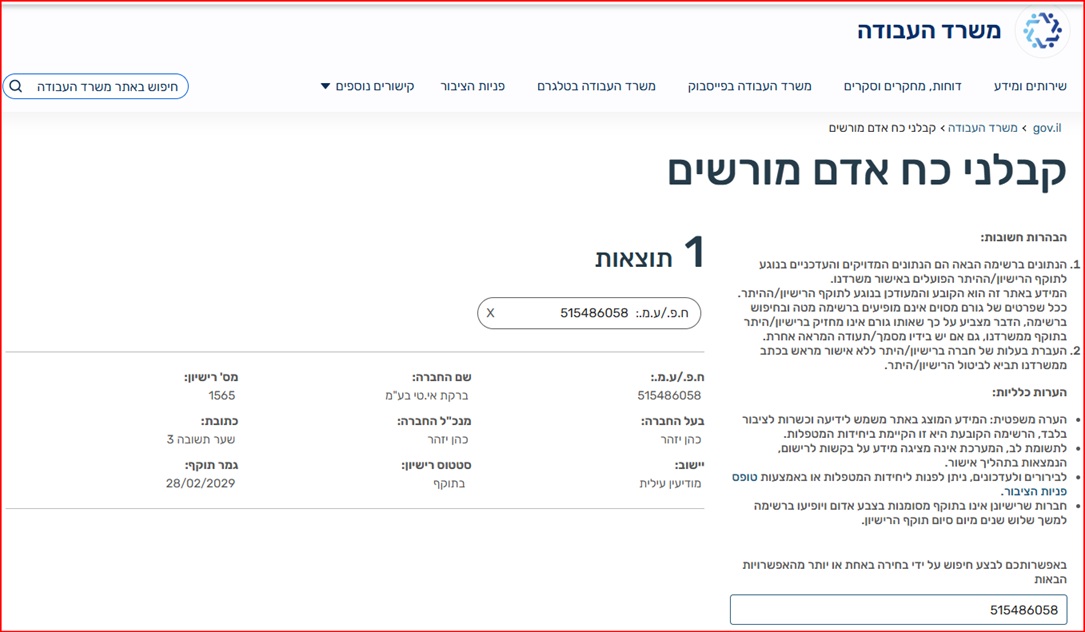
For each topic you get first a faithful English translation of the relevant statutory section (with its original section number) and then a plain-English explanation with a worked example · payment deadlines, delayed-wage compensation, permitted deductions and the payslip duty. NETO is a licensed manpower contractor (license 1565) that pays wages on a compliant payslip under this Law.

Every statute, extension order, ruling and current figure · in one place, each with its source.
AI summary · Wage Protection LawClick to read the page summary
The Wage Protection Law, 5718-1958 protects an employee's wage. It fixes the dates for paying wage (monthly wage is paid at the end of the month, section 9), defines the determining day (the ninth day after the due date) after which unpaid wage becomes delayed wage and accrues compensation for delayed wage (section 17), sets a closed list of permitted deductions (section 25), and requires a detailed payslip under the Schedule (section 24). On this page each topic shows a faithful English translation of the statutory text next to a plain-English explanation, two worked examples and a short knowledge check. The English is unofficial; the Hebrew text is legally authoritative.
- Determining day · the ninth day after the payment due date (section 1).
- Monthly wage is paid at the end of the month for which it is payable (section 9).
- Delayed-wage compensation · added to delayed wage under the section 17 formula.
- Deductions · only the amounts listed in section 25 are allowed.
- Payslip mandatory · with every particular in the Schedule (section 24).
- This page is informational only · the binding text is the Hebrew in the Official Gazette.
The Wage Protection Law in numbers

About the Wage Protection Law
The Wage Protection Law, 5718-1958, is a cornerstone of Israeli labor law. It protects the employee's right to receive their wage on time, in full, and transparently through a payslip · shielding workers from wage theft and late payment. It came into force on 1 April 1958.
The Law sets out when, how and by what deadline wage must be paid, what compensation is due for delayed wage, which deductions are permitted, what a payslip must contain, and the penalties on an employer who breaches it. It sits alongside the other pillars of Israeli employment law · see our guides on employee rights in Israel, the Hours of Work and Rest Law, and mandatory benefits. NETO operates as a licensed manpower company (license 1565), pays wages on a payslip and observes every employee right under the Law.
- Each topic · first the faithful statutory translation, then a plain-English explanation.
- Payment deadlines, delayed wage and delayed pension.
- Payslip, deductions, penalties and preservation of rights.
The statutory text was translated from, and cross-checked against, the consolidated Hebrew version on Nevo. The original Hebrew is the only legally authoritative text.

The figures you have to know
Amounts and deadlines in force today · each with its effective date and source.
The Wage Protection Law · section by section
For each topic, the English translation of the statutory section is shown first (inside the expandable boxes, marked as statute text) · and below it a plain-English explanation in a teal box tagged "Explanation · not part of the statute", with a worked example. The English is unofficial; only the Hebrew text published in the Official Gazette (Reshumot) is legally binding; a consolidated version is available on Nevo.
Wage Protection Law, 5718-1958 (unofficial English translation)
A law governing how and when work wage is paid, the compensation for delayed wage, the permitted deductions, the payslip duty and penalty provisions. It came into force on 11 Nisan 5718 (1 April 1958).
Definitions · section 1 (wage definition)
Section 1 · Definitions
The Wage Protection Law, like every statute, opens with a set of definitions. In this Law:
"wage" (work wage) · including payments for holidays, work productivity and overtime, and other payments due to the employee by reason of, and in the course of, their employment;
"delayed wage" · work wage that has not been paid by the determining day;
"the determining day" · the ninth day following the date for payment of the work wage or the pension under sections 9, 10, 11, 13, 14 and 16(b), as the case may be (and, for a person in service work under Chapter F, Sub-chapter B1 of the Penal Law, 5737-1977 · the twenty-first day following that date);
"index differentials", in respect of a given period · differentials linked to the Consumer Price Index published by the Central Bureau of Statistics, according to the rate of increase of the index from the index last published before the start of the period to the index last published before the end of the period.
The definitions in section 1 are the "dictionary" that runs through the whole Law. Two terms are the heart of it: "wage" · not only the base salary but also the associated payments (holidays, overtime, productivity) due to the employee by reason of their work; and "the determining day" · the ninth day after the wage payment due date. The employer must pay by that day; if they have not, the wage becomes "delayed wage" and starts to accrue delayed-wage compensation under section 17.
Payment deadlines · sections 9 to 11
Section 9 · Date for payment of monthly wage
Work wage paid on the basis of a month shall be paid at the end of the month for which it is payable. In the case of work wage paid on the basis of a period longer than a month, the proportionate part for each month shall be treated as if it were paid on the basis of a month.
Section 10 · Date for payment of wage that is not monthly wage
Work wage paid on the basis of an hour, a day, a week or by quantity of output shall be paid, unless another date has been fixed by a collective agreement or a contract of employment, at the end of the first half of the month in which the employee was employed; however, in respect of an employee whose wage is paid on such a basis but who was employed throughout that month, section 9 shall apply if, during the month, advances were paid to them in accordance with a collective agreement or a contract of employment.
Section 11 · Date for payment of piece-work wage
Work wage paid for the performance of specific work, the performance of which extends over more than fourteen days, shall be paid on the day the work is completed, if advances were paid during the performance of the work in accordance with a collective agreement or a contract of employment. If no such advances were paid, the wage shall be treated as if it were paid by quantity of output.
This is the most practical part · when the wage must be paid. Monthly wage is paid at the end of the month for which it is payable (section 9). Wage on an hourly, daily, weekly or output basis is paid at the end of the first half of the month (section 10), and piece-work wage for work lasting more than 14 days is paid on the day the work is completed (section 11). Remember that non-payment turns into "delayed wage" only after the determining day, the ninth day following these due dates.
Delayed-wage compensation · section 17
Section 17 · Compensation for delayed wage
(a) To the delayed wage shall be added the higher of the following (hereinafter · compensation for delayed wage):
(1) for the first week following the date for payment of the work wage · one twentieth of the delayed wage, and for each week or part of a week thereafter · one tenth of the delayed wage;
(2) index differentials for the period from the date for payment of the work wage until the day of its payment, plus 20% of the total amount of the delayed wage and the said index differentials for each month within that period; for part of a month the said 20% addition shall be paid proportionately.
(b) Compensation for delayed wage shall, for all purposes except this section, be part of the work wage.
Section 17A · Prescription (time bar)
(a) The right to compensation for delayed wage, as distinct from the wage itself, shall be time-barred if a claim is not filed with a regional labor court within one year from the day on which the wage is treated as delayed, or within 60 days from the day the employee received the wage to which the compensation relates, whichever is earlier; however, the regional labor court may extend the 60-day period to 90 days.
(b) Notwithstanding subsection (a), if the employer delayed the employee's wage, in whole or in part, three times within a period of twelve consecutive months falling within the three consecutive years following the day of payment of the wage to which the compensation relates, the period of prescription shall be those three years.
Section 18 · Reduction of compensation
The regional labor court may reduce or cancel compensation for delayed wage if it is satisfied that the wage was not paid on time due to a bona fide mistake, or due to a circumstance over which the employer had no control, or as a result of a genuine dispute about the very existence of the debt · provided that the amount not in dispute was paid on time.
Section 17 is the heart of the Law · the formula for the compensation when an employer delays the wage. The delayed wage is increased by the higher of two methods: (a) a percentage of the wage · one twentieth for the first week and then one tenth for each further week; or (b) index differentials plus 20% per month. Section 17A limits the right in time (prescription · one year, or 60 days from receiving the wage, whichever is earlier), and section 18 lets the court reduce or cancel the compensation for a bona fide mistake or a genuine dispute over the debt.
Payslip & deductions · sections 24 to 25
Section 24 · Wage register and payslip
(a) An employer must keep a wage register and deliver to each employee, in writing, a payslip; in this Law ·
"wage register" · a register of the work wage due to employees and of the particulars of the wage paid to them;
"payslip" · a record of data from the wage register, detailing the particulars of the wage paid to the employee.
(b) The wage particulars in the wage register and in the payslip shall include the particulars listed in the Schedule.
(c) The entry in the wage register and the delivery of the payslip to the employee shall be made no later than the determining day.
(d) The provisions of this section shall not apply to an individual in respect of an employee whom they employ otherwise than in the course of their business or occupation, unless the Minister has provided otherwise for classes of employers or employees.
Section 25 · Deductions from wage
(a) No amounts shall be deducted from work wage except the following:
(1) an amount that must be deducted, or may be deducted, under an enactment;
(2) donations that the employee has consented in writing to have deducted;
(3) membership dues in an employees' organization of which the employee is a member, which are to be deducted under a collective agreement or a contract of employment or which the employee has consented in writing to have deducted, and the regular payments to the works committee;
(4) an amount imposed as a disciplinary fine under a collective agreement or under an enactment;
(5) current payments to provident funds, provided that payments to a provident fund which the employee alone is liable to pay shall not be deducted from their wage if they notified the employer in writing of their objection to paying them;
(6) a debt under a written undertaking from the employee to the employer, provided that no more than one quarter of the work wage shall be deducted on account of such a debt;
(7) advances on account of work wage, if the advances do not exceed the wage for three months; where the advances exceed the wage for three months, paragraph (6) applies to the balance.
(b) Notwithstanding subsection (a), where an employee has ceased to work for the employer, the employer may deduct from the employee's final wage any balance of a debt the employee owes them, including advances.
Section 25B · Penalties (extract)
(a) An employer who does any of the following is liable to half the fine prescribed in section 61(a)(2) of the Penal Law, 5737-1977 ·
(1) fails to deliver to their employee a payslip by the date stated in section 24(c), contrary to section 24(a); an offence under this paragraph is one of strict liability;
(2) delivers to their employee a payslip that does not include the particulars of the wage paid to the employee, in whole or in part, contrary to section 24(b).
(b) An employer who deducted amounts from an employee's wage contrary to section 25 is liable to half the fine prescribed in section 61(a)(3) of the Penal Law.
A payslip is mandatory: the employer must keep a wage register and deliver each employee a written payslip no later than the determining day, with every particular in the Schedule (section 24). Deductions · section 25 is a closed list: the employer may deduct only mandatory statutory amounts, donations agreed in writing, union dues, a disciplinary fine, provident-fund payments, a written debt (up to a quarter of the wage) and advances · any other deduction is prohibited. Failing to deliver a payslip, an incomplete payslip, an unlawful deduction or failing to transfer a deducted amount · these are offences with penalties under section 25B.
Legal notice. The statutory text above is an unofficial English translation provided for information and ease of reading only · it is not legal advice and must not be relied on as such. It was translated from and cross-checked against the consolidated Hebrew version on Nevo. The only legally binding text is the original Hebrew as published in the Official Gazette (Reshumot), which may contain later amendments and updates; where the translation and the Hebrew differ, the Hebrew prevails. For any legal use, consult the official Hebrew text and a lawyer. See also the authoritative Hebrew page.
Continue from here
Three ways to go deeper · pick what fits you now.
Two worked examples
Two illustrative examples only · compensation for delayed wage under section 17, and a gross-to-net wage calculation using the deductions permitted by section 25. The actual result depends on the precise figures.
Example 1 · Compensation for delayed wage (section 17)
Example 2 · From gross to net (section 25)
Automate payroll & payslips with NETO
NETO automatically generates legally compliant payslips and ensures on-time wage payment every month · under manpower contractor license #1565, supervised by the Ministry of Labor. The client company pays a 5% commission on the invoice (pre-VAT); nothing is ever charged to the worker. No setup fees, no minimums.
Test your knowledge · Wage Protection Law
Five short questions on the essentials of the Law. Pick an answer for each · you will see straight away whether you were right, with the relevant section.
1 What is the "determining day" under section 1?
Correct · the "determining day" is the ninth day following the wage payment due date; after it, unpaid wage becomes "delayed wage".
2 When is monthly wage paid under section 9?
Correct · monthly wage is paid at the end of the month for which it is payable (section 9). Hourly or weekly wage is paid at the end of the first half of the month (section 10).
3 How is compensation for delayed wage calculated under section 17?
Correct · the delayed wage is increased by the higher of: one twentieth for the first week then one tenth per week, or index differentials plus 20% per month.
4 Which deductions may be made from wage under section 25?
Correct · section 25 is a closed list · mandatory statutory deductions, donations agreed in writing, union dues, a disciplinary fine, provident funds, a written debt (up to a quarter of the wage) and advances.
5 By when must the employer deliver a payslip under section 24?
Correct · the payslip must be delivered to the employee no later than the determining day (section 24(c)). Non-delivery or an incomplete payslip is an offence under section 25B.

Freelancers: guaranteed on-time payments
The Wage Protection Law protects employees · classic freelancers invoicing clients directly fall outside it. Through NETO's EOR model you get the best of both worlds: your wage is paid on time, every time, with a legally compliant payslip, full social benefits, and zero administrative burden on your side.
New to the model? Start with salary payment by invoice and working worry-free with NETO.
Wage Protection Law · frequently asked questions
Is this English text the official version of the Wage Protection Law?
What is the "determining day" under the Wage Protection Law?
When must monthly salary be paid in Israel?
How is compensation for delayed wage calculated under section 17?
Which deductions from wage are permitted under section 25?
Must an employer provide a payslip in Israel?
Related guides on Israeli labor law
 Employee Rights in IsraelEvery right an Israeli employee has, in one guide.Read more
 Hours of Work & Rest LawWorking hours, overtime, and weekly rest, explained.Read more
 Mandatory Benefits in IsraelPension, leave, and every benefit the law requires.Read more
 Severance Pay LawWhen severance is due and how it is calculated.Read more
Pension ContributionsEmployer and employee pension duties in Israel.Read more
Severance Pay LawWhen severance is due and how it is calculated.Read more
Pension ContributionsEmployer and employee pension duties in Israel.Read more
 Termination Process in IsraelHearings, notice, and final payments done right.Read more
 Israel Payroll GuidePayslips, withholding, and reporting in Israel.Read more
 Employer Cost in IsraelWhat an employee really costs beyond gross salary.Read more
 Online Payslip in IsraelRead and verify every line of your payslip.Read more
Employer of Record in IsraelEmploy workers in Israel without a local entity.Read more
Online Payslip in IsraelRead and verify every line of your payslip.Read more
Employer of Record in IsraelEmploy workers in Israel without a local entity.Read more
 Contractor vs EmployeeClassification in Israel and why it matters.Read more
The law requires 6% · at NETO it is 8.33%
The mandatory pension extension order obliges every employer to contribute 6% of salary to the severance component, and section 14 of the Severance Pay Law applies to that money automatically. NETO contributes the full severance component by default · 8.33% · so the ongoing contribution replaces severance pay in full and no top-up is due when the employment ends. An employer contributing less than 8.33% must top up severance at the end of the employment relationship.
A worker who declares they have no active pension fund, in a one-off engagement · there the contribution obligation begins only after six months of work. A worker with an active pension arrangement is entitled from day one, with contributions made retroactively after three months or at the end of the tax year, whichever is earlier.
General information · not legal advice. The binding text is the statute and the extension order themselves.
Test yourself
Five questions from NETO's labour law compendium. Every answer comes with an explanation and a link to the full item.
Need a labour law lawyer?
Tell us briefly what happened. We will understand the picture and connect you with a specialist. There is no commitment, and this is not legal advice from us.
Received · thank you
Your request is saved. We will be in touch to connect you with a suitable lawyer. If it is urgent · +972-8-976-1874.
General information · not legal advice. The binding text is the statute and the ruling themselves.
Before you move on
The information on this page is correct as of the verification date below, and is general by nature. The outcome in a concrete case turns on seniority, sector, the applicable collective agreement and the exact wording of the contract · details a page cannot verify for you.
Every statute, ruling and figure in one place
This statute is one item in a full compendium · statutes, extension orders, leading rulings and current figures, each with an official source and a verification date, read from both the employer's and the worker's side.
Open the labour law centre