Israeli Labor Law at a GlanceEmployee rights & employer obligations · from first hire to termination
Israeli labor law covers every stage of employment: the written contract within 30 days, minimum wage of ₪6,443.85/month, mandatory pension contributions, annual leave, sick pay, and the hearing required before any dismissal. Here is the whole picture in one guide · for employers and employees alike.

Every statute, extension order, ruling and current figure · in one place, each with its source.
AI summary · Israeli labor law at a glanceClick to read the page summary
Israeli labor law is a set of statutes and collective extension orders that protect employees from the first day of work to termination. The core rules: a minimum wage of ₪6,443.85/month (₪35.40/hour) under the Minimum Wage Law; a work day and week capped by the Hours of Work and Rest Law, with overtime at 125% then 150% and a weekly rest of at least 36 hours; on-time wages and a lawful payslip under the Wage Protection Law; mandatory pension of 18.5% under the extension order; severance of one month per year under the Severance Pay Law; a mandatory pre-dismissal hearing plus advance notice; and paid annual leave and sick days. Each topic below quotes the governing Hebrew statute in unofficial English, then explains it in plain language with an example.
- Minimum wage · ₪6,443.85/month, ₪35.40/hour (Minimum Wage Law).
- Hours · day up to 8h, week up to 45h; overtime 125% then 150%.
- Weekly rest · at least 36 consecutive hours; 150% for rest-day work.
- Wages & payslip · paid at month end, written payslip mandatory.
- Pension · 6% + 6.5% + 6% severance = 18.5% under the extension order.
- Ending work · hearing + notice + severance (one month per year).
- The law in numbers
- What is Israeli labor law?
- Employer obligations
- Employment agreement & Form 101
- Minimum wage
- Working hours & overtime
- Rest days & weekly rest
- Wages & payslip
- Pension contributions
- Severance pay
- Notice & dismissal
- Annual leave & sick days
- Two worked examples
- Test your knowledge
- Frequently asked questions
Israeli labor law in numbers

What is Israeli labor law?
Israeli labor law is a body of laws, regulations, and collective extension orders governing the relationship between employees and employers. Its main purpose is to protect employee rights and ensure fair employment conditions across all employment types · salaried employees, contractor employees, and temporary workers.
Sectoral extension orders expand rights in specific industries, on top of the key statutes:
- Minimum Wage Law, 1987 · Hebrew: wage protection / Nevo
- Hours of Work and Rest Law, 1951 · Hebrew: ("חוק שעות עבודה ומנוחה")
- Wage Protection Law, 1958 · Hebrew: ("חוק הגנת השכר")
- Severance Pay Law, 1963 · Hebrew: ("חוק פיצויי פיטורים")
- Annual Leave Law, 1951 · Nevo
- Sick Pay Law, 1976 · Advance Notice Law, 2001 · Mandatory Pension Extension Order

Employer obligations · rights & duties
When an employer-employee relationship exists, Israeli labor law imposes extensive obligations on the employer. The employer must open a withholding tax file with the tax authorities and National Insurance, and every month submit reports and payments to National Insurance (Bituach Leumi), income tax, and pension companies.
Register with the tax authorities and National Insurance before running the first payroll.
Reports and payments to National Insurance, income tax, and pension companies · every month.
Issue a monthly payslip, make pension contributions, and comply with all labor laws.
The recruitment process begins with posting a job vacancy and ends with full onboarding · there are places where employers can post job listings for free. Proper management of all employee rights is essential to avoid legal violations and fines. Not sure whether your worker is an employee at all? Misclassifying an employee as a contractor is one of the costliest mistakes in Israeli employment · see the contractor vs employee guide.
Example · your first hire, step by step
A small studio hires its first employee, starting on the 1st of the month. The owner's compliance timeline under Israeli labor law looks like this:
- Before the first payroll: open a withholding tax file with the tax authorities and National Insurance.
- Within 30 days: give the employee a written employment agreement, and have them complete Form 101.
- From day one: track attendance daily · clock-in and clock-out times are the basis for salary, overtime, vacation and sick days.
- Every month: issue a detailed payslip and report to National Insurance, income tax, and the pension company.
- Pension: if the new employee already has an active pension fund, contributions begin after 3 months of work · retroactively from the first day. If not, they begin after 6 months.
Miss any of these and the employer is exposed to fines and lawsuits · which is exactly the paperwork NETO takes over for you.
Employment agreement & Form 101
Two documents anchor every new hire in Israel: the written employment agreement and the employee's tax form.
Every employer must provide a written employment agreement within 30 days of the start of employment. It must include:
- Job description · responsibilities and the direct supervisor
- Work days and hours · scope of position
- Salary and conditions · gross salary, components, social benefits
- Contributions · pension insurance and severance details
- Collective agreement · if the sector is subject to one, it must be stated and followed
Form 101 is mandatory for every employee, completed within 30 days of starting work. It determines income tax credit points and the tax calculation.
- Renewed and re-signed every year at the start of the tax year
- Tax credit points are determined by the personal data on the form
- Special benefits require documents · new immigrants, priority-area residents, disabled persons, discharged soldiers, degree holders
Employees with more than one income source should also check tax coordination.
Minimum wage · Minimum Wage Law, 1987
The statute that sets the floor on pay. The figures below are confirmed for 2026.
"An employee who has completed the age of 18 and is employed on a full-time basis is entitled to receive from his employer a wage that is no less than the minimum wage per month; an employee paid on an hourly basis is entitled to no less than the minimum hourly wage."
Summary translation of the Minimum Wage Law, 5747-1987, s. 2. Authoritative text: Hebrew (Reshumot; consolidated on Nevo).
The minimum wage is the lowest pay allowed by law and applies to every employee, without exception. As of 2026 it is ₪6,443.85 gross per month for a full-time role, and ₪35.40 per hour. Part-time pay is pro-rated, but the hourly rate can never drop below ₪35.40. These are floors set by statute, updated periodically by law; sectoral extension orders may set a higher figure, never a lower one.
| Basis | Minimum wage (2026) | Notes |
|---|---|---|
| Monthly (full-time) | ₪6,443.85 | Gross, full-time position |
| Hourly | ₪35.40 | Applies to all hourly employees |
| Part-time | Pro-rated | By actual hours · never below ₪35.40/hour |
The figures you have to know
Amounts and deadlines in force today · each with its effective date and source.
Working hours & overtime · Hours of Work and Rest Law, 1951
Work day (s. 2): "A work day shall not exceed eight hours; on night work, and on the day before the weekly rest or before a festival, it shall not exceed seven hours."
Work week (s. 3): "A work week shall not exceed forty-five hours."
Overtime pay (s. 16): "For the first two overtime hours on a given day the employer shall pay not less than 1¼ of the regular wage, and for each additional overtime hour not less than 1½ of the regular wage." Under s. 18, the "regular wage" for this calculation includes every supplement the employer pays.
Summary translation of the Hours of Work and Rest Law, 5711-1951, ss. 2, 3, 16, 18. Authoritative text: Hebrew (Reshumot; consolidated on Nevo).
The statute caps the work day at 8 hours and the work week at 45 hours. Anything beyond the cap is overtime, paid at 125% for the first two hours each day and 150% thereafter. In practice, extension orders shortened the customary week to 42 hours (about 182 hours a month), so many payslips compute overtime beyond that lower threshold. Crucially, overtime is calculated on the "regular wage" including fixed supplements, not on base pay alone.
Weekly rest · Hours of Work and Rest Law, 1951
Weekly rest (s. 7): "The weekly rest shall be at least thirty-six consecutive hours. For a Jewish employee it shall include the Sabbath; for a non-Jewish employee it shall include the Sabbath, Sunday or Friday, according to the day of rest observed by that employee."
Work on the weekly rest (s. 17): "An employee employed during the weekly rest, or part of it, shall be paid not less than 1½ of his regular wage, and shall in addition be given compensatory hours of rest as fixed in the permit under which he was employed."
Summary translation of the Hours of Work and Rest Law, 5711-1951, ss. 7, 17. Authoritative text: Hebrew (Reshumot; consolidated on Nevo).
Every employee is entitled to a continuous weekly rest of at least 36 hours. Employing someone during that rest is only allowed with a permit, and when it happens the employee earns two things together: at least 150% pay for those hours and compensatory rest hours. Employers may not simply "buy out" the rest day at ordinary rates.
Wages & payslip · Wage Protection Law, 1958
Time of payment (s. 9): "Wages paid on a monthly basis shall be paid at the end of the month for which they are due." Wages unpaid by the ninth day after that date become "delayed wages", carrying a delay-of-wages penalty.
Payslip (s. 24): "An employer must keep a wage ledger and give every employee a written payslip; the ledger entry and the payslip shall be provided not later than the determined day, and shall include the particulars listed in the Schedule to the Law."
Deductions (s. 25): "No sums shall be deducted from wages other than those specified" in the Law, such as sums a statute requires or permits to be deducted.
Summary translation of the Wage Protection Law, 5718-1958, ss. 9, 24, 25. Authoritative text: Hebrew (Reshumot; consolidated on Nevo).
Monthly wages must be paid by the end of the month, and a detailed written payslip is mandatory every month, no later than the 9th of the following month. The payslip has to show the statutory particulars: pay components, hours, leave and sick balances, and every deduction. Deductions are closed-list: only amounts the law allows (income tax, National Insurance, pension, and specific agreed items) may be taken off.
Mandatory pension · Pension Extension Order
Pension is not set by a Knesset statute but by a general collective extension order that binds every employer in Israel.
"Every employee shall be insured under a comprehensive pension arrangement. The employer shall contribute to the pension savings, the employer shall contribute in respect of severance, and the employee shall contribute from his wage, at the rates fixed in the order."
Current contribution rates: employee 6%, employer 6.5% to pension, and employer 6% in respect of severance · a total of 18.5% of the insured wage.
Summary of the general Extension Order for Comprehensive Pension Insurance in the Economy. Authoritative text: Hebrew (Reshumot; consolidated on Nevo).
Every employer must pay into the pension fund the employee chooses. Timing depends on the employee's pension status: with an active fund, contributions start after 3 months of work, retroactively to day one; without one, after 6 months. Together the deposits come to 18.5% of wage (6% + 6.5% + 6%). The 6% severance portion links to Section 14 of the Severance Pay Law, below.
Severance pay · Severance Pay Law, 1963
Right to severance (s. 1): "A person who has worked one year continuously with one employer, or at one workplace, and is dismissed, is entitled to severance pay from the employer who dismissed him."
Rate (s. 12): "The rate of severance pay is one month's wage for each year of employment for a monthly-paid employee; part of a year entitles to a proportional amount."
Fund in lieu (s. 14): "Payment to a provident fund, pension fund or similar fund shall not be in place of severance pay, unless so provided by the applicable collective agreement, or approved by the Minister of Labor, and to the extent so provided or approved."
Summary translation of the Severance Pay Law, 5723-1963, ss. 1, 12, 14. Authoritative text: Hebrew (Reshumot; consolidated on Nevo).
An employee dismissed after one continuous year is entitled to severance of one month's last wage per year of service (about 8.33% of pay accrued each year). Under Section 14, the monthly 6% severance deposit into the pension fund can replace the lump sum, and then the fund passes to the employee at the end of employment even on resignation. Certain resignations (health, relocation, a serious worsening of terms) are treated as dismissal for severance purposes.
The law requires 6% · at NETO it is 8.33%
The mandatory pension extension order obliges every employer to contribute 6% of salary to the severance component, and section 14 of the Severance Pay Law applies to that money automatically. NETO contributes the full severance component by default · 8.33% · so the ongoing contribution replaces severance pay in full and no top-up is due when the employment ends. An employer contributing less than 8.33% must top up severance at the end of the employment relationship.
A worker who declares they have no active pension fund, in a one-off engagement · there the contribution obligation begins only after six months of work. A worker with an active pension arrangement is entitled from day one, with contributions made retroactively after three months or at the end of the tax year, whichever is earlier.
General information · not legal advice. The binding text is the statute and the extension order themselves.
Continue from here
Three ways to go deeper · pick what fits you now.
Notice & dismissal · Advance Notice Law, 2001
"An employer wishing to dismiss an employee, and an employee wishing to resign, shall give advance notice in accordance with this Law."
Notice period (s. 3): "For a monthly-paid employee: during the first year of work, one day of notice for each of the first six months and two and a half days for each additional month; from the second year of work onward, notice of one month."
Summary translation of the Advance Notice of Dismissal and Resignation Law, 5761-2001, ss. 2, 3. Authoritative text: Hebrew (Reshumot; consolidated on Nevo).
Both sides must give advance notice, growing with seniority to a full month from the second year. Separately, Israeli labor-court case law (not this statute) requires the employer to hold a hearing (shimua) before dismissing: a written invitation stating the reasons, and a real chance for the employee to respond. Dismissal without a genuine hearing can be ruled unlawful and carry extra compensation. Order of events: hearing, termination or resignation letter, notice period, final settlement (leave redemption and recreation pay), release of pension and severance funds, and an employment certificate (Form 161).
Annual leave & sick days · Annual Leave Law & Sick Pay Law
"The length of annual leave for each year of work with the same employer, or at the same workplace, is fixed by the seniority table in the Law, and increases with years of service. Leave that is not taken may be accumulated within the limits set by the Law, and on termination the unused balance is redeemed in cash."
Summary translation of the Annual Leave Law, 5711-1951, s. 3. Authoritative text: Hebrew (Reshumot; consolidated on Nevo).
Payment (s. 2): "For the first day of illness, no sick pay is paid; for the second and third days, sick pay at 50% of the wage; from the fourth day of illness onward, sick pay at 100% of the wage."
Accrual (s. 4): "An employee accrues one and a half days of sick leave for each month of work, up to a total of 90 days."
Summary translation of the Sick Pay Law, 5736-1976, ss. 2, 4. Authoritative text: Hebrew (Reshumot; consolidated on Nevo).
Paid annual leave follows a seniority table and accrues monthly; unused days can accumulate within limits and are paid out as leave redemption on termination. Sick days accrue at 1.5 per month (up to 90) and need a medical certificate: day 1 is unpaid, days 2 and 3 pay 50%, and from day 4 pay 100%. Recreation pay (dmei havra'ah) and travel reimbursement are added by separate extension orders.
Two worked examples
Numbers put the statutes together. Both examples are for illustration only; the real figure depends on the actual pay components and regulations.
Example 1 · overtime on one work day
An hourly employee at the minimum wage of ₪35.40/hour works an 11-hour day. The statutory day is 8 hours (Hours of Work and Rest Law, s. 2), so 3 hours are overtime, paid under s. 16:
Overtime is computed on the "regular wage", which under s. 18 includes every supplement the employer pays.
Example 2 · severance after 4.5 years
A monthly employee on a final wage of ₪10,000 is dismissed after 4 years and 6 months. The rate is one month's wage per year of service (Severance Pay Law, s. 12), with a proportional part for the half year:
Where Section 14 applies, most of this sits in the pension/severance fund and passes to the employee at the end of employment.
Israeli labor law · quick quiz
Five short questions on the core rules. Pick an answer in each; you get instant feedback and the governing law.
1 What is the 2026 monthly minimum wage for a full-time role?
Correct · under the Minimum Wage Law the full-time monthly minimum is ₪6,443.85 (₪35.40/hour), applying to every employee.
2 How is overtime paid under the Hours of Work and Rest Law?
Correct · section 16 sets 125% for the first two overtime hours each day and 150% for each hour after that.
3 What is the minimum weekly rest?
Correct · section 7 sets a weekly rest of at least 36 consecutive hours, including the Sabbath for a Jewish employee.
4 When does a monthly salary become "delayed wages"?
Correct · under the Wage Protection Law, monthly pay is due at month end and becomes "delayed wages" if unpaid by the ninth day after.
5 What is the total mandatory pension contribution rate?
Correct · the extension order sets employee 6%, employer 6.5% pension and 6% severance, totalling 18.5% of the insured wage.
All labor law handled · you just start
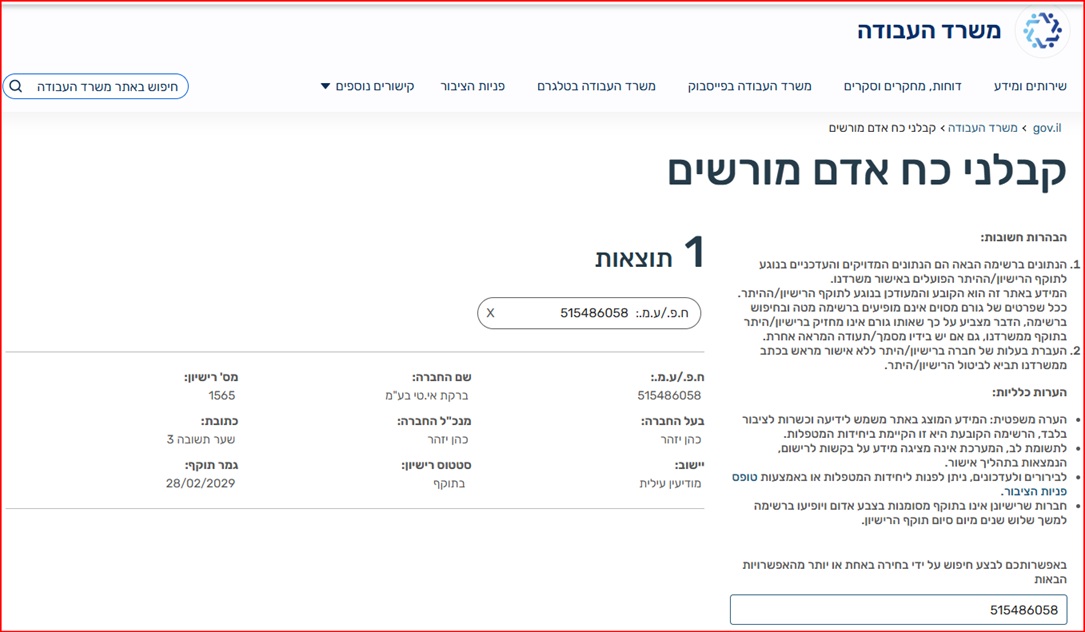
Payroll calculations, payslips, pension contributions, reporting to the authorities, severance · NETO manages the entire employment process from A to Z, under manpower contractor license #1565, supervised by the Ministry of Labor, since 2016. The client company pays a 5% commission on the invoice (pre-VAT); nothing is ever charged to the worker.
Israeli labor law · frequently asked questions
What is the current minimum wage in Israel?
How long does the employer have to provide an employment agreement?
What pension contributions is an employer required to make?
How many vacation days is an employee entitled to?
Is a pre-dismissal hearing mandatory?
What happens when an employee is sick?
What is overtime and how is it calculated?
When is recreation pay paid and who is entitled to it?
More information on Israeli labor law
 Employee Rights in IsraelEvery right an Israeli employee has, in one guide.Read more
 Employer Rights in IsraelWhat employers may require, monitor and decide.Read more
Hours of Work & Rest LawWorking hours, overtime, and weekly rest, explained.Read more
Employer Rights in IsraelWhat employers may require, monitor and decide.Read more
Hours of Work & Rest LawWorking hours, overtime, and weekly rest, explained.Read more
 Wage Protection LawOn-time salary, payslips, and legal deductions.Read more
 Severance Pay LawWhen severance is due and how it is calculated.Read more
 Pension ContributionsEmployer and employee pension duties in Israel.Read more
 Termination Process in IsraelHearings, notice, and final payments done right.Read more
 Temporary Employee RightsThe rights of temps and contractor employees.Read more
 Travel Expense ReimbursementWhat employers must pay for the commute.Read more
 Contractor vs EmployeeClassification in Israel and why it matters.Read more
Tax Coordination for EmployeesWorking two jobs? Avoid maximum withholding.Read more
Employer Cost in IsraelWhat an employee really costs beyond gross salary.Read more
Contractor vs EmployeeClassification in Israel and why it matters.Read more
Tax Coordination for EmployeesWorking two jobs? Avoid maximum withholding.Read more
Employer Cost in IsraelWhat an employee really costs beyond gross salary.Read more
 Israel Payroll GuidePayslips, withholding, and reporting in Israel.Read more
 Employer of Record in IsraelEmploy workers in Israel without a local entity.Read more
Hire Israeli Employees EasilyFrom offer to payslip · without the bureaucracy.Read more
Employer of Record in IsraelEmploy workers in Israel without a local entity.Read more
Hire Israeli Employees EasilyFrom offer to payslip · without the bureaucracy.Read more
Test yourself
Five questions from NETO's labour law compendium. Every answer comes with an explanation and a link to the full item.
Need a labour law lawyer?
Tell us briefly what happened. We will understand the picture and connect you with a specialist. There is no commitment, and this is not legal advice from us.
Received · thank you
Your request is saved. We will be in touch to connect you with a suitable lawyer. If it is urgent · +972-8-976-1874.
General information · not legal advice. The binding text is the statute and the ruling themselves.
Before you move on
The information on this page is correct as of the verification date below, and is general by nature. The outcome in a concrete case turns on seniority, sector, the applicable collective agreement and the exact wording of the contract · details a page cannot verify for you.
Every statute, ruling and figure in one place
This statute is one item in a full compendium · statutes, extension orders, leading rulings and current figures, each with an official source and a verification date, read from both the employer's and the worker's side.
Open the labour law centre