Salary Payment by Invoice in Israel: When It Works and When It Doesn't
Paying for work by invoice can be perfectly fine · or a costly mistake. Here's how to tell the difference, stay compliant with Israeli law, and choose payroll or an EOR when that's the right call.
AI summary Smart overview of this page · click hereClick to read the page summary
Salary payment by invoice means paying someone against an invoice instead of running them through payroll. In Israel this is fine for a genuinely independent contractor, but paying an actual employee this way is misclassification, with retroactive liability for social rights and severance. Classification follows the substance of the relationship, not the contract label, so employee-like roles belong on payroll or an Employer of Record.
- When invoice payment may fit, and when payroll is required instead.
- How to decide using the substance test, not the contract label.
- The misclassification risk: retroactive social rights, severance and penalties.
- A payslip vs pure invoice vs NETO salary-by-invoice comparison.
- How to invoice compliantly without opening a business.
This summary is based on the page content. It is not legal, tax or accounting advice.
Summary · salary payment by invoice in Israel
Salary payment by invoice means paying someone against an invoice instead of running them through payroll. In Israel it is fine for a genuine independent contractor · but paying an actual employee this way is misclassification, with retroactive liability for social rights and severance.
- Invoice is fine for a genuine, independent contractor or one-off service.
- Employee-like roles (set hours, your tools, exclusive, ongoing) belong on payroll.
- Classification follows the substance of the relationship, not the contract label.
- For a foreign company, an Employer of Record (EOR) is the compliant route.
- Through NETO a worker can invoice without opening a business and still get a payslip with full rights.
Quick answer
Paying a genuinely independent contractor by invoice is legal. Paying someone who is effectively an employee by invoice · to avoid employer obligations · is misclassification, and exposes the company to retroactive social rights, severance and penalties.
If the role is ongoing, exclusive, or you control how and when the work is done, use payroll or an Employer of Record (EOR). A worker who simply wants to invoice without opening a business can still do so compliantly through NETO and receive a payslip with full rights.
When salary payment by invoice may fit
Invoice payment is appropriate when the worker is a real, independent business · not an employee in disguise.
- The worker runs their own business, sets their own hours and uses their own tools.
- The engagement is project-based or occasional · not a permanent, full-time role.
- The worker serves multiple clients and isn't economically dependent on you alone.
- There is no subordination: you buy a result, not day-to-day control over the person.
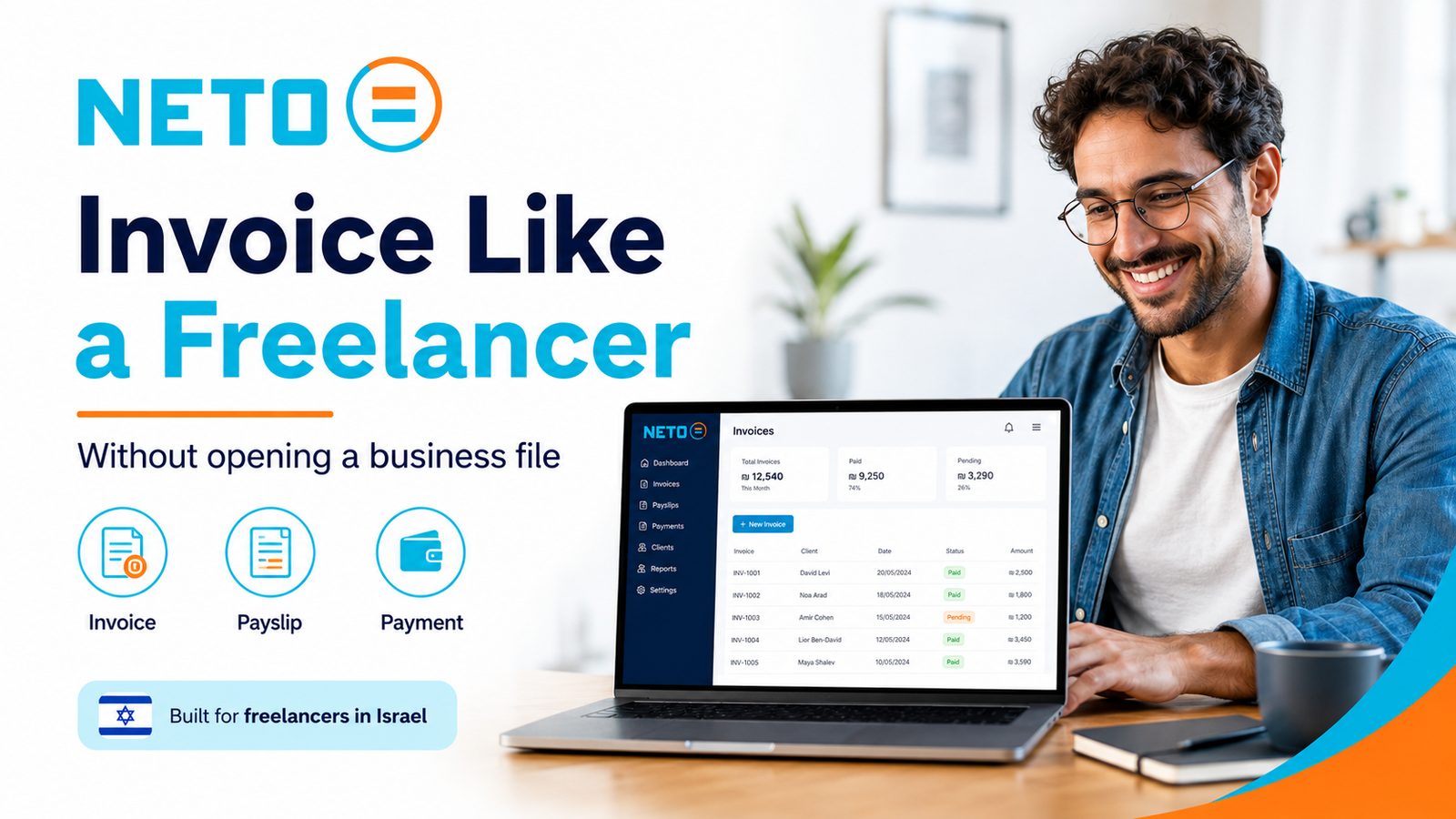
A worker who wants to invoice but doesn't have a registered business can use a payroll platform such as NETO to issue a one-time invoice and still receive a compliant payslip.
How to decide: the substance test
In Israel, classification follows the substance of the relationship, not the label on the contract or the fact that an invoice was issued.
Who decides hours, place and method? Heavy control points to employment.
Is the worker integrated into your business and reliant on you for most income?
Ongoing, exclusive, full-time work looks like a job, not a one-off service.
Comparison: payslip vs pure invoice vs NETO salary-by-invoice
Three ways to pay for work in Israel · and how each one handles rights, risk and admin.
| Factor | Employee payslip (payroll) | Pure invoice (own business) | NETO salary-by-invoice |
|---|---|---|---|
| Open a tax file / business | Not needed · employer runs payroll | Required (Income Tax & VAT) | Not needed |
| Payslip & social rights | Provided by law | Not provided | Provided · employed by NETO |
| National Insurance & pension | Handled by employer | Entirely on the worker | Deducted & remitted by NETO |
| Fits an ongoing / exclusive role | Yes | Misclassification risk | Yes · worker is employed |
| Misclassification exposure | None | High if employee-like | None · genuine employment |
| Admin & bookkeeping | Employer payroll setup | Accountant, reports, filings | NETO handles it |
| Best for | Direct employees | Established independent businesses | Invoice without opening a business |
Two examples
Invoice may fit
A graphic designer with several clients delivers a one-off logo project, works on her own schedule and tools, and bills you once. This is a genuine independent service · an invoice (or a NETO payslip-invoice) is appropriate.
Payroll / EOR required
A developer works full-time, only for you, on your laptop, on hours you set, for many months. Paying "by invoice" here is misclassification. Put them on payroll · or, for a foreign company, use an EOR.
How to set up payment by invoice · the compliant way
Four steps to pick the right route and keep the arrangement defensible.
Look at control, economic dependence and continuity. Employee-like signs mean it should be payroll · not an invoice.
Genuine one-off service · invoice may fit. Ongoing or employee-like role · payroll, or an EOR for a foreign company.
NETO employs the worker on payroll and issues a compliant payslip, while the company receives one consolidated invoice. No business needed to invoice.
Keep the agreement, work order and invoices on file so the classification can be supported if it is ever reviewed by a labor court or the National Insurance Institute.
Invoice without opening a business
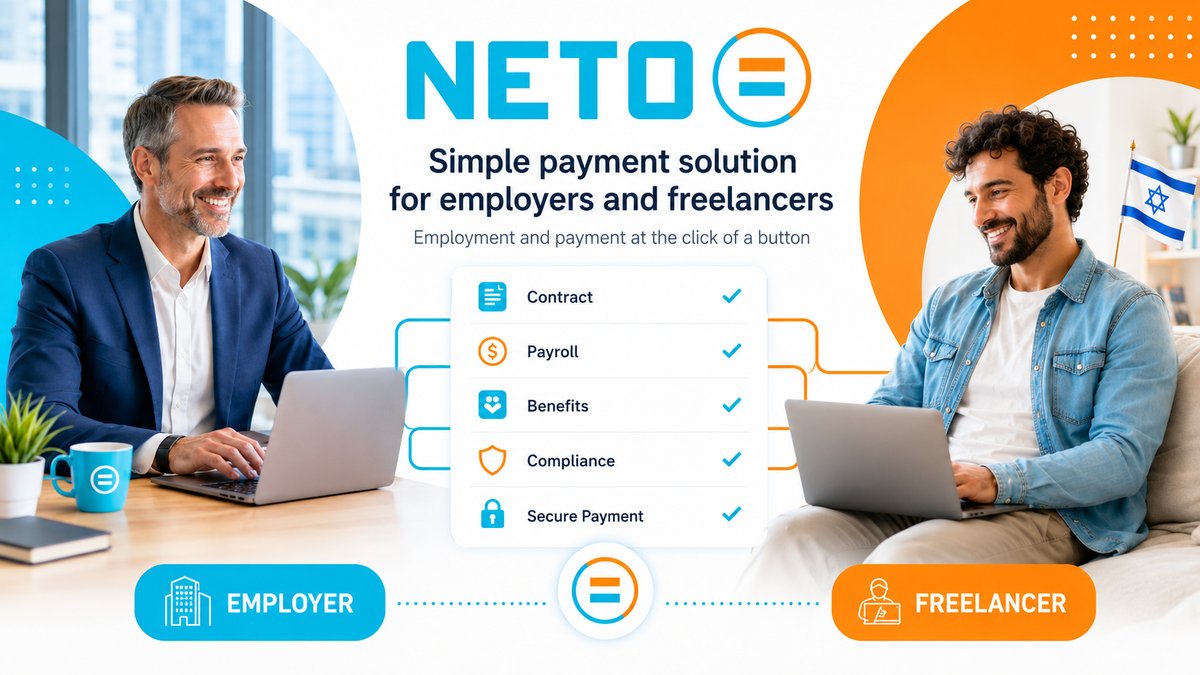
A worker who wants to invoice a client · but has no registered business · can work through NETO as an employee. NETO issues the invoice to the client, receives payment, and pays the worker with a compliant payslip including National Insurance, pension and full social rights.
- The company gets a single, clean invoice · no contractor risk.
- The worker gets a payslip and full rights · no bookkeeping.
- For foreign companies, the same works through an EOR.
Watch · how you get paid through NETO
Two minutes that show exactly what happens from signup to payslip · before you commit to anything.
Frequently asked questions
Can a salaried person issue an invoice in Israel?
Is it legal to pay staff by invoice?
What is the misclassification risk?
How does NETO help?
Official sources
Summary · salary payment by invoice in Israel
Paying by invoice is a legitimate way to pay a genuine independent contractor for a real, self-directed service. The moment the relationship becomes employee-like · set hours, your tools, exclusivity, an ongoing role · paying "by invoice" turns into misclassification, and the company can be liable retroactively for social rights, severance and penalties if a labor court or the National Insurance Institute reclassifies the worker. Because Israeli classification follows the substance of the relationship rather than the contract label, the safe path for ongoing or employee-like work is an employee payslip, or an Employer of Record for foreign companies. Through NETO, a worker can invoice a client without opening a business and still receive a compliant payslip with full rights, while the company gets one consolidated invoice. When in doubt, document the decision · or let NETO run compliant employment for you. This guide is general information, not legal or tax advice.
Not sure which route you need?
Tell us about the role and we'll point you to the compliant setup · invoice, payroll, or EOR · and handle it end to end.
The law requires 6% · at NETO it is 8.33%
The mandatory pension extension order obliges every employer to contribute 6% of salary to the severance component, and section 14 of the Severance Pay Law applies to that money automatically. NETO contributes the full severance component by default · 8.33% · so the ongoing contribution replaces severance pay in full and no top-up is due when the employment ends. An employer contributing less than 8.33% must top up severance at the end of the employment relationship.
A worker who declares they have no active pension fund, in a one-off engagement · there the contribution obligation begins only after six months of work. A worker with an active pension arrangement is entitled from day one, with contributions made retroactively after three months or at the end of the tax year, whichever is earlier.
General information · not legal advice. The binding text is the statute and the extension order themselves.