Employee vs Contractor in Israel · The Mixed Test & Misclassification Risk
Working as a freelancer does not automatically rule out an employer-employee relationship. Israel's labour courts look at the substance, not just the contract. This 2026 guide covers the mixed test, the integration test, the real danger of misclassification for businesses, and how NETO's manpower model removes the risk entirely.
AI Summary Smart overview of this page · click hereClick to read the page summary
In Israel, whether someone is an employee or a contractor is decided by substance, not by the label in the contract. The labour court applies the mixed test, whose main component is the integration test, alongside supervision, working hours, place of work, tools, personal service, registration and payment, and the duration of the engagement. A worker engaged as a freelancer can be recognized as an employee retroactively from the first day · exposing the business to back-payment of severance and pension, interest, fines and public rulings. National Insurance applies its own separate tests. The clean way out for both sides is to work through NETO, a licensed manpower contractor (#1565): the client receives a proper invoice, NETO employs the worker on a payslip and carries the employer-employee responsibility · so nobody carries misclassification risk.
This summary is generated from the page content and the linked sources · full detail below. It is not legal advice.
Guide Summary
The essentials on employee vs contractor status in Israel · for every business owner and every freelancer, in brief:
- The relationship is decided by substance, not by the label in the contract.
- The main tool is the mixed test · centred on the integration test.
- A freelancer recognized as an employee is entitled to full derived rights.
- Misclassification can be found retroactively · with back-pay and fines.
- National Insurance applies its own separate tests · check them too.
- Working via NETO (manpower, licence #1565) removes the risk for both sides.
Table of Contents
- What Is Employee vs Contractor Status?
- Why Misclassification Is Dangerous for Businesses
- How the Law Defines the Relationship
- The Mixed Test · The Integration Test
- The Additional Tests
- National Insurance · Separate Tests
- Three Ways to Engage · Who Carries the Risk
- How NETO Removes the Risk
- Frequently Asked Questions
- Summary
Employee vs contractor in Israel · what matters
What Is Employee vs Contractor Status in Israel?
The relationship between a freelancer and the party that hires them is often a point of contention. A common assumption is that engaging someone as a freelancer means there is no employer-employee relationship · but that assumption is not necessarily correct. In many cases a business is convinced it engaged a contractor, and the labour court later finds that an employer-employee relationship existed all along.
The real test is more nuanced and varies from case to case. It is established that even if the agreement between the parties defines the worker as "self-employed" or "independent", the relationship is decided by a substantive rather than a formal test. A worker who signed a contract as an independent contractor · and even issued tax invoices for the work · can still demand to be recognized as an employee, and if the demand is accepted they are entitled to all the derived rights. See also the difference between self-employed and salaried status under National Insurance.
Why Misclassification Is Dangerous for Businesses
Calling a worker a "contractor" to save on employer costs is a false economy. If the court later recognizes an employer-employee relationship, the exposure can be significant:
Employee status can be recognized from the first day of work · not from the date of the claim.
Severance, pension, vacation, recuperation and more · often with interest and linkage differentials.
Labour-court verdicts are public record and can harm your reputation and future recruitment.
How Israeli Law Defines the Relationship
The employer-employee relationship for a freelancer is not defined by a single statute. Instead, in many rulings the labour court defines it using the mixed test. Determining employee status is a legal question · and it is decided on substance, not on form.
Sometimes workers are engaged as independent contractors even though in practice they are employees in every respect. The label is usually chosen by the business to reduce costs and avoid paying rights such as vacation, holidays, recuperation, pension and severance. It has already been ruled that even when the agreement labels the worker "self-employed", the relationship is decided by the substantive test, so a worker labelled a contractor may still be recognized as an employee entitled to the full derived rights.
The Mixed Test · The Integration Test
Employment relationships are examined under the mixed test, which combines several sub-tests. The central one is the integration test, and it has two sides:
How far the worker is integrated into the organizational set-up · in other words, whether the work they perform is an integral part of the business activity, or a side or complementary activity.
Whether the worker is an independent business owner who also provides services on an ongoing basis to other clients · that is, whether they bear business costs such as an office, a secretary, marketing, equipment and tools.
The more the work is an integral part of the business and the fewer independent business characteristics the worker has, the more likely the court is to find an employer-employee relationship.
The Additional Tests Within the Mixed Test
Alongside the integration test, the labour court weighs a number of further criteria. No single factor is decisive · the court looks at the overall picture:
| Test | What it examines |
|---|---|
| Personal service | Must the worker perform the work personally, or can they send a replacement or subcontractor? Sending a substitute points to a contractor relationship. |
| Supervision and control | Does the worker have flexibility over days, hours and pace, or are they subject to authority and supervision? More control points to employment. |
| Framework of working hours | Does the worker work only for that one client, at fixed hours and times? A rigid framework describes an employment relationship. |
| Place of work | Is the work done at the client's premises or elsewhere? Working at the client's offices points to employment · though remote work no longer reduces this much. |
| Work tools | Does the client provide the tools, or does the worker bring their own equipment? A contractor usually supplies their own tools. |
| The agreement | The parties' agreement is evidence of intent, but it does not determine the relationship on its own. |
| Registration and payment | Registration as self-employed indicates business activity but does not decide employee status; the form of payment is only one parameter. |
| Duration and continuity | The longer and more continuous the engagement · and the greater the worker's dependence on the client · the more likely an employment relationship is found. |
National Insurance Applies Its Own Tests
The National Insurance Institute uses tests that differ somewhat from those of the labour court. This means that even when a worker is defined as an employee (or as self-employed), they may or may not be entitled to benefits such as unemployment or unpaid-leave allowances. Insured-status rights must be checked separately from the labour-court classification.
The criteria the National Insurance Institute applies are not identical to the labour court's.
Recognition as an employee by the court does not guarantee insured-status rights · eligibility for benefits is assessed on its own.
Each situation should be examined on its facts. See self-employed vs salaried under National Insurance.
Three Ways to Engage · Who Carries the Risk
The same work can be done in three formats. The critical question is who is exposed to a retroactive employer-employee finding, and who issues the invoice and the payslip:
| Direct employee (payslip) | Engaging a freelancer (invoice) | Working via NETO | |
|---|---|---|---|
| Who carries the misclassification risk | Not relevant · already an employee | The business · may be found retroactively | NETO carries the employer-employee responsibility |
| Who issues the invoice | No invoice · payslip only | The freelancer · needs a business file | NETO issues the invoice to the client |
| Who issues the payslip | The employer | No payslip | NETO pays on a payslip |
| Social rights (vacation, holidays, recuperation, pension, severance) | Full | None · unless recognized retroactively | Full employee rights |
| Need to open a business file | No | Yes · osek murshe or osek patur | No · without a business file |
| Licence and regulation | Direct employment | Commercial engagement between the parties | Manpower company · licence #1565 · Ministry of Labor supervision |
This comparison is general and is not legal advice. In the NETO model the client receives an invoice and pays NETO, and NETO pays the worker on a payslip and is responsible for the employer-employee relationship. Work begins only after an approved engagement agreement and a work order.
How NETO Removes the Misclassification Risk
"The client wants an invoice and prefers not to pay a payslip. The problem is I have no business file and I do not want to open one right now · but I really want the work. What do I do?" There is a solution · and it protects the business at the same time.
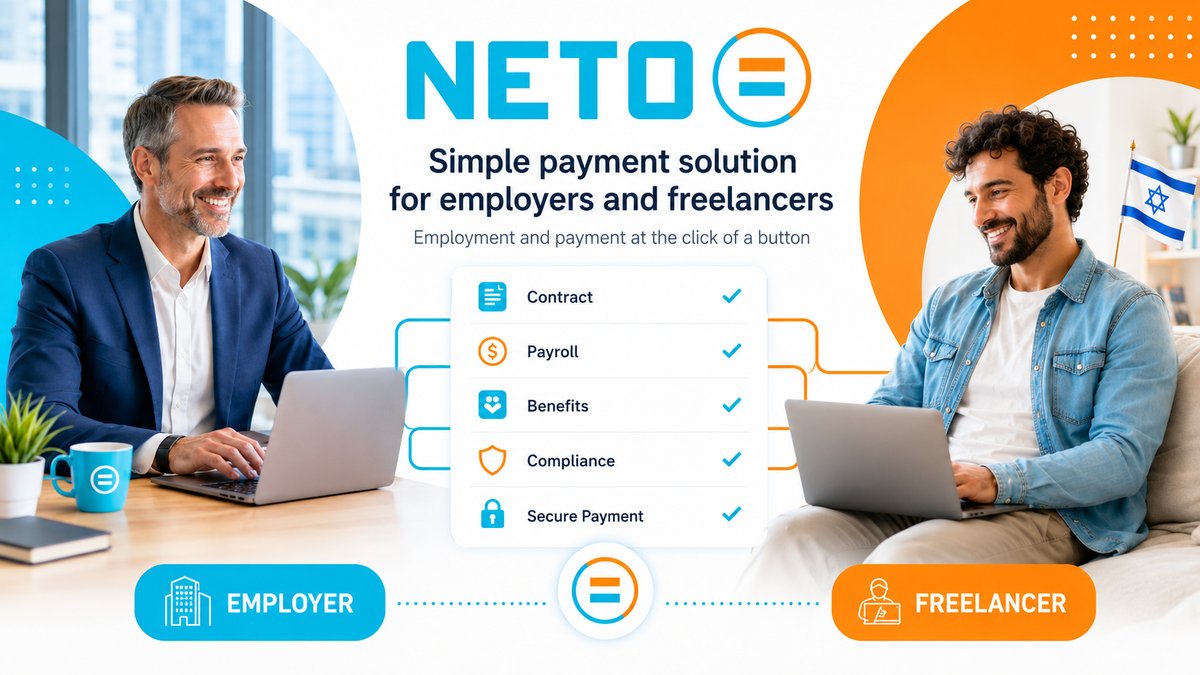
You can work through NETO in a manpower model. NETO is a licensed manpower company (licence #1565), so it is permitted to employ you to perform work for a client it has an agreement with. It is simple: the client receives an invoice from NETO, pays NETO, and NETO pays you on a payslip · while carrying the employer-employee responsibility.
You are a salaried employee of NETO · with a payslip and full social rights, without opening a business file.
No exposure to a retroactive employee finding · NETO is the legal employer under licence #1565.
The client receives a valid tax invoice from NETO · the ~5% fee derives from the client's pre-VAT invoice. See salary payment by invoice.
To meet the law, work begins only after an approved engagement agreement and a work order.
Watch · how employers work with NETO
Two minutes that show exactly what happens from signup to payslip · before you commit to anything.
Frequently Asked Questions
Is a freelancer entitled to employee rights in Israel?
Not always, but it is possible. Working as a freelancer does not require an employer-employee relationship, but it does not necessarily rule one out either. A worker defined in the contract as an independent contractor can demand to be recognized as an employee; if the demand is accepted, they are entitled to all derived rights, such as severance pay on termination.
How does Israeli law define the employment relationship?
The relationship is not defined by a single statute. In many rulings the labour court defines it using the mixed test. The determination is legal and based on substance rather than form · so even if the contract defines the worker as self-employed, the relationship is decided by what actually happens in practice.
What tests determine employee vs contractor status?
The mixed test, whose main component is the integration test, alongside personal service, supervision and control, the framework of working hours, place of work, work tools, the agreement between the parties, registration and form of payment, and the duration and continuity of the engagement.
What does the integration test check?
How far the worker is integrated into the workplace. The positive side asks whether the work is an integral part of the business or a side activity. The negative side asks whether the worker is an independent business owner who also serves other clients and bears business costs such as an office, marketing, equipment and tools.
Does registering as self-employed prove there is no employment relationship?
No. Registration with the authorities (VAT, income tax, National Insurance) indicates business activity, but it does not determine whether an employer-employee relationship exists. Even an osek murshe or osek patur may be found to be an employee for all intents and purposes.
How does working through NETO remove the misclassification risk?
NETO is a licensed manpower contractor (licence #1565). The client receives a proper tax invoice from NETO and pays NETO, and NETO employs the worker on a payslip and is responsible for the employer-employee relationship. This removes the ambiguity: the worker is a salaried employee of NETO, so the client is not exposed to a retroactive employee finding.
Summary
Employee vs contractor status in Israel is not written in a single statute · the labour court decides it under the mixed test, whose main component is the integration test, alongside personal service, supervision, working hours, place of work, tools, the agreement, registration and payment, and duration and continuity. The decision follows the substance, not the label · so a freelancer defined as self-employed may be recognized as an employee entitled to full rights, including severance. National Insurance applies its own separate tests.
For a worker who needs to invoice a client without opening a business file · and for a business that wants to remove the risk of a retroactive employee finding · working through NETO in a manpower model under licence #1565 solves both sides: the client receives an invoice, the worker receives a payslip and full rights, and NETO is responsible for the employer-employee relationship.
Last updated: 09/07/2026 · this is general information and not legal advice. Each case is decided on its facts; consult a labour-law professional where needed.
Remove the Misclassification Risk · for Good
Work through NETO with a payslip and full rights, or let us handle the invoice and the employer-employee responsibility. Register free, or ask us on WhatsApp.
The law requires 6% · at NETO it is 8.33%
The mandatory pension extension order obliges every employer to contribute 6% of salary to the severance component, and section 14 of the Severance Pay Law applies to that money automatically. NETO contributes the full severance component by default · 8.33% · so the ongoing contribution replaces severance pay in full and no top-up is due when the employment ends. An employer contributing less than 8.33% must top up severance at the end of the employment relationship.
A worker who declares they have no active pension fund, in a one-off engagement · there the contribution obligation begins only after six months of work. A worker with an active pension arrangement is entitled from day one, with contributions made retroactively after three months or at the end of the tax year, whichever is earlier.
General information · not legal advice. The binding text is the statute and the extension order themselves.