We use essential cookies to make the site work. With your consent, we also use measurement and advertising cookies from Google and Microsoft to understand how the site is used, improve it and measure our advertising. We never sell your data.
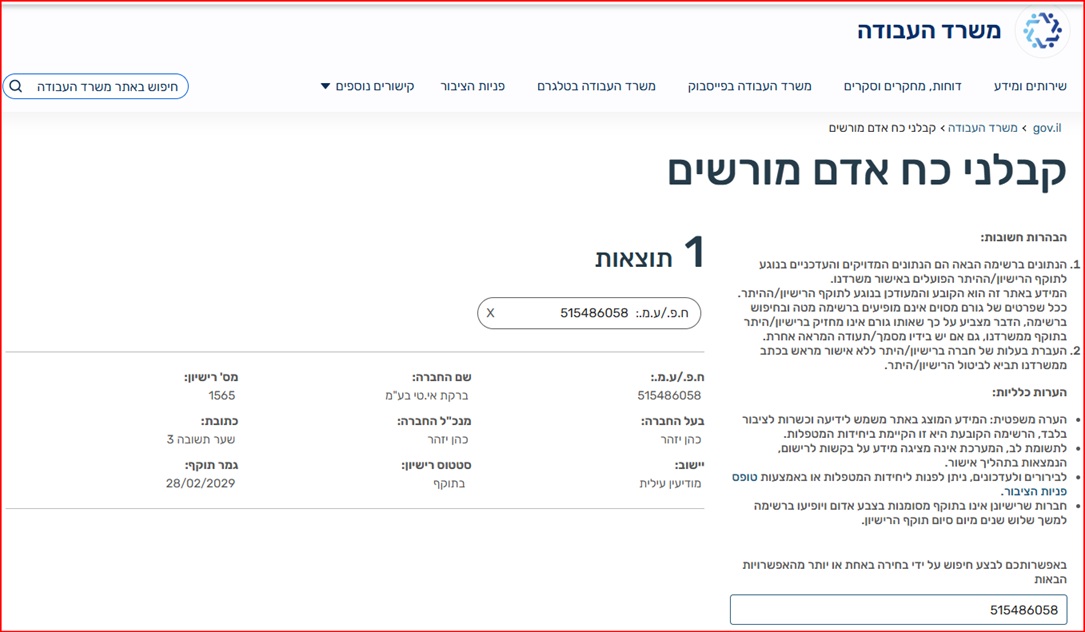
NETO · Bareket I.T. Ltd. Reg. 515486058 · Licensed manpower contractor #1565 (valid to 28.02.2029) Licensed private employment bureau #2435 (valid to 30.11.2027) · verify in the Ministry of Labor registry Office: Sha'arei Teshuva 31, Modi'in Illit Tel +972-8-976-1874 · neto@neto.work
Open →
Book a demo
Pick a convenient time · we'll confirm by phone/email
Knowledge centre · Israeli labour law
Israeli labour law, in language you can actually use
Statutes, extension orders, leading rulings and the figures in force · every item with a public source, a verification date and two readings: what it means for an employer and what it means for a worker.
NETO's labour law centre gathers the statutes, extension orders, leading rulings and current figures that shape employment in Israel. Each item carries a plain summary, its practical meaning separately for an employer and for a worker, a link to a public source, its legal status and a verification date. You can search in free text, filter by type and topic, and share a direct link to any item. The centre is general information only and is not a substitute for individual legal advice.
Updated and verified: 7 October 2026Each item shows the source it is based on and the date it was checked. Items based on a secondary source are marked as such. Reviews run monthly.
General information · not legal advice
The content on this page is general information intended to make the law accessible. It is not legal advice and is no substitute for it. Do not rely on it to decide a concrete case. The binding text is the statute, the extension order and the ruling themselves. Every case has its own facts · for an individual review, consult a lawyer specialising in labour law.
Choose your point of view
In force today
The figures you have to know
Amounts and deadlines in force today. Each figure shows its effective date and source · a figure without a date is a figure you cannot rely on.
ILS 6,443.85
Monthly minimum wage
For an adult employee in a full-time post (182 hours). Hourly ILS 35.40 · daily ILS 297.41 on a five-day week · ILS 257.75 on a six-day week.
Recuperation year 2026 (1.7.2025 to 30.6.2026). The public-sector rate is ILS 511.60. The number of days derives from seniority, and entitlement arises after one year of work.
The cap derives from the extension order on employer participation in travel costs. Reimbursement follows actual travel cost or a monthly pass, up to the cap.
Up to a maximum of 90 days. Day 1 unpaid, days 2 to 3 at 50%, full pay from day 4.
125% then 150%
Overtime premium
125% for the first two overtime hours in a day, 150% from the third hour onward (s.16). Work during the weekly rest also pays 150% and entitles the worker to compensatory rest hours (s.17).
Employment during the weekly rest requires a permit, pays 150% and entitles the worker to compensatory rest hours as set in the permit (s.17(a)).Read the rest
For a monthly-salaried employee, the employer may, instead of the additional pay, give at least 1.5 hours' rest per hour worked (s.17(b)).
In years 1 to 5. These are calendar days, equal to 14 working days on a six-day week and 12 on a five-day week. Year 6: 18 days; year 7: 21; from year 8 one more per year up to 28 (s.3).
One month
Prior notice · by seniority and pay basis
A full month after one year for a salaried employee, and after three years for a wage employee (hourly or daily). Before that it accrues by seniority: for a salaried employee, one day per month in the first six months and then six days plus 2.5 days per month (s.3); for a wageRead the rest
employee, one day per month in the first year, 14 days plus one day per two months worked in the second, and 21 days with the same addition in the third (s.4). The same periods apply to a resignation notice (s.5).
A manpower contractor's worker placed for more than 9 consecutive months is deemed an employee of the actual employer (s.12A) · the minister may extend to 15 months in total. The rule covers manpower contractors' workers, not service contractors' workers in security or cleaning.Read the rest
Statutory exceptions · a worker in computing roles · maintenance, development and implementation of computer systems (s.13A) · a foreign worker of a permit-holding contractor in the construction sector (s.12A(e)) · placement with an individual for nursing care (s.1). Working from Israel for a foreign company, and the 9-month limit · The law contains no express exception to the 9-month limit (s.12A) merely because the party commissioning the work is a foreign company with no Israeli entity, so that fact alone should not be relied on as a basis for exemption. An express exception applies to workers in computing roles, i.e. maintenance, development and implementation of computer systems (s.13A): the 9-month limit does not apply to them. The test looks to the actual role performed, not the job title or the company's industry. Where s.12A applies, continuing the placement with the same actual employer beyond the permitted period results in the worker being deemed that employer's employee. In exceptional cases the Minister of Labor may permit an extension, up to 15 months in total; the permit is not automatic, so continued employment should be reviewed and arranged well in advance. This information is general and does not substitute for a review of the specific engagement. NETO believes the law should expressly regulate remote employment from Israel, through a licensed contractor, for foreign companies. This is a position on the desirable regulatory framework, not a claim that an exemption currently exists.
One month per year
Severance pay
For a salaried employee, one month's wage per year of service; for a wage (hourly or daily) employee, also one month's wage per year worked from 1 August 1983 (regulations under s.12(b)).Read the rest
The basis is the last wage; if the job scope changed, each period is calculated proportionally (reg. 7 of the 1964 regulations). Entitlement arises after one continuous year of service.
The extension order obliges the employer to contribute 6% of salary to the severance component, and section 14 of the Severance Pay Law applies to it automatically. NETO contributes the full severance component · 8.33%Read the rest
· so the contribution substitutes for severance in full and no top-up is due at the end of employment. An employer contributing less than 8.33% must top up severance when the employment ends.
An employee with an active pension arrangement is entitled from day one, with contributions made retroactively after three months of work or at the end of the tax year, whichever is earlier.Read the rest
An employee with no active pension arrangement becomes entitled only after six months with that employer.
Sets the maximum working hours, mandatory breaks and weekly rest, and the premium payable for overtime or work during the weekly rest.
What it means for an employer
You must keep reliable time records for every worker, preserve an uninterrupted weekly rest and pay the overtime premium. Exceeding the caps requires a valid permit.
What it means for a worker
You are entitled to a premium for hours beyond the standard day or week, to breaks, and to an uninterrupted weekly rest. Missing time records may work in your favour before the labour court.
Workday up to 8 hours, work week up to 45 by statute (42 under the extension order)
Overtime premium (s.16): 125% for the first two hours of the day, 150% from the third
Weekly rest (s.7): at least 36 consecutive hours · working it pays 150% and entitles the worker to compensatory rest under the permit (s.17)
Break (s.20): on a day of 6 hours or more, at least 45 minutes including 30 continuous · a general permit (s.23) allows a non-manual worker to be employed for up to 8 hours without a break (9 on a five-day week)
Sets when wages must be paid, what a payslip must contain, which deductions are lawful, and what happens when wages are paid late.
What it means for an employer
Wages are payable by the 9th of the following month; later payment exposes you to delayed-wage compensation. A detailed payslip is mandatory and only statutory deductions are permitted.
What it means for a worker
You are entitled to a detailed payslip every month. Deductions are lawful only in the cases the law allows, and a disputed debt is not grounds to withhold your pay.
Governs the number of leave days by seniority, who sets the timing, how much may accrue, and what happens to unused leave at the end of employment.
What it means for an employer
You must keep a leave register, allow leave to actually be taken, and redeem the balance on termination. Missing records weaken your defence in a claim.
What it means for a worker
Your leave days accrue with seniority and do not simply vanish at year end. On termination you are entitled to redemption of the unused balance.
Years 1 to 5: 16 days; year 6: 18; year 7: 21; from year 8 one more per year up to 28 (s.3)
These are calendar days; only one weekly rest is counted per seven leave days · in practice, 16 calendar days equal 14 working days on a six-day week and 12 on a five-day week
The employer sets timing subject to advance notice
Sets when severance pay arises, how it is calculated, and the circumstances in which resignation also entitles the worker to severance.
What it means for an employer
An employee dismissed after one year of service is entitled to severance. Check separately whether Section 14 applies and what has accrued in the pension fund.
What it means for a worker
Dismissal after a year entitles you to severance, and there are circumstances where resignation does too, such as a material worsening of conditions.
Entitlement after one continuous year with the same employer (s.1)
Calculation (s.12): one month's wage per year for a salaried employee, and also for a wage employee for work from 1 August 1983 (1983 regulations under s.12(b)); the two-week rate applies only to earlier periods
A partial year entitles a proportional amount
Resignation treated as dismissal in recognised circumstances
A mechanism under which employer contributions to a severance fund replace statutory severance pay, on defined terms and scope.
What it means for an employer
Applying Section 14 requires a suitable agreement or general approval and clear documentation. Partial or careless application leaves exposure to a severance top-up.
What it means for a worker
Where Section 14 applies, the money accrued in the fund is your severance and stays with you even if you resign. Check whether the application is full or partial.
Contributions replace severance on defined terms
Requires consent and documentation under the general approval
Sets how many days of advance notice each side must give before employment ends, by seniority and employment type.
What it means for an employer
Dismissal without notice requires payment in lieu. The notice is given in writing and states the termination date.
What it means for a worker
You are entitled to a notice period based on seniority, or payment in lieu. You also owe notice when you resign.
Salaried employee (s.3): first 6 months, one day per month; months 7 to 12, six days plus 2.5 per month; after a year, one month
Wage employee (s.4): year one, one day per month; year two, 14 days plus one per two months; year three, 21 days plus one per two months; after three years, one month
Employment of Employees by Manpower Contractors Law, 1996
Governs the licensing of manpower contractors, the rights of workers placed through them, and the limit on placement with a single actual employer.
What it means for an employer
Engaging through a manpower contractor requires a contractor holding a valid licence. Beyond 9 consecutive months with the same actual employer the worker is deemed your employee · this is not a fine, it is a change of status.
What it means for a worker
Even when employed through a company, you are entitled to full rights. After an extended period with the same actual employer, your status may change.
Manpower contractors must hold a licence
Placement with the same actual employer for up to 9 consecutive months (s.12A(a))
If exceeded, the worker is deemed an employee of the actual employer from the end of the ninth month (s.12A(c))
The minister may extend in exceptional circumstances, up to 15 months in total (s.12A(b))
Does not apply to a worker in computing roles · maintenance, development and implementation of computer systems · section 13 (equal conditions) does not apply either (s.13A)
Does not apply to a foreign worker of a permit-holding contractor in the construction sector (s.12A(e))
Extends a service recipient's liability for the rights of a contractor's workers and enables administrative financial sanctions for breaches.
What it means for an employer
A service recipient in cleaning, security or catering may bear civil and even criminal liability for the contractor's breaches. Documented periodic monitoring is required.
What it means for a worker
If the contractor employing you breaches your rights, the service recipient may also be liable to you.
Protects an employee during pregnancy, maternity leave and the period that follows, and restricts dismissal in those periods without a permit.
What it means for an employer
Dismissing an employee during pregnancy or the protected post-birth period requires a permit from the Ministry of Labour. Reducing scope or income is also restricted.
What it means for a worker
During pregnancy and after birth there is protection from dismissal and from a worsening of terms, and it cannot be waived by consent.
Dismissal protection in pregnancy applies after 6 months with the same employer (s.9)
For 60 days after maternity leave ends, dismissal requires a permit
A permit is granted only if the dismissal is unrelated to the pregnancy or the birth
The protection also covers cuts to scope of position and income
Prohibits sexual harassment and retaliation, and imposes prevention, policy and complaint-handling duties on employers.
What it means for an employer
You must publish a policy, appoint a responsible officer and handle complaints effectively. Failure to act may impose liability on the employer itself.
What it means for a worker
You have a right to a safe work environment, an orderly complaint route and protection from retaliation for complaining.
Governs the conditions for employing a foreign worker in Israel, including a work permit, medical insurance, suitable accommodation and a written contract in a language the worker understands.
What it means for an employer
Employing a foreign worker without a permit is an offence. A contract in a language the worker understands, medical insurance and compliant accommodation are required.
What it means for a worker
A foreign worker is entitled to the full set of Israeli labour rights, to a payslip and to a contract in a language they understand.
A work permit is a precondition
Written contract in a language the worker understands
Medical insurance and suitable accommodation are the employer's responsibility
Governs social insurance in Israel: contributions, work injury, maternity, unemployment, reserve duty and further entitlements.
What it means for an employer
You must report the employee and withhold contributions lawfully. Failure to report harms the employee's rights and exposes the employer to debt and sanctions.
What it means for a worker
Your entitlements at the National Insurance Institute depend on correct reporting by the employer. Verify that you are reported and that deductions appear on the payslip.
Duty to report and withhold contributions
Work injury, maternity, unemployment and reserve duty
Failure to report directly harms the worker's rights
Discharged Soldiers (Reinstatement in Employment) Law, 1949
Secures the right of a discharged soldier and reservist to return to their workplace and protects them from dismissal because of service.
What it means for an employer
Dismissal because of reserve service is prohibited, and in certain circumstances a permit is required. The position must be preserved as the law provides.
What it means for a worker
You may not be dismissed because of reserve duty, and you have a right to return to your role when service ends.
Right to return to work at the end of service
Dismissal because of service is prohibited
A permit is required in the circumstances the law defines
Protection of Employees (Exposure of Offences and of Harm to Integrity or Proper Administration) Law, 1997
Protects an employee who reported a breach of law at the workplace from dismissal or from a worsening of their conditions.
What it means for an employer
Harming an employee following a complaint may lead to substantial compensation and reinstatement. Document objective considerations separately from the complaint.
What it means for a worker
If you complained in good faith about a breach of law, you are protected from dismissal or worsened terms in response.
Restricts dismissal of an employee absent because of an emergency, closure of an educational institution or evacuation, in the circumstances the law defines.
What it means for an employer
Absence due to a recognised emergency is not grounds for dismissal. Check the definitions and their application to the relevant period.
What it means for a worker
Justified absence in an emergency is protected, and dismissal for it is prohibited in the recognised circumstances.
Governs the inspection framework for workplace safety and hygiene and the powers of inspectors.
What it means for an employer
A safety management programme is required according to the type and size of the business, and an inspector may enter, demand documents and issue orders.
What it means for a worker
You have a right to a safe work environment and to report a safety hazard.
A duty established in case law: before deciding to dismiss, the employee must be given a genuine opportunity to be heard by the decision maker.
What it means for an employer
A written invitation in advance, the specific allegations, reasonable preparation time, an open-minded hearing and documentation are required. A sham hearing is a breach.
What it means for a worker
You are entitled to know the allegations in advance, to time to prepare, and to a genuine opportunity to influence the decision before it is made.
Written invitation setting out the allegations
Reasonable preparation time and the option to be accompanied
The National Labour Court mapped how the burden of proof is divided in overtime claims, according to the degree of certainty on whether overtime was worked and on its extent. Once the court is satisfied that the employee did work overtime, the burden of proving the extent shifts to the employer. However, if at the end of the process the court is not satisfied that overtime was worked at all, the employer is not liable even without attendance records.
What it means for an employer
Reliable, retained attendance records are your main defence. Their absence is not an automatic penalty, but it shifts the burden to you once the employee establishes that overtime was worked.
What it means for a worker
You do not need to prove every single hour. Establishing that you worked overtime is enough to shift the burden of proving the extent to the employer.
Burden divided by degree of certainty
Missing attendance records shift the burden to the employer
No automatic liability without an initial showing
Court: National Labour CourtCase number: National Labour Court appeal 47715-09-14Decided: 2017
It was held that the right to a hearing is a fundamental right in our system, holding an honoured place in labour relations, particularly where terminating employment is considered, whether by dismissal or by non-renewal of a contract. The duty stems from good faith, and its purpose is that the decision be taken after the employee's position has been heard.
What it means for an employer
A hearing is not a ceremony. A reasoned, balanced decision taken after genuinely listening is required, otherwise the dismissal may be unlawful.
What it means for a worker
Non-renewal of a contract also counts as termination requiring a hearing, not only an explicit dismissal.
The hearing applies to non-renewal of a contract too
The duty derives from good faith in labour relations
The decision must follow the hearing, not precede it
Court: National Labour CourtCase number: National Labour Court appeal 1027/01Decided: 2003-01-07
The Kuta ruling · retroactive recognition of employment
It settled how compensation is determined when someone engaged as a freelancer or independent contractor against invoices is retroactively recognised as an employee. Compensation includes a pecuniary component based on comparing the employer cost had the person been salaried with the contractor fee actually paid, and, by default, compensation for non-pecuniary harm such as loss of job security and of the right to organise. The burden of proving the alternative salary rests on the employer.
What it means for an employer
Invoice-based engagement is not immune. If employment is later established, the exposure includes a non-pecuniary component, and the burden of proving the alternative salary is yours.
What it means for a worker
If you were engaged as a freelancer but in practice worked as an employee, you may be owed differentials and compensation for the engagement structure itself.
Pecuniary compensation by alternative employer-cost comparison
Non-pecuniary compensation as the default
The employer bears the burden on the alternative salary
Court: National Labour CourtCase number: National Labour Court appeal 15868-04-18, Gavriel Kuta v. Ra'anana Municipality (joined with 12372-04-18, 7338-10-17, 34665-10-17)Decided: 2021-04-07
It was held for the first time that an employer may not express itself, directly or indirectly, against an initial unionisation drive by its employees. The ruling was upheld by the Supreme Court in 2014 and is regarded as a milestone in the development of unionisation in Israel.
What it means for an employer
During an initial unionisation drive you must refrain from speaking against it, including in internal communications to staff. Crossing that line may be unlawful interference.
What it means for a worker
During initial unionisation you are protected from employer pressure or persuasion against joining a workers' organisation.
Employer speech against initial unionisation is prohibited
Upheld by the Supreme Court in 2014
A turning point for unionisation in Israel
Court: National Labour CourtCase number: The Pelephone rulingDecided: 2013
It was held that in the restaurant sector tip money constitutes restaurant income intended to pay the wages of the service chain. The tips component forms an inseparable part of wages for computing social rights and national insurance contributions, regardless of how it was paid. The ruling took effect on 1 January 2019.
What it means for an employer
Tips are not outside the payroll system. Include them in the base for social rights and report them lawfully.
What it means for a worker
Tips you received count as part of your wage for pension, severance and national insurance, even if paid in cash.
Tips are business income used to pay wages
Included in the base for social rights
In force from 1.1.2019
Court: National Labour CourtCase number: National Labour Court appeals 44405-10-15 (Omri Kis v. National Insurance Institute and others) and 28480-02-16 ("ד.ע. יבוא וניהול מסעדנות בע״מ" v. Yehiel Buda)Decided: 2018-03-26
The Iskov ruling · employer access to employee mailboxes
Rules were set for employer access to employees' email accounts. Given the power gap between employer and employee, greater weight is given to the employee's right to privacy than to the employer's right to act on computers it owns. The court distinguished between mailbox types and defined what is permitted for each.
What it means for an employer
There is no blanket permission to access mailboxes. An explicit policy, informed consent matching the mailbox type, and proportionality are required.
What it means for a worker
A personal mailbox is far more protected than a professional one. Owning the computer does not give the employer free access to your correspondence.
Distinction between professional, mixed and personal mailboxes
Policy and informed consent are required
Privacy outweighs the employer's property right
Court: National Labour CourtCase number: The Iskov-Inbar caseDecided: 2011-02-08
The Yolanda Gluten case · applying the Hours of Work and Rest Law to care workers
A series of proceedings on whether the Hours of Work and Rest Law applies to migrant care workers. It was held that the law does not apply to workers in the care sector, given the mismatch between the nature of the work and the statutory provisions, so no overtime premium arises under it. A further hearing was later held on the question.
What it means for an employer
In the care sector the arrangement differs from other sectors, and the ordinary overtime rules should not be applied automatically. A case-specific review is required.
What it means for a worker
In the care sector the protection regarding working hours differs from other sectors, so check which arrangement applies to you.
The Hours of Work and Rest Law does not apply to care workers
No basis for a global supplement under the law
The question was reheard in a further hearing
Court: Supreme Court and National Labour CourtCase number: HCJ 1678/07 · Further Hearing HCJ 10007/09Decided: 2009-11-29
The Menachem Yahav ruling · a shortened working day for a parent
It was held that an employee whose spouse is self-employed may enjoy the workplace right to a shortened working day on parenthood grounds, a right until then granted to a female employee who is a mother. Following the ruling, the Equal Employment Opportunities Law was amended.
What it means for an employer
Parenthood benefits are not confined in advance to one gender. Assess the benefit by its purpose rather than by historic wording.
What it means for a worker
A workplace parenthood right may apply to a working father too, subject to the conditions set.
Parenthood right extended to a male employee
Applies where the spouse is self-employed
Led to an amendment of the Equal Opportunities Law
Court: National Labour CourtCase number: National Labour Court appeal 1039/00Decided: 2002-08-13
The Dan Bahat ruling · excess hours and parenthood rights
It was held that payment for excess hours to mothers in the civil service is not a parenthood-related right under Section 4 of the Equal Employment Opportunities Law, but an affirmative benefit for working mothers permitted by the law. A working father is therefore not entitled to the same additional payment beyond the shortened working day.
What it means for an employer
Not every benefit given to a working mother is a parenthood right that must be extended to all. Distinguish a parenthood right from a permitted affirmative benefit.
What it means for a worker
There is a distinction between parenthood benefits that apply to both parents and affirmative benefits the law permits for working mothers.
Distinguishing a parenthood right from a permitted benefit
Excess hours for a working mother are not a parenthood right
A limit on automatic extension of benefits
Court: National Labour CourtCase number: The Dan Bahat case
The Mika ruling · wage, supplement and expense reimbursement
The National Labour Court set a substantive test for distinguishing a wage component, a wage supplement and an expense reimbursement, for determining the pensionable salary. The rule was adopted in later labour court case law.
What it means for an employer
The label on the payslip does not decide. A component not conditioned on a genuine condition may count as wages and enter the base for severance and pension.
What it means for a worker
If a supplement on your payslip is always paid and unconditional, it may form part of your wage for severance and pension.
A substantive test, not a labelling test
Conditional supplement versus wage component
Direct effect on the severance and pension base
Court: National Labour CourtCase number: National Labour Court 39/3-56Decided: 1979
The first ruling to recognise ethnic discrimination at the hiring stage. It was held that the claimant was discriminated against on the ground of his origin, giving legal force to the prohibition on such discrimination.
What it means for an employer
Screening and hiring processes are exposed to discrimination claims. Documenting objective, consistent criteria is the main defence.
What it means for a worker
Discrimination at the hiring stage, not only during employment, can give rise to a claim.
Recognition of discrimination at the hiring stage
Documented objective criteria as a defence
A regional labour court decision
Court: Tel Aviv Regional Labour CourtCase number: Regional Labour Court case 3816/09Decided: 2013
The Zinger case · admissibility of evidence obtained through a privacy breach
The balance between the right to privacy and the employer's property right was examined. Copying the content of a personal email left open on the employee's screen was held to be a privacy breach, but the request to exclude the evidence was denied.
What it means for an employer
A privacy breach does not necessarily exclude evidence, but it remains a breach that may create separate liability.
What it means for a worker
Even if evidence obtained through a privacy breach is admitted, the breach itself may count in your favour in the proceedings.
A privacy breach does not automatically bar admissibility
Personal correspondence is protected even on an employer computer
Balancing privacy against property
Court: Supreme CourtCase number: Leave for Civil Appeal 2552/16Decided: 2016
It was held that a uniform retirement age must apply to women and men, contrary to arrangements setting a lower retirement age for women. Even before the ruling, and following the campaign, the Equal Retirement Age for Female and Male Employees Law was enacted.
What it means for an employer
An early-retirement arrangement for women only is exposed to a discrimination claim. Review retirement arrangements against current law.
What it means for a worker
You cannot be required to retire earlier solely because of your gender.
Abolition of different retirement ages by gender
Impact on collective agreements and arrangements
Led to legislation on the subject
Court: Supreme Court sitting as High Court of JusticeCase number: HCJ 104/87Decided: 1990-10-22
El Al v. Danilowitz · no discrimination in employee benefits
The Supreme Court's first ruling on discrimination based on sexual orientation. It was held that employers may not discriminate in granting employee benefits between opposite-sex and same-sex partners.
What it means for an employer
Employee benefit policies must be uniform and must not distinguish on the basis of sexual orientation or family structure.
What it means for a worker
A benefit granted to an employee's partner must be granted equally.
No discrimination based on sexual orientation
Applies to benefits for employees and their partners
The first such ruling in the Supreme Court
Court: Supreme Court sitting as High Court of JusticeCase number: HCJ 721/94Decided: 1994
The High Court's first ruling addressing discrimination in the equal-pay context. It was held that employers may not discriminate on the basis of sex in granting benefits to employees. The ruling followed proceedings in the regional and national labour courts.
What it means for an employer
A pay gap between a female and a male employee in equivalent roles requires a documented objective explanation, not a retrospective one.
What it means for a worker
If you discovered a pay gap against a colleague in an equivalent role, you may have a claim under the equal pay and equal opportunity laws.
Gender-based pay discrimination is prohibited
An objective justification is required for a gap
Passed through all three instances
Court: Supreme Court sitting as High Court of JusticeCase number: HCJ 1758/11Decided: 2012
Every item carries a verification date. An item not re-verified within 90 days is flagged internally for refresh, and updates enter as drafts for review rather than publishing automatically. Last updated: 7 October 2026.
NETO's AI assistant
Ask a question
Gai, NETO's assistant, answers labour law questions and points you to the source the answer rests on. When a question turns on details that cannot be verified here · seniority, sector, the applicable collective agreement and the wording of the contract · we will help you reach a lawyer.
Professional referral
Need a labour law lawyer?
Tell us about the case in six short questions and in your own words. We will understand the picture and connect you with a lawyer specialising in labour law. There is no commitment, and this is not legal advice from us.
Interactive
Test your knowledge
Ten questions drawn from the compendium above. Every answer comes with an explanation and a link to the item it came from · so a wrong answer is worth something too.
10 questions · no sign-up, no timer. Getting one wrong is fine.
Israeli labour law rests on statute, on extension orders that widen it across whole sectors, and on case law that decides how all of it is read in practice. The three together are what binds · not any one of them alone. This page gathers the 46 central items, each with its source and the date it was checked, and each in two readings: what it requires of an employer and what it grants a worker. Figures change, so every number carries its effective date · a number without one is not a number you can rely on. And where the question turns on a specific case, no page is a substitute for a lawyer.
Frequently asked questions
Frequently asked questions
Is the information on this page legal advice?
No. The page makes the law accessible in plain language and links to the source, but it is not legal advice and is no substitute for it. The binding text is the statute, the extension order and the ruling. A concrete case requires a lawyer specialising in labour law.
Where does the information come from and how do you verify it?
Every item rests on a public source you can open and check, alongside a verification date and a verification level. An item resting on a secondary source is marked as such. A source not re-checked within 90 days is flagged internally for refresh.
Legislation and case law are monitored continuously, and an update first enters as a draft for review. Nothing publishes to the page automatically · in legal content, automatic publishing is the fastest way to publish a mistake.
Why separate the employer view from the worker view?
Because the same provision reads differently from each side. For an employer it is a duty to implement and document; for a worker it is a right to know exists. We present both readings against the same source, without colouring the law.
Because in labour law the answer quickly turns on details a system cannot verify · seniority, sector, the applicable collective agreement and the exact wording of the contract. Rather than guess, we refer you to a specialist. Saying plainly that you need a person beats an answer that sounds confident and is wrong for your case.
What happens after I fill in the lawyer referral form?
The request is saved with the description you wrote. We read it, understand the picture and connect you with a lawyer specialising in the field. There is no commitment, and it is not legal advice from us.
Yes. NETO is a licensed manpower contractor, licence no. 1565, supervised by the Ministry of Labour, and has employed workers since 2016 · including payslips, social rights and full reporting to the authorities.
Israeli labour law is not a list of arbitrary rules · it is one network of statutes, extension orders and case law that complete each other. Three practical conclusions follow from the library above:
A right is not measured by what the contract saysAn agreement cannot reduce a right set by statute or by an extension order, even if both sides signed it. A clause waiving a mandatory right is simply void.
Documentation is what decides a disputeHour records, payslips, the written notice to the employee and the hearing minutes are the evidence the labour court examines. Missing documentation almost always counts against the employer.
The answer turns on details this page does not holdSeniority, sector, the applicable collective agreement and the exact wording of the contract change the outcome. This page exists to give you the right questions · not to replace a specific review.
The content on this page was checked against its sources on 7 October 2026A re-check runs once a month · a change to a figure or a ruling is documented before it publishes.
Continue from here
Continue from here
The full statute pages on the site, section by section.
NETO is a licensed manpower contractor, licence no. 1565, supervised by the Ministry of Labour. We employ, issue payslips and administer the full set of rights · so that the questions on this page never reach a labour court.
Yizhar CohenEntrepreneur · CEO and Founding Partner at NETO
I founded NETO to turn complex employment and payment processes into something simple, clear and legal for everyone. Good service starts with human understanding, combined with smart technology and personal attention.
Disclaimer: This page is for general information only and is not legal, tax or accounting advice. Consult a licensed professional as needed. See our terms and privacy policy.
Topics
NETO · full site map
Every section, organized by topic. Browse the full hierarchy or jump straight in.
Here you can ask to see the data we hold about you, correct it, delete it, withdraw consent you gave, or stop receiving our emails and alerts. We reply within 30 days, and handle removal requests within 7 business days. Privacy policy
Manpower Contractor License
Barkat I.T Ltd · trading as NETO · is a licensed manpower company (license 1565), supervised by the Israeli Ministry of Labor.