Frequently asked questions
How often do these figures change?
There is no single date. The minimum wage changes by agreement or legislation, recuperation pay is updated by an extension order, and the National Insurance and VAT ceilings are usually updated at the start of the year. Wherever it has been verified, each card shows the date from which the figure applies.
How do I know which rate applies to a given period?
Where a figure has changed over time, its card includes a change history showing the period in which each value applied. To calculate an entitlement for a past month, use the value that was in force in that month, not the current one.
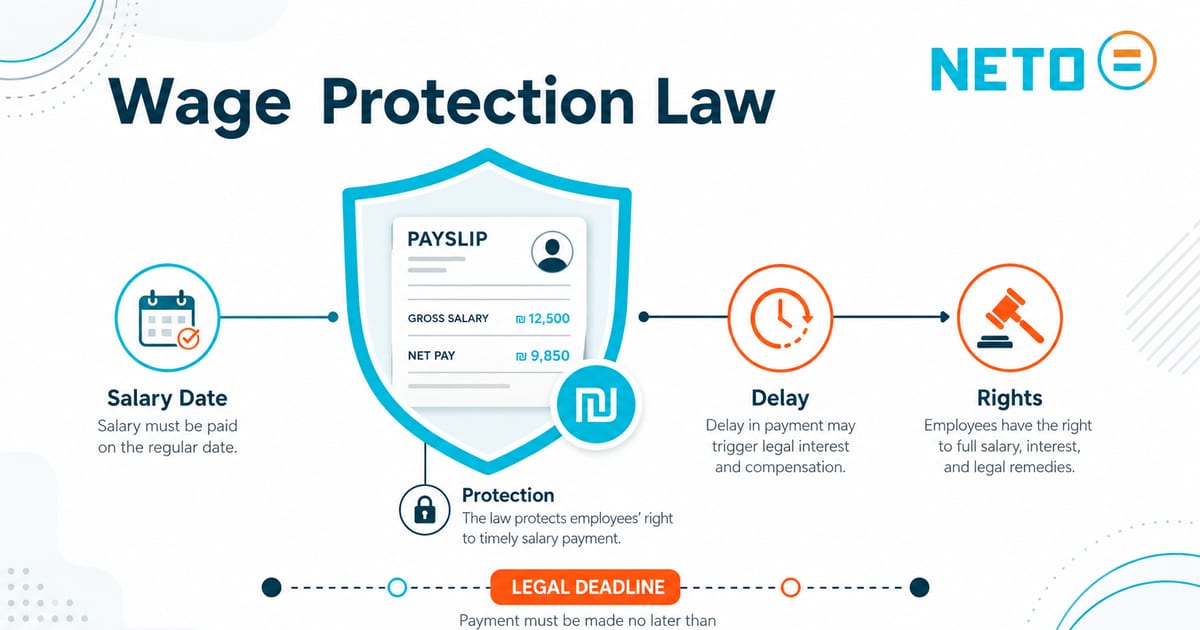
By what date must the salary be paid?
A monthly wage is due at the end of the month, and the final payment date is the 9th of the following month. If the 9th falls on a Sabbath or holiday, it must be paid before that day. After that date, the wage is considered delayed, and the employee is entitled to delayed-wage compensation.
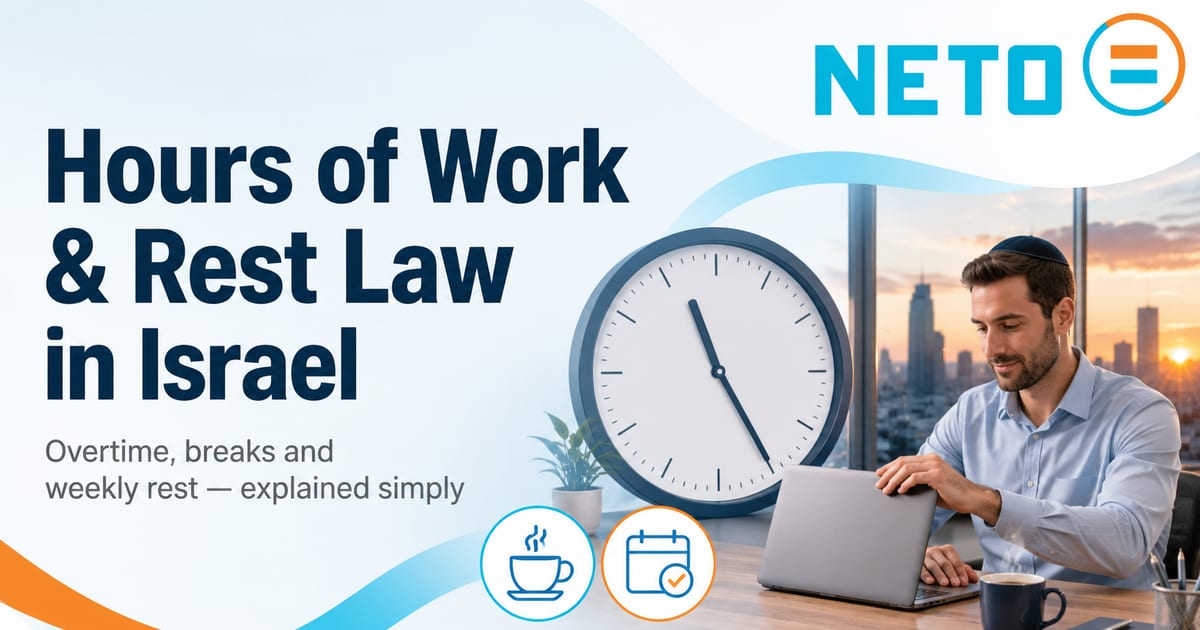
How many hours of weekly rest is an employee entitled to?
At least 36 consecutive hours. For a Jewish employee this includes the Sabbath, and for a non-Jewish employee, Saturday, Friday or Sunday, according to their custom. The rest day is specified in the Notice to Employee on Terms of Employment.
Is it permitted to employ an employee on the Sabbath?
As a rule, no. Employment during the weekly rest is prohibited, except with a permit from the Minister of Labour under section 12 of the Hours of Work and Rest Law, and the request is submitted to the Ministry of Labour. An employee who worked during the rest period is entitled to at least 150% of the regular wage, and, under National Labour Court case law, to 175% and 200% for overtime during the rest period.
What is the minimum distance to qualify for travel reimbursement?
The extension order does not set a distance. According to National Labour Court case law, an employee who lives within 500 metres of the workplace is generally considered not to need transport, but this is a rebuttable presumption. The 3-stop rule in the order concerns a second bus, not the eligibility threshold.
Is the employer required to pay for a monthly pass?
No. The reimbursement is at the discounted public-transport fare, up to the daily cap, for each day actually worked. If a monthly pass is cheaper, the employer may pay on that basis, but is not required to.
How much severance pay is an employee entitled to?
One month's salary for each year of employment, based on the last salary, provided the employee worked at least one continuous year with the same employer or at the same workplace. When section 14 applies and the employer has deposited 8.33% into the severance component, the deposits fully replace the severance pay.
How much time before the hearing must the summons be delivered?
The law does not set a number of days. The summons must be delivered a reasonable time in advance and detail all the reasons. Regional Labour Courts have held that 24 hours, and even two working days, are not sufficient. The decision is given after the hearing, within a reasonable time, and not at the hearing itself.
How many days of advance notice is a monthly-salaried employee entitled to?
In the first six months, one day per month of work. From the seventh month until the end of the first year, 6 days, plus 2.5 days for each month beyond the sixth month. From the second year onwards, one month. The same periods apply to an employee who resigns.
Is recuperation pay the same for every employee?
No. The general private-sector rate differs from the rate in the cleaning and maintenance sector, which is set by a sector-specific extension order. Both rates appear separately on this page.
What does “being verified” mean in a table?
It marks a date we have not yet verified against an official source, usually the start date of a value that applied in the past. We do not show a date we have not verified.
Is the information on this page advice?
No. It is general information only. The binding text is the one published in the official gazette and official sources, and for a specific case you should consult a qualified professional.
Summary
This page brings together 49 statutory figures and 9 rules covering pay, working hours and rest, social benefits, pension, National Insurance, taxes and termination. For each figure you get the current value, the date it took effect or the section that sets it, and the earlier values, with their periods of validity where verified. The page is generated automatically from a single data source, so each rate update is reflected across the whole page at once.
This page is part of the Employee Rights in Israel guide and the Israel Labor Law Center.
Disclaimer. This page is general information and is not legal, tax or accounting advice. The binding text is the one published in the official gazette and official sources. For a specific case, consult a qualified professional.
Last updated: 10 Sep 2026 · Each month we do our best to scan the official sources with AI tools and present the most reliable, up-to-date information.