
We use essential cookies to make the site work. With your consent, we also use measurement and advertising cookies from Google and Microsoft to understand how the site is used, improve it and measure our advertising. We never sell your data.
You can change your choice at any time via “Cookie settings” at the bottom of every page.
Log in to your account, or sign up in a minute.
Pick whatever works for you · we're here.
Everything about NETO · transparent and available
Pick a convenient time · we'll confirm by phone/email
Home · Payroll in Israel · Tax brackets and national insurance
The full bracket table and national insurance rates, plus a calculator that answers the two questions people actually have: what lands in the employee's bank account, and what the employer really pays.
NETO · Israeli manpower contractor licence 1565 · employing and paying people in Israel since 2016
Israeli income tax is progressive · each shekel falls into its own band, so crossing into a higher bracket never re-prices the whole salary. The page sets out the 2026 bracket table, credit points, national insurance and health levy, pension and severance, with a gross-to-net calculator and what a hire really costs. Worked example on ₪12,000: the first ₪7,010 at 10%, the slice up to ₪10,060 at 14%, the remainder at 20% · about ₪1,516 before credit points. Figures from the Israel Tax Authority 2026 deductions booklet · general information, not tax advice.
Drag the gross and watch the real take-home. Credit points move the answer more than anything else, which is why they are here.
Israeli income tax is progressive: each shekel falls into its own band and is taxed at that band's rate. Crossing into a higher bracket never re-prices the whole salary. On top of tax, both sides pay national insurance and health levy, and a pension contribution is mandatory.
Sources: Israel Tax Authority · 2026 deductions booklet · National Insurance Institute · contribution rates · Employer cost in Israel
This is the part most people get wrong, and the answer is the reassuring one: moving into a higher bracket does not make the whole salary more expensive.
The salary is sliced. The first slice pays 10%, the next 14%, and so on. Only the shekels sitting in the higher slice pay the higher rate.
The first ₪7,010 pays 10%, the slice up to ₪10,060 pays 14%, and the remainder up to ₪12,000 pays 20%. Total tax before credit points: about ₪1,516.
Credit points reduce the tax itself, not the taxable income. That is why lower salaries often end up paying no income tax at all.
For income from personal exertion (salary or business), tax year 2026, per the Israel Tax Authority's deductions booklet.
| Monthly income | Annual income | Rate | Cumulative tax at the top of the band |
|---|---|---|---|
| Up to ₪7,010 | Up to ₪84,120 | 10% | ₪701 |
| ₪7,011 – ₪10,060 | ₪84,121 – ₪120,720 | 14% | ₪1,128 |
| ₪10,061 – ₪19,000 | ₪120,721 – ₪228,000 | 20% | ₪2,916 |
| ₪19,001 – ₪25,100 | ₪228,001 – ₪301,200 | 31% | ₪4,807 |
| ₪25,101 – ₪46,690 | ₪301,201 – ₪560,280 | 35% | ₪12,364 |
| ₪46,691 – ₪60,130 | ₪560,281 – ₪721,560 | 47% | ₪18,680 |
| Above ₪60,130 | Above ₪721,560 | 50% | 47% plus the 3% surtax |
The cumulative column is the total tax before credit points, for someone earning exactly the top of that band. The additional 3% surtax under section 121B applies to taxable income above ₪721,560 a year.
The table above is the Israeli schedule, set by the Income Tax Ordinance and published by the Israel Tax Authority. It governs income taxed in Israel and nothing else; rates and bands elsewhere are set separately and do not map onto these.
Employment income paid through an Israeli payroll is taxed on this schedule, whatever the employee's nationality. The employer withholds the tax every month and reports it, so the bands are applied for you rather than filed by you.
Where the work is performed in Israel, the income is taxed in Israel on the same bracket table. What moves with residency status is the credit points, declared on Form 101 with the employer at the start of each year.
The brackets do not change because the paying company sits abroad. A foreign employer without a local entity can still run a compliant Israeli payslip through an Employer of Record, and the deductions on this page are the ones that appear on it.
Residency moves the credit points, not the rates. The bands and percentages in the table are identical for everyone taxed in Israel. Residency status changes how many credit points a person may claim, and credit points come off the tax itself rather than the taxable income, so two people on the same gross salary can take home different amounts. Entitlement is declared on Form 101. See Employer of Record in Israel and tax coordination for employees.
On 31 March 2026 section 121 of the Income Tax Ordinance was amended under the Economic Efficiency Law, widening two bands retroactively to 1 January 2026.
| Band | Until 2025 | From 2026 | Who gains |
|---|---|---|---|
| 20% applies up to | ₪16,150 / month | ₪19,000 / month | Anyone earning above ₪16,150 |
| 31% applies up to | ₪22,440 / month | ₪25,100 / month | Anyone earning above ₪22,440 |
In shekels: a ₪25,000 salary paid about ₪4,647 of income tax last year and about ₪4,232 now. Around ₪415 a month, with no change to the salary itself.
A credit point removes a fixed amount from the tax, not from the income. In 2026 each point is worth ₪242 a month.
| Who | Points | Monthly value |
|---|---|---|
| Israeli resident | 2.25 | ₪544.50 |
| Israeli resident, female | 2.75 | ₪665.50 |
| Per child (by age and parent) | 1.5 to 4.5 | ₪363 to ₪1,089 |
Further points exist for new immigrants, discharged soldiers, degree completion and designated localities. Entitlement is declared on Form 101 with the employer. The calculator on this page assumes 2.25 points.
Two tiers again: the first part of the salary is charged at a reduced rate, the remainder at the full rate, and nothing above the ceiling. Rates below are for a resident employee aged 18 to retirement.
| Portion of salary | Employee | Employer | Total |
|---|---|---|---|
| Up to ₪7,703 · reduced rate | 4.27% | 4.51% | 8.78% |
| ₪7,703 to ₪51,910 · full rate | 12.17% | 7.6% | 19.77% |
| Above ₪51,910 | No contributions on the portion above the ceiling | ||
The employee's share combines national insurance and the health levy. The ceiling is updated each January in line with the index.
This looks like a deduction on the payslip and is in fact savings. Under the mandatory pension extension order, ₪18.50 is paid into the fund for every ₪100 of gross salary.
Deducted from the salary and paid into a pension fund in their name.
Employer contributions, on top of the agreed salary.
The severance component, accruing throughout the employment.
Drag either slider and the other follows. Start from the gross figure in a job ad, or start from the amount someone wants in their account and see what gross to offer.
| Gross salary | |
| Income tax (after 2.25 credit points) | |
| National insurance and health levy | |
| Employee pension contribution | |
| Net pay | |
| Employer pension contribution | |
| Severance component | |
| Employer national insurance | |
| Total employer cost |
Why a real payslip may differ: the calculator assumes 2.25 credit points, a full-time month of 182 hours, and pension contributions at the statutory minimum. Additional credit points, overtime, travel allowance, company car value, a study fund or enhanced contributions all change the result. Where they disagree, the payslip and the tax authority's instructions govern.
When an employer agrees a ₪12,000 salary, the real outlay is about 18% higher. This is the gap between "what I pay them" and "what it costs me".
| Gross salary | Net to employee | Cost to employer | Markup |
|---|---|---|---|
| ₪6,000 | ₪5,328 | ₪7,021 | 17% |
| ₪9,000 | ₪7,538 | ₪10,571 | 17.5% |
| ₪12,000 | ₪9,456 | ₪14,174 | 18.1% |
| ₪16,000 | ₪11,929 | ₪18,978 | 18.6% |
| ₪25,000 | ₪16,834 | ₪29,787 | 19.1% |
Includes employer pension contributions, the severance component and the employer's national insurance. Excludes recuperation pay, travel, holiday, sick leave and any additional benefits.
Hiring in Israel from abroad? These are the same figures a local employer faces. A company with no Israeli entity can employ people here through an Employer of Record, and the cost base does not change. See Employer of Record in Israel and hiring without a local entity.
No. This is the most common misunderstanding. Tax is progressive: only the shekels inside the higher band pay the higher rate, and everything below keeps paying the lower rates. A raise always leaves more in hand, even when it crosses a bracket.
The contribution does come out of net pay, but it goes into a fund in the employee's name, and the employer adds 12.5% more on top. On a ₪12,000 salary about ₪2,220 accrues every month, roughly ₪26,640 a year.
The first ₪7,703 of monthly salary is charged at a lower rate for the employee (4.27%), and the remainder at the full rate (12.17%), up to a ceiling of ₪51,910 above which no contributions are due. That is why the deduction grows as a percentage as the salary rises.
Very likely. Employers withhold tax assuming a full year at the same salary, so anyone who worked a few months, changed jobs or held two jobs at once usually overpays. It can be corrected through a tax coordination during the year or a refund claim afterwards.
Roughly 17% to 19% above the gross salary, rising slightly with the salary. A ₪12,000 salary costs about ₪14,174 once pension, severance and the employer's national insurance are included, before optional benefits.
It is a good estimate, not a payslip. It assumes 2.25 credit points, 182 hours a month and statutory minimum pension contributions. Additional credit points, a company car, a study fund or enhanced contributions will change the result.
An additional 3% on the portion of taxable income above ₪721,560 a year, which is ₪60,130 a month. In practice that portion is taxed at 50%.
Where the work is performed in Israel, the income is taxed in Israel on the same bracket table, whatever the employee’s nationality. What moves with residency status is the credit points a person may claim. Those are declared on Form 101 with the employer and come off the tax itself rather than the taxable income, so two people on the same gross salary can take home different amounts.
The same brackets and the same national insurance rates. A company with no local entity can still run a compliant Israeli payslip through an Employer of Record, and the deductions look identical to those of a locally employed person. See Employer of Record in Israel.
Every figure on this page comes from the documents below. Verify against them before making a financial decision.
Last updated: 13 August 2026, against the Israel Tax Authority's 2026 deductions booklet and the National Insurance Institute's published rates. NETO has employed people and issued payslips in Israel since 2016 under manpower contractor licence 1565; the calculations on this page are the same ones our system runs every month.
Disclaimer: this page provides general information only and is not tax, pension or legal advice. The binding text is the Income Tax Ordinance, the National Insurance Law and the authorities' instructions. Consult a tax adviser or accountant before making a financial decision.
Every job on the NETO board shows a salary range, and we handle everything on this page: compliant payslips, correct deductions, pension contributions and reporting to the authorities.
 YC
YCEvery section, organized by topic. Browse the full hierarchy or jump straight in.
Adjust the site to your needs
Here you can ask to see the data we hold about you, correct it, delete it, withdraw consent you gave, or stop receiving our emails and alerts. We reply within 30 days, and handle removal requests within 7 business days. Privacy policy
Barkat I.T Ltd · trading as NETO · is a licensed manpower company (license 1565), supervised by the Israeli Ministry of Labor.
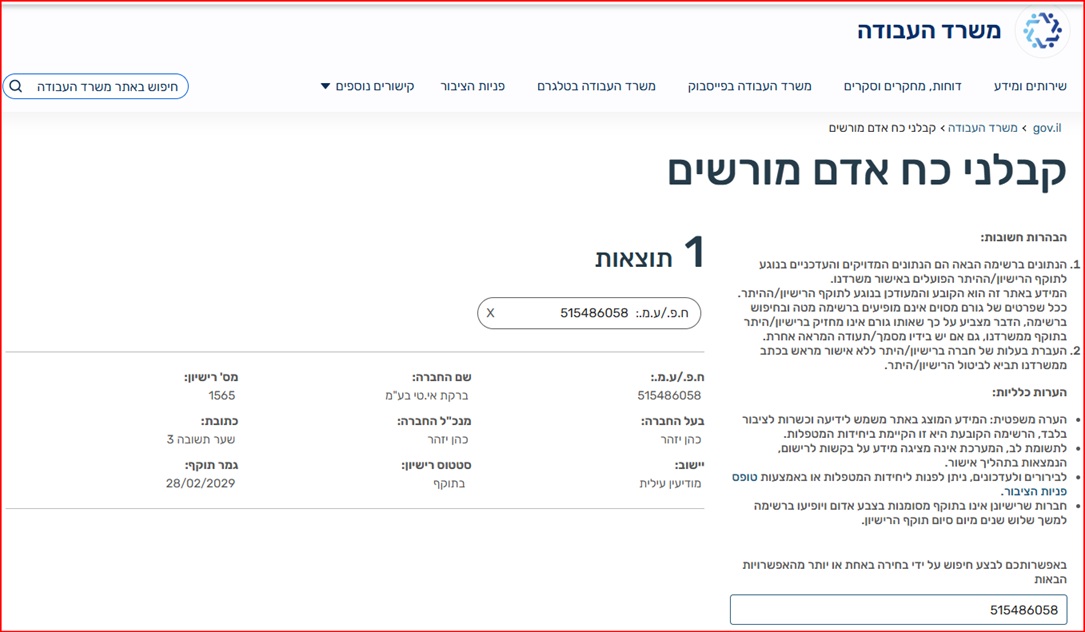 Verify the license on the Ministry of Labor website
Full details · Manpower contractor license page →
Verify the license on the Ministry of Labor website
Full details · Manpower contractor license page →