
Recruiting and employing workers
Free job posting, recruitment and employment at the click of a button · for employers.
Read more
Log in to your account, or sign up in a minute.
Pick whatever works for you · we're here.
Everything about NETO · transparent and available
Pick a convenient time · we'll confirm by phone/email
When the duty to contribute to a pension begins, whether you pay retroactively, the contribution rates under the Extension Order for Mandatory Pension, and how NETO contributes to pensions for the workers it employs.
The duty to contribute to a pension is determined by the employee's status on day one. An employee who arrives with an active pension fund is entitled to pension insurance from the first day · the employer may wait until the end of 3 months of employment and then deposit retroactively for the whole period. An employee without an active fund · contributions start only from the seventh month, with no retroactivity. An employee who left after two months is entitled to pension and severance only if they arrived with an active fund. Contribution rates under the Extension Order: employee 6% for benefits, employer 6.5% for benefits, and severance of at least 6% (topped up to 8.33% upon dismissal) or 8.33% upfront under Section 14. NETO, as an official employer, contributes to the pension of the workers it employs, as required by law.
The mandatory pension extension order obliges every employer to contribute 6% of salary to the severance component, and section 14 of the Severance Pay Law applies to that money automatically. NETO contributes the full severance component by default · 8.33% · so the ongoing contribution replaces severance pay in full and no top-up is due when the employment ends. An employer contributing less than 8.33% must top up severance at the end of the employment relationship.
A worker who declares they have no active pension fund, in a one-off engagement · there the contribution obligation begins only after six months of work. A worker with an active pension arrangement is entitled from day one, with contributions made retroactively after three months or at the end of the tax year, whichever is earlier.
General information · not legal advice. The binding text is the statute and the extension order themselves.
Yes · but when the duty begins depends on the employee's pension status on day one. If the employee has an active pension fund · you must contribute from the first day (the actual payment may be made after 3 months of employment, and then retroactively). If the employee has no active pension fund · the duty begins only from the seventh month of employment.
On this page we sort it all out: what the deciding rule is, what happens in each of the two situations, what the employee, employer and severance contribution rates are under the Extension Order for Mandatory Pension (official Hebrew name: צו הרחבה לפנסיה חובה), what happens when an employee leaves · and how anyone working as a freelancer through NETO or employed via NETO receives pension contributions by law without handling it themselves. Looking at it from the worker's side? See our guide to employee pension contributions in Israel.
To know whether you must pay retroactively, you check one simple thing · whether the employee has an active (existing) pension fund or not. Under the Extension Order for Mandatory Pension, which applies to every salaried employee in Israel, there are two situations.
The three components of the contribution under the Extension Order, as quoted in the source · the employee's share, the employer's share and the severance component. The rates are updated from time to time · verify the exact, up-to-date rates against the official sources before acting.
The employee's share for benefits (provident), deducted from the salary · the minimum rate under the Extension Order.
The employer's share for benefits (pension insurance), at the employer's expense and on top of the salary.
At least 6%, topped up to 8.33% upon dismissal · or 8.33% upfront under Section 14, in which case there is no top-up on dismissal.
The difference between the two situations at a glance · by the employee's status on day one.
| Employee's status on entry | When do you start? | Retroactive? | Left after two months? |
|---|---|---|---|
| Has an active pension fund | From the first day (actual payment after 3 months) | Yes | Must pay |
| No active pension fund | After 6 months of employment | No | No duty to pay |
The practical process for determining the pension contribution duty for a new employee, under the Extension Order for Mandatory Pension.
Find out whether the employee has an active pension fund · that is, whether money was deposited into a pension fund for them in the months before they started. This is the deciding rule.
Entitlement runs from the first day. The employer may wait until the end of 3 months of employment (or the end of the tax year), then deposit retroactively for the whole period at once.
Entitlement begins only after completing 6 months of employment, with contributions from the seventh month onward · no retroactivity, unless a sectoral collective agreement provides otherwise.
Contribute according to the Extension Order rates · the employee's share for benefits, the employer's share for benefits, and the severance component per Section 14 where it applies. Verify the up-to-date rates before acting.
Anyone working through NETO as an employed worker · NETO is their official employer and contributes to their pension as required by law. No need to track deposit deadlines, rates or top-ups · everything is handled at the source, from the payslip.

More information on the NETO site and in the official sources · each link opens as a full page.
A two-minute walkthrough · from signup to a legal payslip.
The duty to contribute to a pension is determined by the employee's status on day one. With an active pension fund · from the first day (actual payment after 3 months, retroactively). Without an active fund · only from the seventh month, with no retroactivity. The rates follow the Extension Order, and anyone working through NETO receives the contributions by law without handling it themselves.
Work through a licensed manpower contractor (licence 1565) · pension, severance and rights are handled for you at the source, from the payslip, under Section 14 and from the first day.
Free job posting, recruitment and employment at the click of a button · for employers.
Read more
The same pension rules from the worker's side · rates, Section 14 and what to check on your payslip.
Read moreWork as a freelancer and receive a payslip with pension and rights · like any salaried employee.
Read moreEmploy workers in Israel through a registered employer · including pension, payroll and legal compliance.
Read moreHow much a worker really costs · salary, pension, severance and social benefits in one calculation.
Read moreThe legal way to issue an invoice to a client · without opening a tax file.
Read moreFree job posting, recruitment and employment at the click of a button · for employers.
Read moreThe same pension rules from the worker's side · rates, Section 14 and what to check on your payslip.
Read moreWork as a freelancer and receive a payslip with pension and rights · like any salaried employee.
Read moreEmploy workers in Israel through a registered employer · including pension, payroll and legal compliance.
Read moreHow much a worker really costs · salary, pension, severance and social benefits in one calculation.
Read moreThe legal way to issue an invoice to a client · without opening a tax file.
Read more YC
YCEvery section, organized by topic. Browse the full hierarchy or jump straight in.
Adjust the site to your needs
We use cookies to run the site and, with your consent, to measure traffic and improve your experience. Privacy policy
Barkat I.T Ltd · trading as NETO · is a licensed manpower company (license 1565), supervised by the Israeli Ministry of Labor.
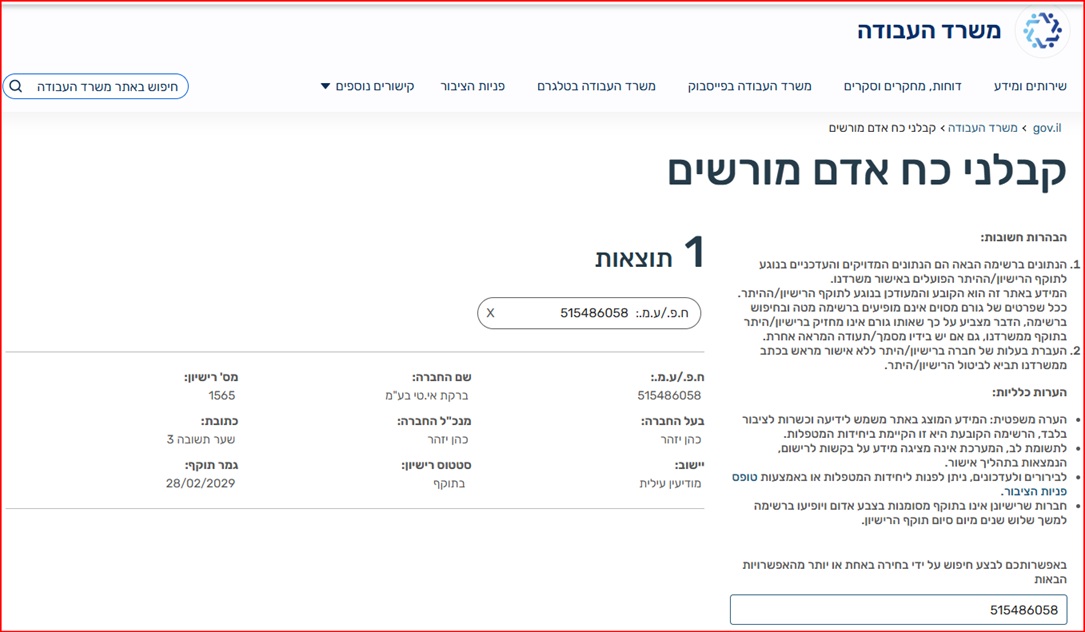 Verify the license on the Ministry of Labor website
Full details · Manpower contractor license page →
Verify the license on the Ministry of Labor website
Full details · Manpower contractor license page →