Section 102 stock options in Israel
The general guide to Section 102: the tracks, the trustee and the holding period.
Read moreWe use essential cookies to make the site work. With your consent, we also use measurement and advertising cookies from Google and Microsoft to understand how the site is used, improve it and measure our advertising. We never sell your data.
You can change your choice at any time via “Cookie settings” at the bottom of every page.

Log in to your account, or sign up in a minute.
Pick whatever works for you · we're here.
Everything about NETO · transparent and available
Pick a convenient time · we'll confirm by phone/email
Hiring an Israeli employee through an EOR and want to give them stock options? You can. Under Section 102? No, when the EOR is not related to your company. Here is why, what applies instead, and how to choose between your own Israeli entity, an EOR, or an EOR now and your own entity later.
The short answer: an employee hired through an EOR can receive stock options or RSUs in your company. But not under Section 102 when the EOR is not related to your company. Section 102 applies only to shares of an "employing company": the employer itself, a company that controls it or that it controls, or a sister company. When the employer is an EOR with no control relationship with you, your company does not meet that definition. So the Israel Tax Authority (ITA) treats these options as generally taxed under Section 3(i).
What this means in practice: the employee generally pays tax at exercise, as ordinary income at their marginal rates, not at the 25% capital gains rate. When NETO is the official employer, it includes this income in the payslip and withholds the tax under Section 3(i) and applicable law, based on data from your plan administrator. If you want Section 102, you need your own Israeli company that employs the workers directly, or a branch approved by the Director of the Israel Tax Authority. You can also start through an EOR and move to your own entity as the team grows.
Why companies grant equity, in the Israel Tax Authority's words:
The distinctive feature of equity compensation is that it encourages the grantee to make a greater effort at work and, at the same time, improves the company's performance and maximizes its profits. It does so by aligning the grantee's interests (the link) with those of the company's shareholders (shared risk and reward), and by creating a sense of belonging and a fruitful long-term partnership between the employee and the place that provides their livelihood. That is why equity compensation is sometimes called "golden handcuffs".
Israel Tax Authority, professional circular 1/2024, 9 December 2024 (Hebrew, PDF), our translation
In plain terms: equity lets a company reward and retain employees and tie them to its success without paying cash now. That is why it matters to get the tax route right.
Section 102 of the Israeli Income Tax Ordinance is a tax-relief regime. On its capital gains track, the capital gain on the shares is taxed at 25%, provided a trustee holds them for at least 24 months from the allotment date (s. 102(b)(2), Hebrew).
But the relief applies only when the shares belong to an "employing company". The law defines it in only three ways (s. 102(a), Hebrew):
When you hire through an EOR, the employer in Israel is the EOR. The Income Tax Rules point the same way: the "employer" is the company in which the employee receiving the shares is directly employed (Rule 1 of the Income Tax Rules (Tax Benefits in Allotment of Shares to Employees), 2003, Hebrew). There is no control relationship between your company and the EOR. So your company is not an "employing company", and its shares generally do not qualify for Section 102. Approving a plan or appointing a trustee does not change this, because the identity of the granting company is the threshold condition.

The Israel Tax Authority has said so explicitly. ITA professional circular 9/2025 (11 November 2025), section 1.5: income from exercising an option over shares of a company that is not an employing company is taxed under the Section 3(i) regime, and Section 102 does not apply to it. Full circular (Hebrew, PDF)
And in ITA professional circular 1/2024 (9 December 2024), section 7.4: equity compensation granted by a company that is not an employing company falls under Part B of the Ordinance only (that is, regular taxation, not under Section 102), and a "no" answer to that question in the plan questionnaire is marked as a "red flag". Full circular (Hebrew, PDF)
Our search of public databases found no published tax ruling that allows Section 102 for employees of an employer unrelated to the granting company (as of 19 November 2026).
| Who employs the worker in Israel | Section 102 possible? | What applies | What it takes |
|---|---|---|---|
| Your Israeli subsidiary | Yes | Section 102, usually the capital gains track with a trustee | An approved trustee, and a plan filed at least 30 days before the allotment (Rule 4(a), Hebrew) |
| The foreign company itself, through a branch or permanent establishment in Israel | Yes, with the ITA Director's approval | Section 102 | A green-track application (Form 952, Hebrew). It may create Israeli corporate tax exposure; check with a tax advisor |
| An EOR unrelated to you, such as NETO | No | Section 3(i): tax at exercise, as ordinary income | Withholding and reporting through the EOR's payroll |
| A freelancer, not an employee | No. Section 102 covers employees only | Section 3(i) | Tax at exercise, as income under section 2(1) or 2(2) (circular 1/2024, s. 2.1.1, Hebrew) |
Section 3(i) is not a penalty. It is simply the regular route. The employee still receives real options in your company, and the tax is paid later, at exercise. The difference from Section 102 is the tax rate and the point at which it is set.

In some cases the classification may differ, for example business income instead of employment income. This mainly affects National Insurance and withholding duties. Check with a tax advisor.
Each card starts with something employers often assume. Flip it to see what the law and the Israel Tax Authority actually say, with the source.
An EOR can file a Section 102 plan for our company's options.
Section 102 applies only to shares of an "employing company": the employer itself, a company linked to it by control, or a sister company. An EOR that is not related to you does not make your company one, so the options are taxed under Section 3(i).
Source: ITA professional circular 9/2025, s. 1.5 (Hebrew, PDF)
Appointing a trustee and filing a plan solves the problem.
No. The identity of the granting company is the threshold condition. Approving a plan or appointing a trustee does not turn your company into an employing company.
Employees hired through an EOR cannot get options at all.
They can. Your company grants real options or RSUs under its regular equity plan. They are generally taxed under Section 3(i), at exercise.
Under Section 3(i), the employee pays tax on the day the options are granted.
For a non-tradable option, there is generally no tax at grant. The tax is deferred to exercise, and the benefit is then taxed as employment income at the employee's marginal rates.
Source: ITA professional circular 9/2025, s. 2.3 (Hebrew, PDF)
A manpower contractor license makes the EOR a Section 102 trustee.
A trustee is a person approved as trustee by the ITA assessing officer, usually a lawyer or an accountant. A manpower contractor license is not trustee status, and NETO does not act as a trustee.
Once you start with an EOR, Section 102 is closed to you for good.
You can move to your own Israeli subsidiary later. Once it employs the team, a Section 102 plan can be filed at least 30 days before new allotments. Grants from the EOR period generally stay under Section 3(i).
Source: Rule 4(a) (Hebrew) · Guide: moving from an EOR to a subsidiary
There is no single right answer. It depends on the size of the team, how central equity is to your offer, and how fast you need to start.

| Route | When it fits | What it takes | Pros | Cons |
|---|---|---|---|---|
| A. EOR through NETO, equity under 3(i) | No Israeli entity, a small team, a fast start, and equity is part of the package but not the core | An agreement with NETO, your regular equity plan, and exercise data passed to payroll | Start without opening a company. The worker is a salaried employee from day one, with full statutory rights. Payroll and withholding sit with a licensed employer | No 25% capital gains track. Tax at exercise at marginal rates, and generally National Insurance contributions as well |
| B. Israeli subsidiary and a Section 102 trustee plan | A large or permanent team, and equity is a central part of your offer to candidates | Incorporation, registration as an employer, payroll and bookkeeping, an approved trustee, and a plan filed 30 days before the allotment. The plan is deemed approved if the ITA assessing officer does not respond within 90 days (Rule 2(c), Hebrew), unless a "red flag" stops the clock (circular 1/2024, s. 4.9, Hebrew) | The employee's capital gain is taxed at 25%, if the trustee holds the shares for 24 months from allotment | Takes time to set up, plus ongoing administration. No Section 102 for allotments made less than 30 days after the plan was filed |
| C. Start with NETO, move to your own entity later | You need to hire now, but you plan a growing team and a lasting presence in Israel | Decide on the direction early and set up the company in parallel. When it is ready, it becomes the employer, and a Section 102 plan is filed before the next allotments | No hiring time lost. You move to your own entity when it pays off, and NETO supports the transition of the employees | Grants from the EOR period generally stay under 3(i). Whether they can move to Section 102 later is an open question; check with a tax advisor |
| D. Cash bonus or phantom units (cash payments tied to share value) | Equity is not central, or you want a simple mechanism | A bonus plan paid as salary through payroll | Simple and transparent. No trustee and no plan to file | Taxed as salary. No real ownership in the company. A cash cost for the company |
There is also a fifth, less common route: the foreign company employs directly through a branch or permanent establishment in Israel, with the approval of the ITA Director (green track, Form 952, Hebrew). This requires the foreign company itself to be the employer of the workers, and may create Israeli corporate tax exposure. It does not fit an EOR structure.
Want the broader EOR vs subsidiary comparison, beyond equity? Read EOR vs opening a subsidiary in Israel: full comparison.
Not sure what fits you? Answer six questions and get a reasoned recommendation.
Go to the decision toolAnswer six questions about your company, your team in Israel and the role equity plays in your offer. You will get a reasoned recommendation and see what each route means for your equity.
A foreign company that hires in Israel through an EOR can grant options, and they will generally be taxed under Section 3(i). If you want Section 102, you need an Israeli company that employs the workers directly. When the team is small and you need to start fast, an EOR usually fits. When the team is large and permanent and equity is central, consider your own entity. You can also start with an EOR and move later.
You have answered every question. Your recommendation is below.
The recommendation uses our own rules of thumb, not thresholds set by law.
The tool gives a general recommendation based on your answers. It is not legal or tax advice, and it does not consider your taxes abroad. For a specific plan, consult an Israeli tax advisor.
We would rather you choose right. Sometimes that means hiring through us, and sometimes it means opening your own company.


Issued by Israel's Ministry of Labor, valid until 28 February 2029. You can check it yourself in the government registry.
Check the gov.il registry (Hebrew)A bank guarantee is deposited with Israel's Ministry of Labor.
Anyone who works through NETO is registered as a salaried employee from day one: a payslip, National Insurance as an employee, and statutory rights including pension, vacation, sick leave and severance.
More than 110,000 workers and more than 8,000 employers have worked through NETO.
NETO's commission is 5% of the invoice amount before VAT, and it is derived from the invoice the client pays.
Good to know: Israel's Employment of Workers by Manpower Contractors Law (Hebrew) sets rules for long engagements through a manpower contractor at the same client (section 12A), with an exception for computing roles (section 13A). We will explain up front how they apply to you. A manpower license is a permit to employ; it does not make NETO a Section 102 trustee.
Further reading: Employer of Record in Israel · Manpower contractor license · Payroll in Israel for foreign companies
These are official Israeli sources and are published in Hebrew.
The binding text is the official version published in the Israeli Official Gazette and by the Israel Tax Authority.
The general guide to Section 102: the tracks, the trustee and the holding period.
Read moreThe full comparison between hiring through an EOR and running your own Israeli company.
Read moreHow a company abroad employs people in Israel through NETO.
Read moreAn employee hired through an EOR can receive options in your company, and they will generally be taxed under Section 3(i), at exercise. Section 102 requires an Israeli company that employs the workers, or an approved branch. When the team is small and you need to start fast, an EOR, for example through NETO, usually fits. When the team grows and equity becomes central, consider your own entity; you can start with NETO and move later.
We will walk you through the structure and tell you honestly whether an EOR fits you now or whether you should open a company.
 YC
Every section, organized by topic. Browse the full hierarchy or jump straight in.
Adjust the site to your needs
Here you can ask to see the data we hold about you, correct it, delete it, withdraw consent you gave, or stop receiving our emails and alerts. We reply within 30 days, and handle removal requests within 7 business days. Privacy policy
Barkat I.T Ltd · trading as NETO · is a licensed manpower company (license 1565), supervised by the Israeli Ministry of Labor.
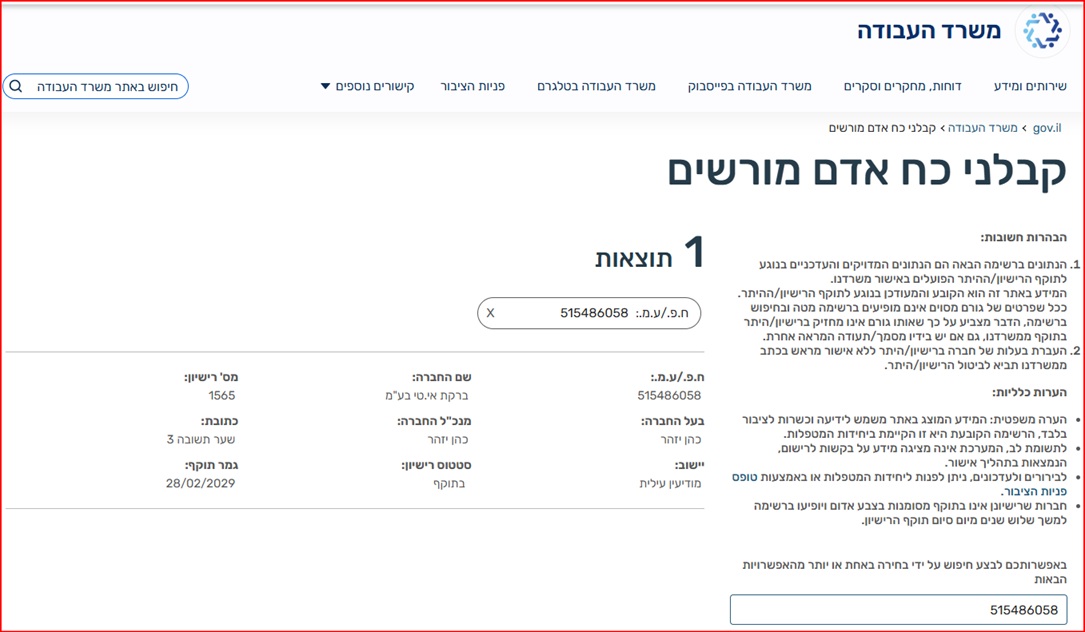 Verify the license on the Ministry of Labor website
Full details · Manpower contractor license page →