EOR vs. opening a subsidiary in Israel
Two legitimate ways to employ people in Israel · an Employer of Record or your own local entity. Here is an honest, head-to-head comparison of cost, speed, compliance, control and exit · and when each is genuinely the right call.
AI summary · EOR vs Subsidiary IsraelClick to read the page summary
This balanced comparison weighs using an Employer of Record versus opening a subsidiary in Israel across setup time, cost, compliance, control, IP, and exit. The cost picture is framed as fixed versus variable, and the guide explains who carries the risk and who stays in charge. It also covers intellectual property, banking, and tax footprint. If you are unsure, it suggests starting lean with an EOR before committing to an entity.
Same goal, two very different paths
You have found the talent in Israel. Now you need to employ them legally. There are two established routes, and the right one depends less on which is "better" and more on your scale, timeline and long-term plans.
With an Employer of Record (EOR), a licensed local company becomes the legal employer of your workers in Israel. You keep full day-to-day control; the EOR carries the employment contracts, payroll, taxes, pension and compliance. No local company, no registration · you can hire in Israel without a local entity.
With a subsidiary (or branch), you register and own an Israeli company. It opens files with the tax authorities and National Insurance, holds a local bank account, and employs people directly. You get maximum control and a permanent local footprint · in exchange for setup time, fixed cost and ongoing legal and accounting responsibility.
- EOR · speed, low fixed cost, compliance handled · built for small teams and market entry.
- Subsidiary · full ownership and control · built for scale and a long-term presence.
- Both give the employee identical, legally mandated social rights.
The dimensions that actually decide it
Neither model is universally "cheaper" or "safer". The honest answer depends on how these dimensions weigh against your specific situation.
How quickly your first employee can legally start · days versus months.
One-time setup plus the fixed overhead of running the model each month.
Who carries liability for Israeli labor law, payroll filings and terminations.
Operational control is yours in both · legal and structural control differs.
How intellectual property is held and whether you need a local bank account.
How easily you grow, shrink, or wind the arrangement down when plans change.
EOR vs subsidiary · full comparison
A balanced view across the decision. Figures are described qualitatively where a precise number depends on salary, sector and provider · always confirm specifics for your case.
| Dimension | Employer of Record (EOR) | Your own subsidiary |
|---|---|---|
| Time to first hire | A few days | Typically months to register and open all files |
| Local entity registration | Not required | Required · Registrar of Companies, tax & National Insurance files |
| Upfront setup cost | None | Incorporation, legal & accounting setup fees |
| Ongoing fixed overhead | A management fee per employee · no fixed infrastructure | Local accountant, lawyer, payroll system & filings · regardless of headcount |
| Israeli labor-law liability | Carried by the licensed EOR (legal employer) | Carried by your entity and its directors |
| Payroll, tax & pension filing | Handled by the EOR | Your entity's responsibility |
| Day-to-day control of work | Fully yours | Fully yours |
| Structural / legal control | Contractual · via the service agreement | Full ownership of the entity |
| Local bank account & contracting | Handled through the EOR | Your own Israeli account & local contracts |
| Intellectual property | Assigned to your company by contract | Can be held directly in the entity |
| Local grants & incentives | Generally accessed via your own entity | Entity can apply directly |
| Permanent-establishment exposure | Reduced · provider is the legal employer | Entity is a taxable local presence by design |
| Best fit by scale | 1–10 hires, market test, fast entry | Larger, long-term teams & permanent operations |
| Exit / wind-down | End the service cleanly · standard offboarding | Formal entity dissolution & deregistration |
| Employee social rights | Full · identical to direct employment | Full · identical to direct employment |
The cost picture · fixed vs variable
The clearest difference is the shape of the cost, not just its size. A subsidiary carries fixed cost: incorporation and professional-services setup at the start, then ongoing accounting, legal and payroll infrastructure every month · whether you employ one person or twenty. That fixed base is why an entity gets more efficient the more people you hire onto it.
An EOR carries variable cost: no entity setup, no retainers, no payroll system to run. You pay the salary and mandatory employer costs plus a management fee per employee. For a small team, that almost always comes out lower · there is simply no fixed overhead to spread. To model the full number, combine the fee with Israel's mandatory employer costs; our employer cost in Israel guide and Israel payroll explainer break those down.
- EOR · lower and predictable for small headcount; scales with each hire.
- Subsidiary · higher fixed base, but the per-employee cost falls as the team grows.
- There is a crossover point · at sufficient scale, an entity can be the cheaper model.

Who carries the risk · and who stays in charge
Israeli labor law is comprehensive and strictly enforced · from pension from month one to mandatory notice, severance and the pre-termination hearing ("Shimua"). The question is who is liable for getting it right.
With an EOR, that liability transfers to the licensed provider from day one. The provider is the legal employer, files payroll and taxes, and manages compliant onboarding, mandatory benefits and termination. With a subsidiary, your entity and its directors carry that responsibility directly · which means building or buying local HR, payroll and legal capability.
Crucially, day-to-day control is identical in both models. You set the tasks, goals and performance management. What differs is structural: a subsidiary gives you a company you own outright, while an EOR gives you a contractual relationship with the legal employer. If you want to understand the underlying obligations either way, see our overview of Israeli labor law and employer rights.
Intellectual property, banking & tax footprint
For many companies this · not cost · is the deciding factor. A subsidiary is a real local presence; an EOR deliberately avoids creating one.
Under a properly structured EOR, IP created by the employee is assigned to your company through the contract. A subsidiary can hold IP directly in the Israeli entity · which some groups prefer for tax planning or strategic reasons. Confirm the exact structure with counsel.
A subsidiary opens its own Israeli bank account and can sign local supplier, lease and customer contracts in its own name. With an EOR you avoid that overhead entirely · payments flow through the provider · but you do not hold a local account.
A subsidiary is, by design, a taxable local entity. A properly structured EOR can reduce permanent-establishment exposure because the provider is the legal employer · though PE is fact-specific. This is not tax advice · consult your international tax counsel.
Israeli government and innovation incentives are generally granted to a local entity. If accessing them directly is central to your plan, that points toward a subsidiary; an EOR is optimized for employment, not for holding local benefits.
Not sure which route fits? Start lean.
Most companies entering Israel begin with an EOR to move fast and stay compliant, then revisit a subsidiary once headcount and long-term commitment justify the fixed cost. NETO makes the first step simple · and supports the transition later.
When an EOR is the better choice
The EOR model shines when speed and flexibility matter more than owning a local structure. It is usually the right call when you are:
- Hiring a small team · roughly 1–10 people · or a single key person.
- Testing the Israeli market before committing to a permanent presence.
- Under time pressure and need someone to start in days, not months.
- Converting an existing Israeli contractor to a compliant salaried employee · see the employee vs contractor test.
- Keen to avoid fixed overhead and keep the option of a clean, simple exit.
When a subsidiary is the better choice
A subsidiary earns its fixed cost when Israel becomes a strategic, long-term part of your business. Lean toward your own entity when you are:
- Building a large, long-term workforce where the per-employee cost of an entity drops below EOR fees.
- Establishing a permanent operational or R&D center with offices and local operations.
- Needing a local legal entity for banking, local contracts, fundraising or M&A.
- Wanting to hold IP directly in Israel or access government grants and incentives.
- Ready to own the compliance and administration in-house for full structural control.
The two are not mutually exclusive. A common, pragmatic path is to start with an EOR for speed and transition to a subsidiary once scale justifies it · read more on how to build a remote team in Israel.
NETO · the licensed EOR route into Israel
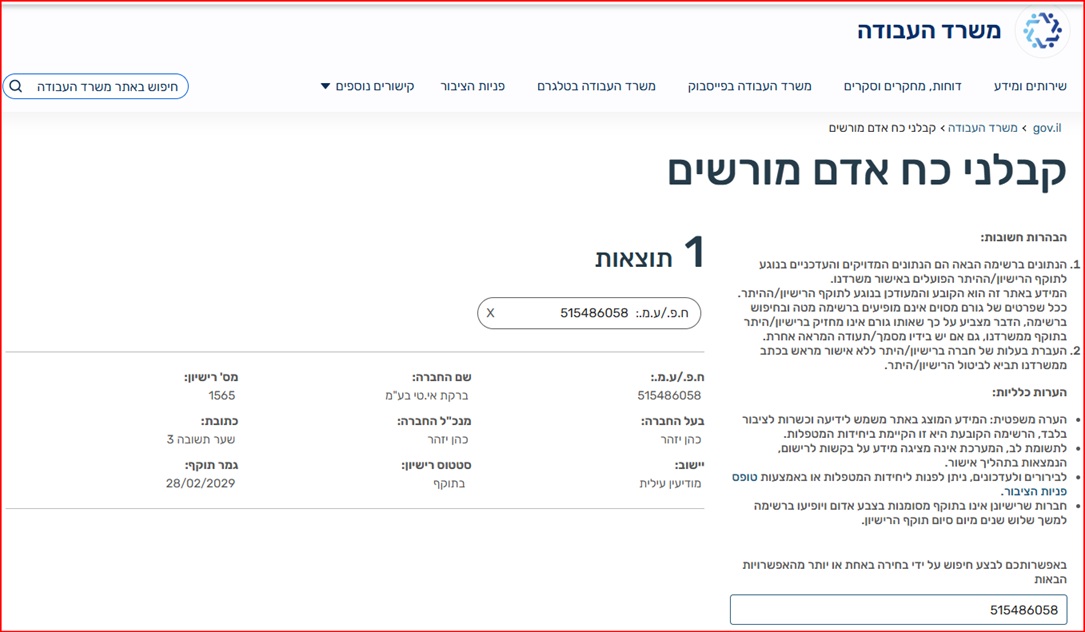
NETO operates through Bareket IT Ltd. under Registered Manpower Contractor License No. 1565, supervised by Israel's Ministry of Labor, with guarantees deposited to protect employee wages. That license is what lets NETO act as the legal employer on your behalf · so you can employ people in Israel without opening a subsidiary.
If your situation points to the EOR side of this comparison · a small team, a fast start, a market test, or a contractor to regularize · NETO handles the entire employment lifecycle: compliant contracts, payroll, taxes, pension, social rights and termination, all in one transparent system. Explore NETO EOR solutions, our EOR services for foreign companies, or verify the manpower contractor license.
Comparing NETO against global EOR platforms specifically? See our NETO vs Global EOR Platforms breakdown.
Watch · how it works
Two minutes that show the whole model, start to finish.
EOR vs subsidiary · common questions
What is the difference between an EOR and a subsidiary?
Which is faster to set up?
Is an EOR cheaper than a subsidiary?
When does a subsidiary make more sense?
Can I start with an EOR and open a subsidiary later?
Who owns IP created by an EOR employee?
Does an EOR reduce permanent-establishment risk vs a subsidiary?
Is NETO a licensed employer in Israel?
In summary
Neither model wins outright · they solve different problems. An Employer of Record is the faster, lower-fixed-cost, lower-risk way to start employing people in Israel, ideal for small teams and market entry. A subsidiary is the model for scale · a large, permanent presence where you need full structural control, local banking, direct IP holding or access to incentives. Many companies begin with an EOR and convert later. Where the EOR route fits, NETO provides it under licensed manpower contractor #1565.
- Speed: EOR in days · subsidiary in months.
- Cost shape: EOR variable & low-fixed · subsidiary fixed, efficient at scale.
- Compliance: EOR carries liability · subsidiary carries it in-house.
- Structure: subsidiary owns local entity, banking & direct IP · EOR keeps it contractual.
Let's map the right route for your Israel hiring
Tell us your headcount, timeline and plans, and we'll recommend whether an EOR or a subsidiary fits · with full transparency and a fast start if you go the EOR way.
The law requires 6% · at NETO it is 8.33%
The mandatory pension extension order obliges every employer to contribute 6% of salary to the severance component, and section 14 of the Severance Pay Law applies to that money automatically. NETO contributes the full severance component by default · 8.33% · so the ongoing contribution replaces severance pay in full and no top-up is due when the employment ends. An employer contributing less than 8.33% must top up severance at the end of the employment relationship.
A worker who declares they have no active pension fund, in a one-off engagement · there the contribution obligation begins only after six months of work. A worker with an active pension arrangement is entitled from day one, with contributions made retroactively after three months or at the end of the tax year, whichever is earlier.
General information · not legal advice. The binding text is the statute and the extension order themselves.