Section 102 stock options in Israel
The general guide to Section 102: the routes, the trustee and the holding period.
Read moreWe use essential cookies to make the site work. With your consent, we also use measurement and advertising cookies from Google and Microsoft to understand how the site is used, improve it and measure our advertising. We never sell your data.
You can change your choice at any time via “Cookie settings” at the bottom of every page.

Log in to your account, or sign up in a minute.
Pick whatever works for you · we're here.
Everything about NETO · transparent and available
Pick a convenient time · we'll confirm by phone/email
You do not need to wait for a local entity to start hiring. Employ your team now with NETO as the official employer, set up an Israeli subsidiary when it makes sense, and move the employees to it. From that point on, new grants can qualify for Section 102, subject to the rules.
The short answer: a foreign company can employ people in Israel through an EOR today and move to an Israeli subsidiary later. During the EOR period, the company's stock options are taxed under Section 3(i), because the EOR is not related to it. Once the subsidiary employs the team, the parent company counts as an "employing company" with respect to them, and a Section 102 plan with a trustee can be filed. It must be filed at least 30 days before the allotment.
What NETO does: NETO employs the team as the official employer until your subsidiary is ready. During that time it includes the equity income in the payslip and withholds tax under Section 3(i) and applicable law, based on data from the plan administrator, and it coordinates the transition of the employees to your subsidiary with you. Grants made during the EOR period do not move to Section 102 automatically.
Setting up an Israeli subsidiary is a big decision. There is no reason to hold up hiring because of it. This is what the path looks like in three stages.

NETO is the official employer (Employer of Record). Your people are salaried employees from day one, and you manage their work. Options you grant during this period are taxed under Section 3(i).
Section 3(i)For example, when the team grows, when your presence in Israel becomes permanent, or when equity becomes a central part of your offer to candidates.
Your decisionNETO coordinates the transition of the employees to your subsidiary with you. Once the subsidiary employs them, you can file a Section 102 plan for future allotments.
Section 102 possible, subject to the rulesWhen exactly should you open a company? It is mainly a business decision: the fixed cost of a company and a trustee, weighed against how much equity matters to your team. To help you choose, there is a short decision tool in the guide to stock options for EOR employees, and a full comparison of an EOR and a subsidiary.
Need to hire in Israel before your entity is ready? Start with NETO, and move when you are ready.
Register as an employerChoose the stage that describes your company today. You will see what it means for equity, and what to do next.
You have not granted anything in Israel yet. The structure you choose decides the tax: through an EOR that is not related to you, grants are taxed under Section 3(i). Section 102 needs an employer in Israel related to you through control, usually a subsidiary.
Where NETO fits: NETO can be the official employer from the first hire, as a licensed manpower contractor (license 1565).
Options you grant now are taxed under Section 3(i): tax at exercise, generally as employment income. NETO includes the equity income in the payslip and withholds tax under Section 3(i) and applicable law, based on data from the plan administrator.
Where NETO fits: NETO employs your team, runs payroll and coordinates with you and the plan administrator.
Until the employees actually move, the subsidiary is not their employer, so options you grant are still taxed under Section 3(i).
Where NETO fits: NETO keeps employing the team in the meantime, so hiring does not stop.
The subsidiary becomes the employees' direct employer, and your company, which controls it, becomes an "employing company" with respect to them. Grants from the EOR period generally stay under Section 3(i) and do not move to Section 102 automatically.
Where NETO fits: NETO coordinates the transition of the employees to your subsidiary with you.
New grants can qualify for Section 102, subject to the rules and to approval of the plan. The company chooses the route within Section 102.
Where NETO fits: The employees who moved are employed by the subsidiary, not through NETO.
General information based on the sources on this page. Not legal or tax advice.
Section 102 applies only to shares of an "employing company". Among other things, that is a company that controls the employer (Section 102(a), Hebrew). A "controlling shareholder" is defined in Section 32(9) (Hebrew) and includes, among other things, a person holding at least 10% of the shares or voting power.
As long as your people are employed through an EOR that is not related to you, these conditions are not met. The full explanation is in the guide to stock options for EOR employees, and the Section 102 routes are explained in the Section 102 guide.

Some steps depend on you, and some are fixed by law. The only time periods shown here are the ones the law or the Rules set. How long the other steps take depends on you and the professionals who advise you.
Filing a Section 102 plan is a regulated process. According to the Israel Tax Authority, about 700 allotment plans are filed for its approval each year. By comparison, according to the same circular, about 7,000 compensation plans are filed with the US Internal Revenue Service (IRS) (Professional Circular 01/2024, section 1.5, page 3, Hebrew, PDF; figures as of December 2024).
Register the company, register as an employer with the authorities, open a bank account and set up payroll. Do this with an Israeli lawyer and accountant.
The subsidiary becomes their direct employer. NETO coordinates the transition with you.
A trustee is a lawyer, an accountant, a company wholly owned by lawyers or accountants, or a person allowed to act as a trustee under the Joint Investment Trust Law. The employing company, its controlling shareholder or its employee cannot act as trustee, apart from a narrow exception (Rule 3, Hebrew). The plan will not be approved if, among other things, it has more than one trustee or more than one route (Rule 6).
The plan is filed online (Professional Circular 01/2024, section 3.4, Hebrew), at least 30 days before the allotment date (Section 102(a), Hebrew; Rule 4(a)).
At least 30 days before the allotmentThe assessing officer approves the plan and the trustee. If the officer does not respond within 90 days of receiving the notice, they are deemed approved (Section 102(a)). If a "red flag" is raised, the approval timeline stops (Professional Circular 01/2024, section 4.9, Hebrew).
90 days, unless a red flag is raisedThe shares or options are deposited with the trustee on the allotment date (Section 102(a), "allotment of shares through a trustee").
Under the capital gains route, 24 months "from the day on which the shares were allotted and deposited with a trustee" (Section 102(a), "end of the period", our translation). The count starts from the allotment and deposit, not from the business decision to grant.
24 months from allotment and depositThe allotment is reported on Form 146 within 120 days of the end of the quarter (Rule 5), and the trustee files an annual report on Form 156 by 30 April (Rule 8).
Steps 4 and 5 are two separate conditions: the filing date relative to the allotment, and the approval of the plan and the trustee. The full text is in Section 102(a) (Hebrew) and in the Rules (Hebrew).
Moving to a subsidiary opens the way to Section 102 for new grants. It does not automatically turn earlier grants into Section 102 grants.

NETO employs your team until your subsidiary is ready and supports the transition of the employees to it. The Section 102 plan is filed by your company, with a trustee and your advisers.


| Before the move | During the move | After the move | |
|---|---|---|---|
| Employer in Israel | NETO, as the official employer | The employees move from NETO to the subsidiary | Your subsidiary |
| Tax on equity | Section 3(i) | Existing grants generally stay under Section 3(i) | New grants: Section 102 possible, after a plan is filed at least 30 days before the allotment |
| What NETO does | Employs and runs payroll. Includes the equity income in the payslip and withholds tax under Section 3(i) and applicable law, based on data from the plan administrator. Coordinates with you and the plan administrator | Coordinates the transition of the employees to the subsidiary with you | The employees who moved are employed by the subsidiary, not through NETO |
| What you do | Grant options under your regular plan, and plan the subsidiary | Set up the company, get ready to employ and appoint a trustee | File the Section 102 plan, allot and deposit with the trustee, and report |
The law (Hebrew) sets rules for long-term employment through a manpower contractor at the same client. Take them into account when you plan the timing of the move.
Issued by Israel's Ministry of Labor, valid until 28 February 2029. You can check it yourself in the government registry.
Check the gov.il registry (Hebrew)A bank guarantee is deposited with Israel's Ministry of Labor.
Anyone who works through NETO is registered as a salaried employee from day one: a payslip, National Insurance as an employee, and statutory rights including pension, vacation, sick leave and severance.
More than 110,000 workers and more than 8,000 employers have worked through NETO.
NETO's commission is 5% of the invoice amount before VAT, and it is derived from the invoice the client pays.
A manpower contractor license is a permit to operate as a manpower contractor. It does not make NETO a trustee under Section 102.
Further reading: EOR for foreign companies · Manpower contractor license · Payroll in Israel for foreign companies
These are official Israeli sources and are published in Hebrew.
The binding text is the official version published in the Israeli Official Gazette and by the Israel Tax Authority.
The general guide to Section 102: the routes, the trustee and the holding period.
Read moreWhy there is no Section 102 through an EOR that is not related to your company, plus a decision tool: your own Israeli entity, an EOR, or a move later.
Read moreThe full comparison between employing through an EOR and your own Israeli company.
Read moreWhat applies to your people in Israel: Section 102 or Section 3(i), when the tax is due, and what appears on the payslip.
Read moreYou can employ in Israel through NETO today and open a subsidiary when your team and your equity plans justify it. Options granted until the move are taxed under Section 3(i), and NETO includes the income in the payslip. Once the subsidiary employs the team and a Section 102 plan has been filed at least 30 days before the allotment, new grants can qualify for Section 102. Earlier grants do not move automatically.
NETO employs your team as the official employer until your subsidiary is ready, and supports the transition of the employees to it.
 YC
Every section, organized by topic. Browse the full hierarchy or jump straight in.
Adjust the site to your needs
Here you can ask to see the data we hold about you, correct it, delete it, withdraw consent you gave, or stop receiving our emails and alerts. We reply within 30 days, and handle removal requests within 7 business days. Privacy policy
Barkat I.T Ltd · trading as NETO · is a licensed manpower company (license 1565), supervised by the Israeli Ministry of Labor.
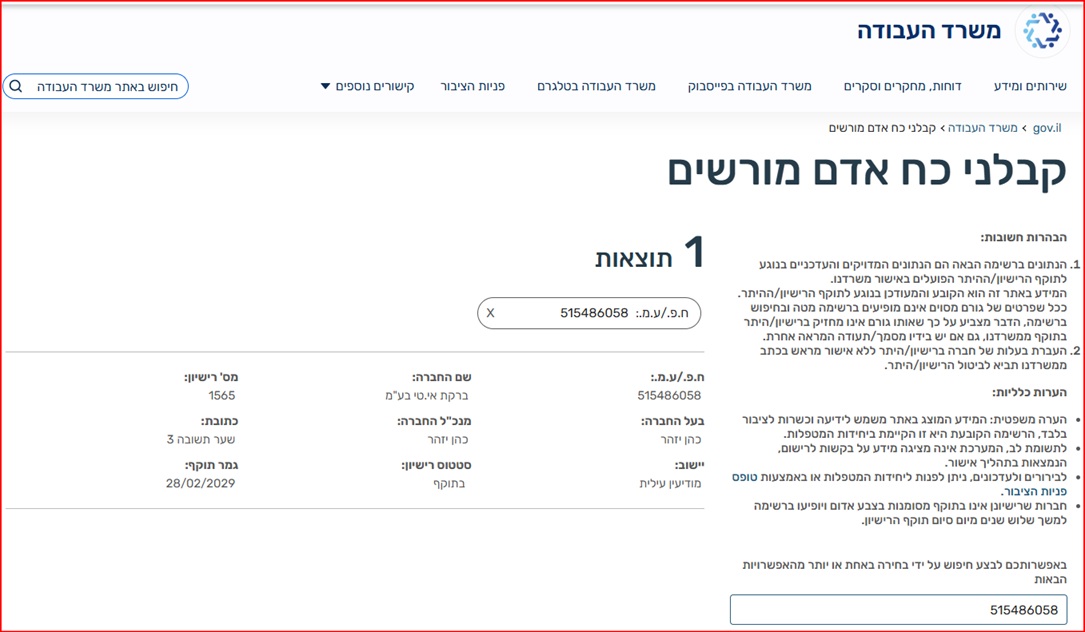 Verify the license on the Ministry of Labor website
Full details · Manpower contractor license page →