
Basic Law: Freedom of OccupationEvery section in full · the statute text alongside a plain-language explanation
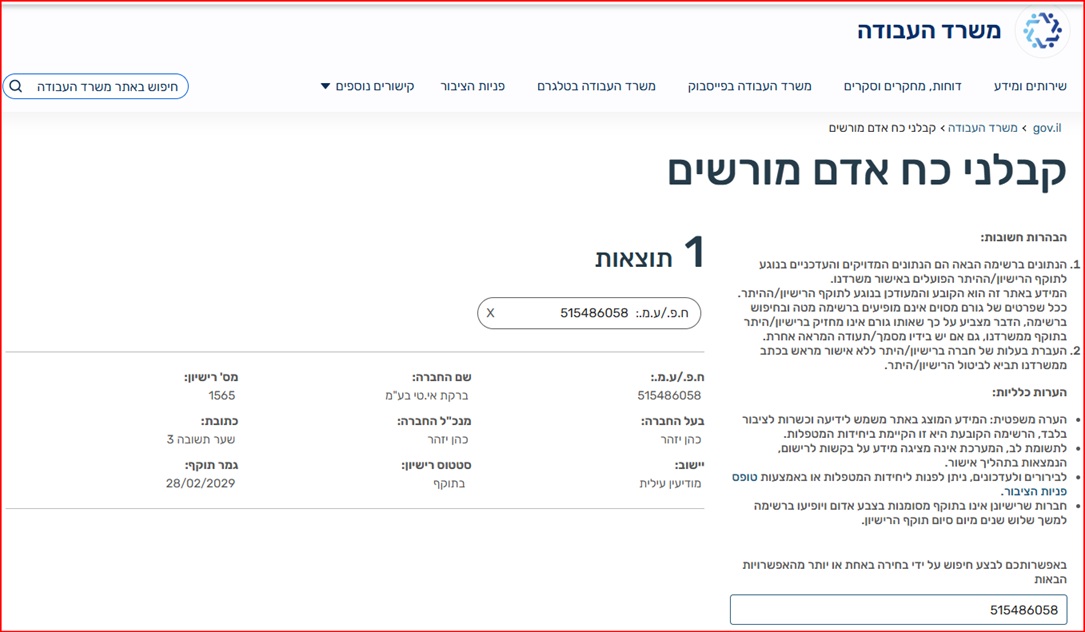
The Basic Law that enshrines the right of every citizen or resident to engage in any occupation, profession or trade · and defines when it may be limited, who must respect freedom of occupation and how the Basic Law can be amended. On this page · section by section, an unofficial translation of each section, followed by the exact Hebrew statute text from Nevo and a plain explanation. NETO is a licensed manpower contractor under licence 1565.
Manpower licence 1565 Basic Law · like a constitution Original and updated versions
Basic Law · like a constitutionConstitutional right
1565Manpower contractor licence
AI check · fidelity to the statuteThe section text in the “Statute text” blocks is quoted verbatim in the original Hebrew, cross-checked against the official version on Nevo. The English translations are unofficial and provided for convenience; the headings, explanations and examples are NETO additions and are marked as such.
100%match to source
Official text · Nevo
Hebrew original
AI summary · Basic Law: Freedom of OccupationClick to read the page summary
Basic Law: Freedom of Occupation provides that every citizen or resident is entitled to engage in any occupation, profession or trade (section 3). This right may be limited only under the limitation clause (section 4) · by a law befitting the values of the State, for a proper purpose and to an extent no greater than required. Every governmental authority must respect freedom of occupation (section 5); the law is stable against emergency regulations (section 6) and entrenched against change (section 7). The override clause (section 8) allows a deviating law passed by a majority of Knesset members · which expires after four years. Below · the exact Hebrew text of each section with an unofficial translation and a plain explanation, two examples, a short knowledge quiz and the original version.
- The right · every citizen or resident may engage in any occupation, profession or trade (section 3).
- Limitation clause · a violation only by a befitting law, for a proper purpose and to the extent required (section 4).
- Duty of the state · every governmental authority must respect freedom of occupation (section 5).
- Override clause · a deviating law by a Knesset majority · expires after four years (section 8).
- Statute text · every section in full, clearly marked as the language of the law.
- The information is for guidance only · the binding version is the one published in Reshumot.
Quick navigation
Background
About Basic Law: Freedom of Occupation
Basic Law: Freedom of Occupation ("חוק-יסוד: חופש העיסוק") is intended to regulate in law the ability of every citizen or resident of Israel to earn a living. A Basic Law is like a constitution · since Israel does not yet have a full constitution, the Basic Laws are the closest thing to one. The purpose of the law is to set out who may work, in what one may work, and who may limit freedom of occupation and in what circumstances.
The law was amended, so this page presents both versions · first the updated version in force today (11 sections), and after it the original version (6 sections). Each section is shown in its exact wording, followed at once by a plain-language explanation. NETO operates as a manpower company and holds a manpower contractor licence (no. 1565) that allows it to employ workers in Israel lawfully.
Constitutional right
Freedom of occupation is enshrined as a basic right at the level of a Basic Law.
Duty of the state
Governmental authorities are bound to respect freedom of occupation.
Proportionate limitation
A violation only by law, for a proper purpose and to the extent required.
Entrenched law
Amendment only by a Basic Law passed by a majority of Knesset members.
Text quoted from Nevo · updated as of 14-11-2021.

1565Manpower licence · Ministry of Labor
At a glance
Basic Law: Freedom of Occupation · in numbers
Status
Basic Law constitutional level · like a constitution
One of the Basic Laws protecting human rights in Israel.
The right
Every citizen or resident section 3 · any occupation, profession or trade
A broad right · work as an employee, as self-employed or as a freelancer.
Override clause
4 years section 8 · validity of a deviating law
A deviating law passed by a Knesset majority expires after four years.
Amending the law
Majority of Knesset members section 7 · a Basic Law only
The law may be amended only by a Basic Law passed by a majority of Knesset members.
The updated version · statute alongside explanation
Below is the version in force today, section by section. Each section shows first an unofficial English translation, then the statute text · the exact wording from the official source on Nevo, kept in the original Hebrew (the block labelled “Statute text”) · and then a plain-language explanation · the light-blue block labelled “Explanation · not part of the statute” is a NETO addition and is not part of the language of the law. The text is quoted from Nevo.
Section 1 · Basic principles
Unofficial translation
1. Fundamental human rights in Israel are founded upon the recognition of the value of the human being, the sanctity of human life and the principle that all persons are free; these rights shall be upheld in the spirit of the principles set out in the Declaration of the Establishment of the State of Israel.
1. זכויות היסוד של האדם בישראל מושתתות על ההכרה בערך האדם, בקדושת חייו ובהיותו בן-חורין, והן יכובדו ברוח העקרונות שבהכרזה על הקמת מדינת ישראל.
Explanation · not part of the statuteThe opening section declares the value base of the law · basic rights rest on the value of the human being, the sanctity of life and liberty, in the spirit of the Declaration of Independence. There is no concrete right here yet, but the spirit in whose light the whole law is to be read.
Section 2 · Purpose
Unofficial translation
2. The purpose of this Basic Law is to protect freedom of occupation, in order to establish in a Basic Law the values of the State of Israel as a Jewish and democratic state.
2. חוק-יסוד זה מטרתו להגן על חופש העיסוק כדי לעגן בחוק-יסוד את ערכיה של מדינת ישראל כמדינה יהודית ודמוקרטית.
Explanation · not part of the statuteThe purpose of the law · to protect freedom of occupation and enshrine it at a constitutional level, as part of the values of Israel as a Jewish and democratic state.
Section 3 · Freedom of occupation
Unofficial translation
3. Every citizen or resident of the State is entitled to engage in any occupation, profession or trade.
3. כל אזרח או תושב של המדינה זכאי לעסוק בכל עיסוק, מקצוע או משלח יד.
Explanation · not part of the statuteThe heart of the law · every citizen or resident has the right to choose and engage in any occupation, profession or trade. The right is broad and covers work as a salaried employee, as self-employed or as a freelancer.
Illustrative example
A freelancer who chooses to work independently is exercising exactly the right in section 3. Through a platform holding a manpower contractor licence (licence 1565) one can work and issue an invoice like a self-employed person, and enjoy the rights of a salaried employee · without opening a business file. This example is a NETO explanation and is not part of the language of the law.
Section 4 · Violation of freedom of occupation · the limitation clause
Unofficial translation
4. There shall be no violation of freedom of occupation except by a law befitting the values of the State of Israel, enacted for a proper purpose, and to an extent no greater than required, or by such a law by virtue of express authorization therein.
4. אין פוגעים בחופש העיסוק אלא בחוק ההולם את ערכיה של מדינת ישראל, שנועד לתכלית ראויה, ובמידה שאינה עולה על הנדרש, או לפי חוק כאמור מכוח הסמכה מפורשת בו.
Explanation · not part of the statuteThis is the “limitation clause” · freedom of occupation may be violated only where the cumulative conditions are met: the violation is by a law (or under a law by virtue of express authorization therein), a law befitting the values of the State, for a proper purpose, and to an extent no greater than required (proportionality).
Illustrative example
An occupation requiring a licence · driving a taxi, medical practice or running a manpower company · does not conflict with freedom of occupation. The licence requirement is legitimate as long as it is grounded in law, for a proper purpose and to the extent required. NETO itself operates under manpower contractor licence 1565, supervised by the Ministry of Labor. This example is a NETO explanation and is not part of the language of the law.
Section 5 · Application
Unofficial translation
5. Every governmental authority is bound to respect the freedom of occupation of every citizen or resident.
5. כל רשות מרשויות השלטון חייבת לכבד את חופש העיסוק של כל אזרח או תושב.
Explanation · not part of the statuteThe law binds every governmental authority · government, Knesset, local authorities and courts · to respect freedom of occupation. This is an active duty of the state towards the individual.
Section 6 · Stability
Unofficial translation
6. Emergency regulations shall not have the power to change this Basic Law, temporarily suspend its effect or set conditions upon it.
6. אין בכוחן של תקנות-שעת-חירום לשנות חוק-יסוד זה, להפקיע זמנית את תוקפו או לקבוע בו תנאים.
Explanation · not part of the statuteStability · the Basic Law cannot be changed, temporarily suspended or made conditional by emergency regulations. The right is protected even in states of emergency.
Section 7 · Entrenchment
Unofficial translation
7. This Basic Law shall not be varied except by a Basic Law passed by a majority of the members of the Knesset.
7. אין לשנות חוק-יסוד זה אלא בחוק-יסוד שנתקבל ברוב של חברי הכנסת.
Explanation · not part of the statuteEntrenchment · amending the Basic Law requires another Basic Law passed by a majority of Knesset members (at least 61), and not by a chance majority of those present in the chamber.
Section 8 · Validity of a deviating law · the override clause
Unofficial translation
8.
(a) A provision of a law that violates freedom of occupation shall be valid even if it does not conform to section 4, provided that it is included in a law passed by a majority of the members of the Knesset and expressly states that it is valid notwithstanding this Basic Law; the validity of such a law shall expire four years from its commencement, unless an earlier date is fixed therein.
(b) The provision concerning expiry of validity, as stated in sub-section (a), shall not apply to a law passed before the end of one year from the commencement of this Basic Law.
8.
(א) הוראת חוק הפוגעת בחופש העיסוק תהיה תקפה אף כשאינה בהתאם לסעיף 4, אם נכללה בחוק שנתקבל ברוב של חברי הכנסת ונאמר בו במפורש, שהוא תקף על אף האמור בחוק-יסוד זה; תוקפו של חוק כאמור יפקע בתום ארבע שנים מיום תחילתו, זולת אם נקבע בו מועד מוקדם יותר.
(ב) ההוראה בדבר פקיעת תוקף, כאמור בסעיף קטן (א), לא תחול על חוק שהתקבל לפני תום שנה ממועד תחילתו של חוק-יסוד זה.
Explanation · not part of the statuteThis is the “override clause” · the Knesset may enact a law that violates freedom of occupation even where it does not meet the limitation clause (section 4), if the law was passed by a majority of Knesset members and expressly states that it is valid notwithstanding the Basic Law. The validity of such a deviating law is time-limited · it expires four years from its commencement.
Section 9 · Repeal
Unofficial translation
9. Basic Law: Freedom of Occupation – repealed.
9. חוק-יסוד: חופש העיסוק – בטל.
Explanation · not part of the statuteThe updated version replaced the earlier version of the Basic Law and repealed it · so the version in force today is the one before you, and not the original version brought below for comparison.
Section 10 · Transitional provision
Unofficial translation
10. Provisions of an enactment which, but for this Basic Law or the Basic Law repealed as stated in section 9, would have been valid on the eve of the commencement of this Basic Law shall remain in force until the 1st of Nisan 5762 (14 March 2002), unless repealed earlier; however, the said provisions shall be construed in the spirit of the provisions of this Basic Law.
10. הוראות חיקוק שאלמלא חוק-יסוד זה או חוק-היסוד שבוטל כאמור בסעיף 9, היו תקפות ערב תחילתו של חוק-יסוד זה יעמדו בתוקפן עד יום א' בניסן התשס״ב (14 במרס 2002), אם לא בוטלו קודם לכן, ואולם פירושן של ההוראות האמורות ייעשה ברוח הוראות חוק-יסוד זה.
Explanation · not part of the statuteA transitional provision · older laws that were in force before the Basic Law and conflict with it remained in force until 14 March 2002, but are to be construed in the spirit of the Basic Law. This is a temporary arrangement that has completed its role.
Section 11 · Amendment of Basic Law: Human Dignity and Liberty
Unofficial translation
11. In Basic Law: Human Dignity and Liberty:
(1) Section 1 shall be renumbered 1A, and it shall be preceded by:
Basic principles
1. “Fundamental human rights in Israel are founded upon the recognition of the value of the human being, the sanctity of human life and the principle that all persons are free; these rights shall be upheld in the spirit of the principles set out in the Declaration of the Establishment of the State of Israel.”
(2) In section 8, at the end there shall be added: “or by such a law by virtue of express authorization therein”.
11. בחוקי-יסוד: כבוד האדם וחירותו:
(1) סעיף 1 יסומן 1א ולפניו יבוא:
עקרונות יסוד
1. "זכויות היסוד של האדם בישראל מושתתות על ההכרה בערך האדם, בקדושת חייו ובהיותו בן-חורין, והן יכובדו ברוח העקרונות שבהכרזה על הקמת מדינת ישראל."
(2) בסעיף 8, בסופו יבוא: "או לפי חוק כאמור מכוח הסמכה מפורשת בו".
Explanation · not part of the statuteThe final section simultaneously amends Basic Law: Human Dignity and Liberty · adding to it a basic-principles section and broadening its limitation clause. The two Basic Laws were updated together.
NETO summary
The updated version sets the central principle · every citizen or resident has the right to engage in any occupation, profession or trade (section 3), and it may be limited only under the limitation clause (section 4). The law protects itself against emergency regulations (section 6) and is entrenched against change (section 7), and the override clause (section 8) allows only a temporary deviation. This summary is a NETO addition and is not part of the language of the law.
Current version of the law as of: 14-11-2021 · Basic Law: Freedom of Occupation
For comparison
The original version · statute alongside explanation
For comparison · the original version of the Basic Law (repealed by the updated version), section by section. In this version the right and the limitation are concentrated in a single section, and it comprises only six sections. Here too · an unofficial translation, then the statute text and a plain-language explanation.
Section 1 · Freedom of occupation
Unofficial translation
1. Every citizen or resident of the State is entitled to engage in any occupation, profession or trade; this right shall not be restricted except by a law, for a proper purpose and on grounds of the general good.
1. כל אזרח או תושב של המדינה זכאי לעסוק בכל עיסוק, במקצוע או משלח יד: אין מגבילים זכות זו אלא בחוק, לתכלית ראויה ומטעמים של טובת הכלל.
Explanation · not part of the statuteIn the original version the right and the limitation appear together in a single section · the right to engage in any occupation, and against it the possibility to limit it only by a law, for a proper purpose and on grounds of the general good.
Section 2 · Grounds for licensing
Unofficial translation
2. Where an occupation is conditional upon obtaining a licence, the right to a licence shall not be denied except pursuant to a law and on grounds of state security, public order, public peace and health, safety, the environment or the protection of public morals.
2. היה עיסוק מותנה בקבלת רשיון, לא תישלל הזכות לרישיון אלא על פי חוק ומטעמים של בטחון המדינה, תקנת הציבור, שלום הציבור ובריאותו, בטיחות, איכות הסביבה או הגנה על המוסר הציבורי.
Explanation · not part of the statuteWhere an occupation requires a licence · the right to a licence shall not be denied except pursuant to a law and on defined grounds only: state security, public order, public peace and health, safety, the environment or the protection of morals.
Section 3 · Application
Unofficial translation
3. Every governmental authority is bound to respect the freedom of occupation of every citizen or resident.
3. כל רשות מרשויות השלטון חייבת לכבד את חופש העיסוק של כל אזרח או תושב.
Explanation · not part of the statuteAs in the updated version · the duty of every governmental authority to respect the freedom of occupation of every citizen or resident.
Section 4 · Stability of the law
Unofficial translation
4. Emergency regulations shall not have the power to change this Basic Law, temporarily suspend its effect or set conditions upon it.
4. אין בכוחן של תקנות שעת חירום לשנות חוק-יסוד זה, להפקיע זמנית את תקפו או לקבוע בו תנאים.
Explanation · not part of the statuteEmergency regulations cannot change, temporarily suspend or make conditional the Basic Law.
Section 5 · Entrenchment of the law
Unofficial translation
5. This Basic Law shall not be varied except by a Basic Law passed by a majority of the members of the Knesset.
5. אין לשנות חוק-יסוד זה אלא בחוק-יסוד שנתקבל ברוב של חברי הכנסת.
Explanation · not part of the statuteAmending the law requires a Basic Law passed by a majority of Knesset members.
Section 6 · Transitional provision
Unofficial translation
6. Provisions of an enactment that were in force on the eve of the commencement of this Basic Law and are inconsistent with its provisions shall remain in force until the end of two years from the commencement of this Basic Law; however, the said provisions shall be construed in the spirit of the provisions of this Basic Law.
Signed on the Basic Law: Yitzhak Shamir · Prime Minister; Chaim Herzog · President of the State; Dov Shilansky · Speaker of the Knesset.
6. הוראות חיקוק שהיו בתוקף ערב תחילתו של חוק-יסוד זה, והן עומדות בסתירה להוראותיו, יעמדו בתקפן עד תום שנתיים מיום תחילתו של חוק-יסוד זה; ואולם פירושן של ההוראות האמורות ייעשה ברוח הוראות חוק-יסוד זה.
חתומים על חוק היסוד:
יצחק שמיר · ראש הממשלה
חיים הרצוג · נשיא המדינה
דב שילנסקי · יושב ראש הכנסת
Explanation · not part of the statuteA transitional provision in the original version · earlier conflicting laws remained in force for two years only, and are to be construed in the spirit of the Basic Law. The original version is signed by the Prime Minister, the President and the Speaker of the Knesset.
Legal notice. The statute text above is provided for information and ease of reading only · it is not legal advice and must not be relied upon as such. The text is quoted from Nevo. The binding version is the one published in Reshumot · in any conflict the official version prevails. For any legal use, consult the official text and a lawyer.
Knowledge check
Test your knowledge · Basic Law: Freedom of Occupation
Five short questions on the essentials of the Basic Law. Choose an answer for each · the system marks it at once and shows the relevant section.
1 Who is entitled to freedom of occupation under section 3 of the updated version?
Correct · under section 3, every citizen or resident of the State is entitled to engage in any occupation, profession or trade.
2 Under the limitation clause (section 4) · when may freedom of occupation be violated?
Correct · section 4 is the limitation clause · a violation only by a befitting law, for a proper purpose and to an extent no greater than required (or by such a law by virtue of express authorization therein).
3 Under the override clause (section 8) · how long does a deviating law remain in force?
Correct · under section 8(a), a deviating law expires four years from its commencement, unless an earlier date is fixed therein.
4 How can the Basic Law be amended under section 7?
Correct · under section 7, the Basic Law may be amended only by a Basic Law passed by a majority of Knesset members. Emergency regulations cannot change it (section 6).
5 Who must respect freedom of occupation under section 5?
Correct · under section 5, every governmental authority must respect the freedom of occupation of every citizen or resident.
The quiz is for illustration and learning only and is not legal advice. In any specific case, consult the language of the law and a professional.
1565Manpower contractor licence
NETO
NETO · freedom to work · without opening a self-employed file
Basic Law: Freedom of Occupation enshrines your right to engage in any occupation, profession or trade. NETO lets you exercise that right with ease · work and issue an invoice like a self-employed person, and enjoy the rights of a salaried employee, without opening a business file. NETO operates through Bareket I.T Ltd, a licensed manpower company supervised by the Ministry of Labor · holder of manpower contractor licence no. 1565.
- An invoice like a self-employed person · the rights of a salaried employee
- A payslip with national insurance, pension and social rights
- No business file, no annual returns
Want to exercise freedom of occupation · without opening a self-employed file?
NETO is a licensed manpower contractor under licence 1565, supervised by the Ministry of Labor · an invoice like a self-employed person and the full rights of a salaried employee. Talk to us and we will explain everything.
Basic Law: Freedom of Occupation · questions and answers
Is this English text the official version of the Basic Law?
No. The English on this page is an unofficial translation provided for convenience only. The single legally authoritative version of Basic Law: Freedom of Occupation is the original Hebrew text as published in the Official Gazette (Reshumot). Where the translation and the Hebrew differ, the Hebrew prevails.
What is Basic Law: Freedom of Occupation?
Basic Law: Freedom of Occupation is one of the Basic Laws of the State of Israel, whose purpose is to protect freedom of occupation in order to establish in a Basic Law the values of the State of Israel as a Jewish and democratic state (section 2 of the updated version). It provides that every citizen or resident of the State is entitled to engage in any occupation, profession or trade, and that every governmental authority must respect freedom of occupation.
Who is entitled to freedom of occupation under the Basic Law?
Under section 3 of the updated version, every citizen or resident of the State is entitled to engage in any occupation, profession or trade. Under section 5, every governmental authority must respect the freedom of occupation of every citizen or resident.
What is the limitation clause in the Basic Law?
Under section 4, there shall be no violation of freedom of occupation except by a law befitting the values of the State of Israel, enacted for a proper purpose, and to an extent no greater than required, or by such a law by virtue of express authorization therein. These are the conditions of the limitation clause.
What does the Basic Law say about licensing an occupation?
In the original version, section 2 provided that where an occupation is conditional upon obtaining a licence, the right to a licence shall not be denied except pursuant to a law and on grounds of state security, public order, public peace and health, safety, the environment or the protection of public morals. A licence requirement is therefore legitimate as long as it is grounded in law and serves a recognized purpose.
What is the override clause in the Basic Law?
Under section 8(a) of the updated version, a provision of a law that violates freedom of occupation shall be valid even if it does not conform to section 4, if it is included in a law passed by a majority of Knesset members and expressly states that it is valid notwithstanding this Basic Law; the validity of such a law expires four years from its commencement, unless an earlier date is fixed therein.
How can the Basic Law be amended?
Under section 6, emergency regulations do not have the power to change this Basic Law, temporarily suspend its effect or set conditions upon it. Under section 7, the Basic Law may be amended only by a Basic Law passed by a majority of Knesset members.
Why are two versions shown on this page?
The Basic Law was amended, so we present both versions · the updated version in force today (11 sections, as of 14-11-2021) and the original version (6 sections and the signatures of the Prime Minister, President and Speaker of the Knesset). This lets you compare and see the development, including the addition of the basic principles, the purpose of the law and the override clause.
What is NETO's manpower contractor licence?
NETO operates through Bareket I.T Ltd, a licensed manpower company supervised by the Ministry of Labor, holding manpower contractor licence no. 1565.
In summary
Basic Law: Freedom of Occupation enshrines at a constitutional level the right of every citizen or resident to engage in any occupation, profession or trade, defines when it may be limited (the limitation clause), who must respect the right and how the law can be amended. NETO makes it easy to exercise freedom of occupation · under manpower contractor licence 1565, supervised by the Ministry of Labor.
- The right · every citizen or resident may engage in any occupation, profession or trade (section 3).
- Limitation clause · a violation only by a befitting law, for a proper purpose and to the extent required (section 4).
- Duty of the state · every governmental authority must respect freedom of occupation (section 5).
- Override clause · a deviating law by a Knesset majority · expires after four years (section 8).
Further reading: employee rights · manpower contractors law · Israeli labor law.
Notice: the information on this page is for enrichment and general knowledge only and is not to be regarded as legal advice. The text here is provided for convenience only · the binding version is the official text published in Reshumot / Nevo, and in any conflict the official version prevails. Consult a lawyer or a suitable professional as needed.
More guides on labor law

NETO for freelancers
An invoice like a self-employed person, the rights of a salaried employee · without opening a business file.
MoreGuides, regulations, orders and labor laws · read more
Beyond Basic Law: Freedom of Occupation, NETO is committed to upholding all employee rights and employer obligations. On the site you will find a collection of further regulations, orders and laws: