
EOR services for foreign companies
Hire and pay Israeli talent with no local entity, no Israeli bank account and one invoice in your currency.
Read moreWe use essential cookies to make the site work. With your consent, we also use measurement and advertising cookies from Google and Microsoft to understand how the site is used, improve it and measure our advertising. We never sell your data.
You can change your choice at any time via “Cookie settings” at the bottom of every page.

Log in to your account, or sign up in a minute.
Pick whatever works for you · we're here.
Everything about NETO · transparent and available
Pick a convenient time · we'll confirm by phone/email

Foreign companies can define compensation in USD while the Israeli payroll is processed locally, documented properly and turned into a compliant Israeli payslip — through NETO, a licensed Israeli manpower contractor (#1565). No local entity required.
Yes. An Israeli worker can be paid based on a USD salary or USD-denominated budget, but the Israeli payroll must still be processed correctly under Israeli law. In practice, the company defines the compensation in USD. NETO invoices the foreign client and converts the payroll into Israeli shekels when needed. NETO issues an Israeli payslip and handles tax, National Insurance, pension and social-benefit reporting. The structure must be documented clearly to avoid exchange-rate confusion, payroll mistakes or misclassification risk.
USD-based compensation is common when a US or international company hires Israeli talent — especially in software, product, operations, finance, marketing and remote-support roles. The foreign company often thinks in dollars, budgets in dollars, and compares the Israeli worker to other global hiring options.
The legal and operational point is simple. The worker is located in Israel. So Israeli payroll rules still apply — tax withholding, National Insurance, pension, vacation, sick leave, severance treatment and local employment documentation. A licensed Employer of Record in Israel lets the company keep a clean USD budget while those obligations are met locally.

The employer wants one clear cost, one invoice, and no need to open an Israeli company. NETO provides the local employment and payroll infrastructure. So the company can work with Israeli talent while keeping the process organized. Compare the routes in our EOR vs. subsidiary in Israel guide, and see the full employer cost in Israel breakdown.
The worker receives a local payslip and social-benefit handling instead of an informal transfer or a confusing contractor arrangement. That improves clarity and helps keep the relationship documented. It also protects Israeli employee rights and correct pension contributions.
A clear, documented workflow. The commercial budget is defined in USD; NETO translates it into a compliant Israeli payroll run.
The foreign company defines the role, the monthly budget, and whether the amount is fixed in USD or converted monthly. Prevents disputes over exchange rates and total employer cost.
NETO calculates expected employer cost, employee gross, employee net, payroll taxes and required social contributions. So both sides understand the economics before work begins.
NETO issues an invoice to the foreign company according to the approved structure. The client receives business documentation instead of managing Israeli payroll directly.
NETO issues an Israeli payslip and handles payroll reporting, National Insurance, tax withholding, pension and related items. So the worker is paid through a local payroll framework.
Step 5 — maintain records. Contracts, invoices, payslips and payroll documentation are kept for review and compliance needs. Good documentation reduces operational and legal risk. See how a single invoice to a foreign client or a recurring salary payment by invoice is handled.
The salary can be discussed in USD, but the worker's payroll must be processed according to Israeli requirements. That means the payslip, deductions and social benefits need to reflect Israeli payroll law and reporting practice.
The key point is to separate the commercial budget from the payroll execution. The foreign company may approve a USD budget, while NETO translates that into the Israeli payroll workflow. If a worker is being treated as a contractor, review the employee vs. contractor test in Israel and the difference between an invoice and a payslip before deciding on a structure.
Before work starts, the parties should decide how exchange rates are handled. The right answer depends on the commercial arrangement and should be documented.
| Method | Advantage | Risk |
|---|---|---|
| Invoice-date rate | Clear and easy to document. | Payment delay may create FX differences. |
| Payment-date rate | Matches actual received funds more closely. | The worker may not know the exact net amount in advance. |
| Fixed monthly rate | Creates predictability for the worker and client. | One side may absorb currency movement. |
NETO is a licensed Israeli manpower contractor and local employment/payroll provider. It helps foreign companies hire and pay Israeli workers without opening a local entity, while giving the worker an Israeli payslip and a documented payroll process.
Israeli employment and payroll workflow under manpower contractor license #1565.
Payslips, tax withholding, National Insurance and pension handling on every run.
Built for foreign companies hiring Israeli workers without local setup friction.
A simulation-focused process before payroll and invoicing begin, so both sides see the numbers.
An Israeli freelancer with a foreign client can invoice through NETO and receive an Israeli payslip.
NETO's fee is 5% of the client invoice before VAT. The worker never pays a commission.
NETO holds Israeli Manpower Contractor License #1565 and operates under Israeli employment and payroll requirements. Licensed manpower contractors can be verified on the official Israeli government website. Read more about the manpower contractor license and the extension order for manpower services.
Commission: NETO charges 5% of the client invoice, calculated before VAT. The fee is paid by the client (the foreign company); the worker never pays a commission. For a full cost picture, see the EOR Israel cost & pricing breakdown.

NETO can help you check the structure, simulate the cost, and process the payment through a local Israeli payroll workflow — with a USD budget and a compliant Israeli payslip.
Two minutes that show exactly what happens from signup to payslip · before you commit to anything.
Hire and pay Israeli talent with no local entity, no Israeli bank account and one invoice in your currency.
Read moreGross-to-net, employer contributions, pension and tax filing — how Israeli payroll actually works.
Read more
The full EOR guide: how foreign companies become compliant Israeli employers without an entity.
Read more
How an Israeli worker or freelancer bills an overseas client and gets paid through a local payslip.
Read moreThe mandatory pension extension order obliges every employer to contribute 6% of salary to the severance component, and section 14 of the Severance Pay Law applies to that money automatically. NETO contributes the full severance component by default · 8.33% · so the ongoing contribution replaces severance pay in full and no top-up is due when the employment ends. An employer contributing less than 8.33% must top up severance at the end of the employment relationship.
A worker who declares they have no active pension fund, in a one-off engagement · there the contribution obligation begins only after six months of work. A worker with an active pension arrangement is entitled from day one, with contributions made retroactively after three months or at the end of the tax year, whichever is earlier.
General information · not legal advice. The binding text is the statute and the extension order themselves.
 YC
YCEvery section, organized by topic. Browse the full hierarchy or jump straight in.
Adjust the site to your needs
Here you can ask to see the data we hold about you, correct it, delete it, withdraw consent you gave, or stop receiving our emails and alerts. We reply within 30 days, and handle removal requests within 7 business days. Privacy policy
Barkat I.T Ltd · trading as NETO · is a licensed manpower company (license 1565), supervised by the Israeli Ministry of Labor.
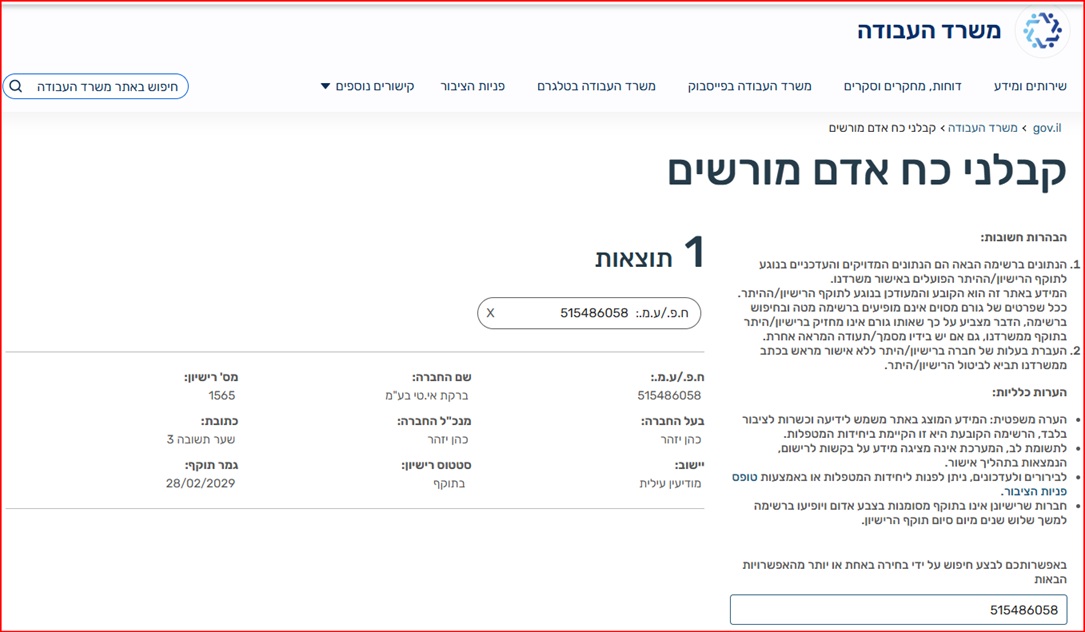 Verify the license on the Ministry of Labor website
Full details · Manpower contractor license page →
Verify the license on the Ministry of Labor website
Full details · Manpower contractor license page →