
Closing a freelance file in Israel
The dedicated guide for closing a licensed freelance (osek) file · step by step with all three authorities.
Read more
Log in to your account, or sign up in a minute.
Pick whatever works for you · we're here.
Everything about NETO · transparent and available
Pick a convenient time · we'll confirm by phone/email
Stopped working as self-employed, or is the activity too small to justify keeping a tax file? Here is how to close correctly with all three authorities · and choose an orderly payment route for what comes next, where the client receives an invoice and you receive a payslip and net pay to your account.
Closing an osek patur (exempt business) does not happen by itself · you close separately with VAT, Income Tax and the National Insurance Institute, keep the closure confirmations and make sure no reports or advance payments are left open. The guide covers when closing makes sense, how each authority is handled, and a checklist for before, during and after. Afterwards you can still be paid through NETO · the client receives an invoice and you receive a payslip and net pay, for a fee of 5% of the invoice before VAT.
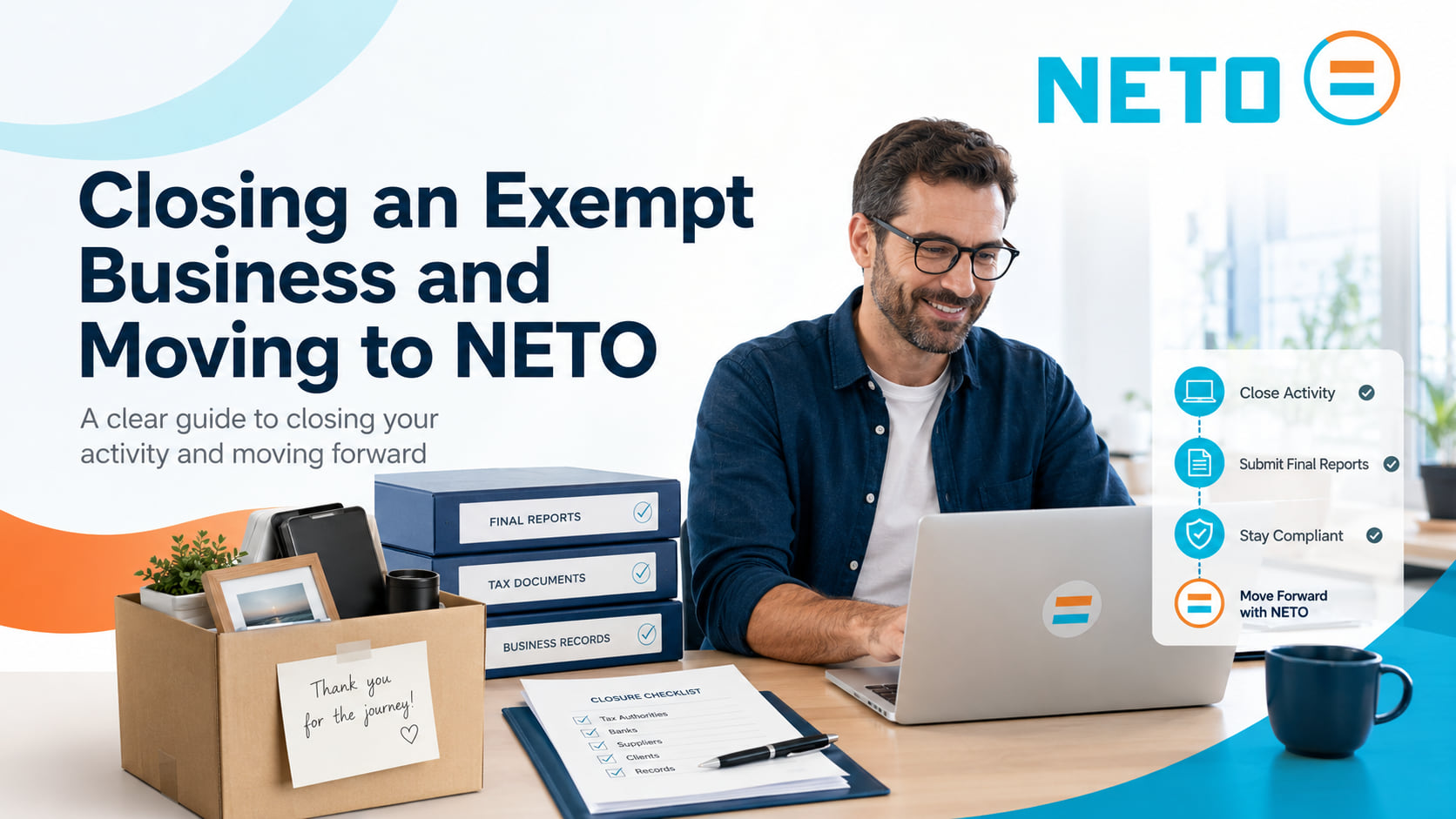
Summary: how do you close an osek patur and keep getting paid?
Closing an osek patur (exempt business) does not happen by itself. You must handle VAT, Income Tax and the National Insurance Institute separately, keep the closure confirmations and make sure no reports or advance payments are left open. After closing, you can keep getting paid for occasional work through a legal route such as NETO: the client receives an orderly invoice, and you receive a payslip and net pay to your account without managing an active business file. The fee · 5% of the invoice amount before VAT · is derived from the invoice the client pays, not from your pocket.
Closing an osek patur mainly makes sense when the activity is no longer steady: there is no stable stream of clients, income is low or rare, and the cost of maintaining the file outweighs the benefit. This is common among employees with side income, students, freelancers just starting out, or people who moved to a salaried job but still take on a small project here and there.
The important point is not to close under momentary pressure. If steady monthly activity is expected, it may be better to keep the file open. If it is only occasional projects, NETO can be a cleaner alternative: the client still receives an invoice, but you are not running an active business.
Employees with side income, students, freelancers just starting out, and people who moved to a salaried job but still take a small project now and then.
If steady monthly activity is expected, keeping the file open may be the better choice · do not close under momentary pressure.
For example: you opened an osek patur for a few projects, but this year only two small jobs remained. Instead of paying an accountant, filing reports and paying advances on activity that barely exists · you can close the file and run the next payments through NETO.
This is the critical point: the three authorities do not close automatically together. You must approach each of them separately, verify that the file was actually closed, and keep a confirmation. Here is how it works with each authority:
You submit a request to close the business file with VAT, usually using Form 18 or an online service. An osek patur does not charge VAT, but the file remains registered in the VAT system until it is actually closed.
Closing an individual file with Income Tax is done using Form 2550 or through a representative. Even after closing, you may still need to file a final report for the year of activity.
The National Insurance Institute stresses that closing a self-employed file with it is separate from closing the file with the Tax Authority. If you do not notify it in time, self-employed insurance contributions may keep accruing.
NETO operates in Israel under manpower contractor license no. 1565 of the Ministry of Labor. The practical meaning for clients is working with an orderly payment and documentation route, subject to an individual review of the type of engagement, the identity of the service recipient and the required documents.
You can start with NETO right now: the client receives an invoice and you receive a payslip and net pay to your account · without running an active business.

In the NETO route the client receives an orderly invoice from NETO, and you receive a payslip and net payment to your account. NETO handles tax deductions, National Insurance and the relevant contributions, so from your side the activity looks like salary · not like managing a self-employed file.
It fits especially well for anyone closing an osek patur who does not want to give up one-off jobs: a lecture, consulting, design, training, writing, repairs, translation, a tech project or a one-time professional service. The fee · 5% of the invoice amount before VAT · is derived from the invoice the client pays, and you do not add a payment from your own pocket. There are no fixed management fees and no cost in a month with no income.
Join NETO and register as an employee within minutes · no business registration, no capital declaration and no commitment to a fixed cost.
The client receives a lawful tax invoice. The fee · 5% of the invoice amount (before VAT), derived from the invoice the client pays · not from your pocket.
You receive a payslip and net pay to your account with employee contributions and rights · without managing an active file and with no cost in an empty month.
Both routes are legal · the difference lies in the cost structure, the time involved and the level of commitment. Here is how they look side by side:
| Parameter | Active osek patur | NETO · invoice without a file |
|---|---|---|
| Fixed cost even with no income | Accountant, minimum National Insurance, reports | None · you pay only when you issue an invoice |
| Payment structure | Ongoing expenses that come out of your own pocket | 5% fee of the invoice amount (before VAT) · derived from the invoice the client pays |
| Dealing with the authorities | Periodic reporting to VAT, Income Tax and National Insurance | NETO handles the deductions and the reporting |
| Status and rights | Self-employed · rights and insurance are your responsibility | Registered as an employee · payslip, contributions and social rights |
| Best suited for | Steady activity with a stable stream of clients | Occasional work and one-off projects |
This comparison is general and for information purposes · it is not tax advice. The choice depends on your scope of activity and personal data. For full details see the page Osek patur vs NETO 2026.
Check that there are no open invoices, unpaid advances or reports that have not been filed.
Submit a request to each authority separately and keep a reference number and a closure confirmation.
If a new project arrives · do not accept money without a document. Choose a payslip, reopening a file, or NETO.
Internal links that can help you decide: if you are still weighing your options, also read the guide to side income for employees, the guide to freelancing while employed, the guide to reporting occasional work, the comparison between an invoice and a payslip, and the guide to closing a licensed freelance file.
No. These are separate actions. The National Insurance Institute states explicitly that closing a self-employed file with it is separate from closing the file with the Tax Authority and does not depend on it. You must handle each authority separately.
Yes, but only through a legal, documented route: a payslip, reopening a file, or an invoice through NETO that lets you receive net salary. Never accept payment without documentation.
Sometimes yes. Closing the file does not necessarily cancel reporting obligations for the period in which the business was active. It is worth checking this with an accountant or with the Tax Authority.
Not always. If it is a one-off project or side work, NETO can provide an invoice for the client and a payslip for you without opening a self-employed business file.
The client pays NETO, NETO issues an invoice and transfers your net pay in an orderly payslip after the mandatory deductions. The fee · 5% of the invoice amount before VAT · is derived from the invoice the client pays, not from your pocket.
It is worth checking your employment contract, tax coordination, your status with National Insurance, and whether the side work fits an orderly route through NETO.
The NETO team will help you understand whether working through a NETO payslip and invoice is right for you instead of keeping an active business file. Start the quick sign-up · one minute and you are done.
The dedicated guide for closing a licensed freelance (osek) file · step by step with all three authorities.
Read more
A full comparison · costs, ceiling, rights and status · which pays off more.
Read more
The legal way to issue an invoice to a client without opening a business file · this is how it works.
Read moreIssuing a single invoice to a client · fast, simple and legal, without opening a file.
Read moreEmployees with income on the side · how to get paid properly without opening a business.
Read moreWhat the difference is, which is better for you and how it affects your rights.
Read moreThe government license behind the service · what it requires and why it matters.
Read moreWho we are, the license, the team and the vision · the legal and simple way to issue an invoice.
Read moreThe dedicated guide for closing a licensed freelance (osek) file · step by step with all three authorities.
Read moreA full comparison · costs, ceiling, rights and status · which pays off more.
Read moreThe legal way to issue an invoice to a client without opening a business file · this is how it works.
Read moreIssuing a single invoice to a client · fast, simple and legal, without opening a file.
Read more YC
YCEvery section, organized by topic. Browse the full hierarchy or jump straight in.
Adjust the site to your needs
We use essential cookies to make the site work. With your consent, we also use measurement and advertising cookies from Google and Microsoft to understand how the site is used, improve it and measure our advertising. We never sell your data.
You can change your choice at any time via “Cookie settings” at the bottom of every page.
Here you can ask to see the data we hold about you, correct it, delete it, withdraw consent you gave, or stop receiving our emails and alerts. We reply within 30 days, and handle removal requests within 7 business days. Privacy policy
Barkat I.T Ltd · trading as NETO · is a licensed manpower company (license 1565), supervised by the Israeli Ministry of Labor.
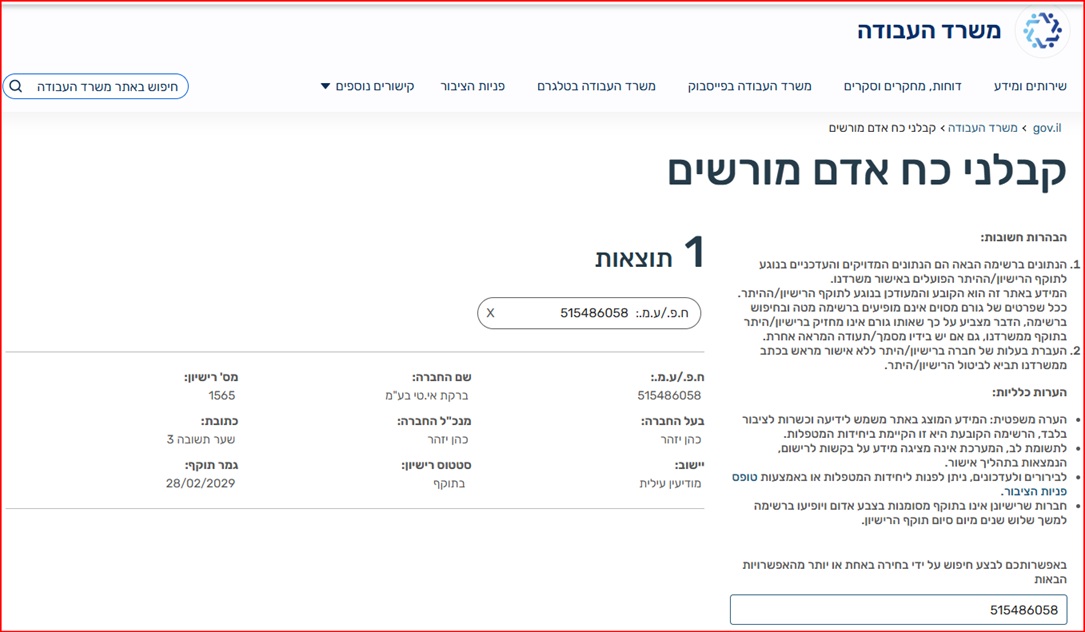 Verify the license on the Ministry of Labor website
Full details · Manpower contractor license page →
Verify the license on the Ministry of Labor website
Full details · Manpower contractor license page →