
Paid, but no tax invoice in advance?Not a mistake · it is the law · and here is why
NETO is a dealer that reports Israeli VAT on a cash basis. By law, in such a business the invoice (a tax invoice-receipt) is issued only upon receipt of payment · before that, a pro-forma invoice is sent. Moreover: the law forbids the client to demand a tax invoice before paying. Here are the explanation, the wording of the law and the official confirmations.
AI summary · cash-basis businessClick to read the page summary
NETO is a dealer that reports Israeli VAT on a cash basis. In such a business the tax point arises upon receipt of the consideration, so a tax invoice-receipt is issued only after payment. Before payment a pro-forma invoice or payment demand is sent · a document that is not an accounting record and does not entitle you to deduct input VAT. Moreover, section 47(a1) of the VAT Law forbids the buyer to demand a tax invoice before payment in a transaction whose tax point arises upon receipt of the consideration. The client is protected twice: demanding an invoice in advance is forbidden, and from the moment you pay · NETO is required by law to issue the invoice within 14 days (in practice · immediately). Want the invoice that very moment? Pay by credit card.
- Cash basis · the tax liability arises when the payment is received, and only then is the invoice issued.
- Before payment · pro-forma invoice / payment demand · not an accounting document.
- Section 47(a1) · the client may not demand an invoice before paying.
- Section 46 · after payment · an invoice within 14 days (in practice immediately).
- Credit card · pay by card · the invoice is issued immediately.
- This information is for guidance only · the binding wording is the Hebrew text published in Reshumot.
- In short
- How it works · before and after payment
- The wording of the law · the tax point
- Client protection · section 47(a1)
- Israel Invoices and the allocation number
- Need an invoice right away?
- The confirmations · backed by law and the Tax Authority
- The full legal detail
- Frequently asked questions
- Summary
In short
You received a payment demand or a pro-forma invoice from NETO, you paid · and only then did the invoice arrive. That is exactly what the law requires of a business that reports VAT on a cash basis: the tax point arises when the money is received, so a tax invoice-receipt is issued upon payment and not before. And not only is this permitted · the client is forbidden to demand a tax invoice before paying.
- Before payment · a pro-forma invoice or payment demand (not an accounting document, no input-VAT deduction).
- Upon payment · a tax invoice-receipt with an allocation number · the binding document.
- Client protection · section 47(a1) forbids demanding an invoice before payment.
- Fast · pay by credit card · invoice immediately. Otherwise · within 14 days by law.
This is how it works · before and after payment
In a business reporting on a cash basis, the VAT clock starts ticking only when the money arrives. Until then there is no taxable transaction yet · and therefore no tax invoice. Here are the two stages.
Pro-forma invoice / payment demand
A document that details how much to pay. Useful and clear · but not an accounting document.
- Not a tax invoice · does not entitle you to deduct input VAT.
- No allocation number (Israel Invoices).
- Enough to know exactly how much and when to pay.
Tax invoice-receipt
The moment the money is received · the tax point arises and the binding document is issued.
- A tax invoice and a receipt in a single document.
- With an allocation number · entitles you to deduct input VAT lawfully.
- Issued immediately · and at the latest within 14 days (section 46).
When does the tax point arise · as the law states
The rule for services in the Israeli VAT Law is a cash basis: liability arises upon receipt of the consideration. At NETO, the tax point is anchored in section 29(1a) · and the service is provided to the client upon receipt of payment. Below are the sections · each in the Hebrew original with an unofficial translation, plus a plain-language explanation.
״בשירות חל החיוב במס עם קבלת התמורה ועל הסכום שהתקבל.״
Unofficial translation“In a service, the tax liability arises upon receipt of the consideration and on the amount received.”
״בשירות שניתן על ידי עוסק שמחזור העסקאות שלו עולה על 15 מיליון שקלים חדשים בשנה וחלה עליו החובה לנהל פנקסי חשבונות לפי תוספת י״א להוראות מס הכנסה ("ניהול פנקסי חשבונות"), התשל״ג–1973 · יחול החיוב במס עם נתינת השירות...״
Unofficial translation“In a service provided by a dealer whose transaction turnover exceeds 15 million new shekels per year and who is required to keep account books under Addendum 11 to the Income Tax Instructions (Bookkeeping), 5733-1973 · the tax liability shall arise upon the provision of the service...”
״חשבונית תוצא תוך ארבעה עשר יום ממועד החיוב במס.״
Unofficial translation“An invoice shall be issued within fourteen days of the tax point.”
Not only permitted · the law forbids demanding an invoice before payment
The amendment to the law was not meant to burden the client · quite the opposite. It was designed to protect small and medium businesses from powerful clients who conditioned payment on receiving an invoice in advance. This is the right that protects both you and us.
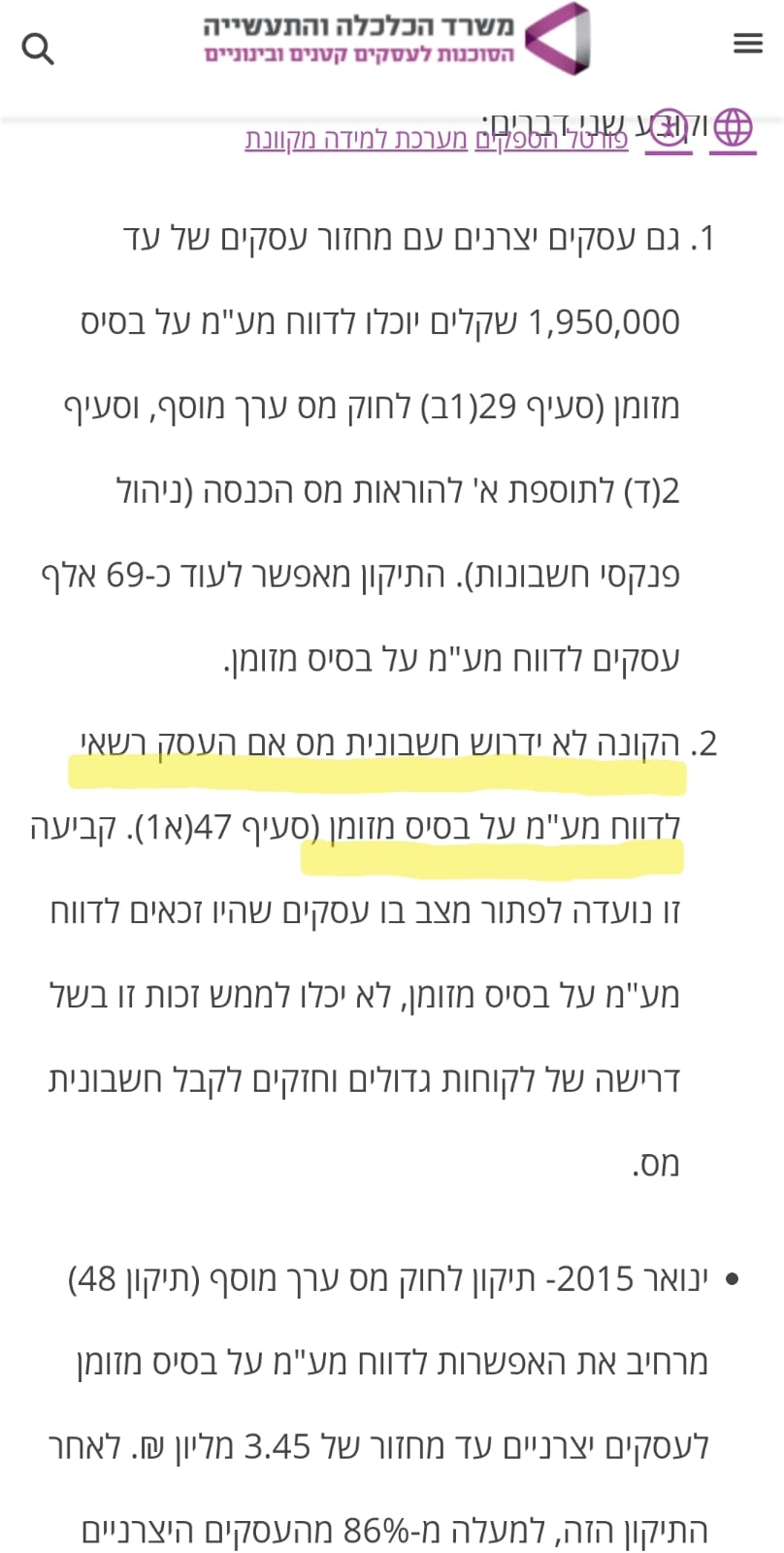
״הקונה לא ידרוש חשבונית מס ... לפני תשלום התמורה או חלקה · אם מועד החיוב במס בשל העסקה הוא עם קבלת התמורה ועל הסכום שהתקבל.״
Unofficial translation“The buyer shall not demand a tax invoice ... before payment of the consideration or part of it · where the tax point for the transaction arises upon receipt of the consideration and on the amount received.”
Two protections · not one
Before you pay · the client may not demand a tax invoice (section 47(a1)). No one may require you to “issue an invoice first”.
After you pay · the dealer is required by law to issue the tax invoice-receipt within 14 days (section 46), in practice immediately. Paying does not turn you into an invoice-chaser · the invoice is guaranteed.
So the order the law sets · first payment, then invoice · protects both sides with full clarity.
Israel Invoices and the allocation number · what actually happens
We understand the concern. Since the “Israel Invoices” model began, an invoice above a certain amount requires an allocation number from the Tax Authority so that input VAT can be deducted. That is why clients want to be sure they will receive the allocation number. Here is how it is resolved · in full honesty.
When the allocation number is issued
The allocation number is part of the tax invoice, and at a cash-basis dealer the tax invoice is born upon payment. So the moment you pay · a tax invoice-receipt is issued with a valid allocation number, entitling you to deduct lawfully.
Why not an “advance allocation”
A dealer cannot scatter invoices (and allocation numbers) with no payment behind them · and then chase each one. That is exactly why the law fixes the order: first the payment · which crystallises the liability, and only then the invoice and the allocation.
What you receive and when
Immediately after payment · a tax invoice-receipt with an allocation number, a single document serving both as the deduction voucher and as the receipt. No need to chase · the document arrives and is available.
Need an invoice right now? Pay by credit card
Payment by credit card crystallises the tax point immediately · so the tax invoice-receipt, including the allocation number, is issued the moment you pay, with no waiting. It is the simplest way to get the invoice that very moment.
Not “because we decided so” · these are the official confirmations
NETO's mechanism is not an internal decision · it is anchored in an auditing CPA confirmation and in official Tax Authority certificates. Here are the documents · open for review (the original documents are in Hebrew).
The VAT tax point
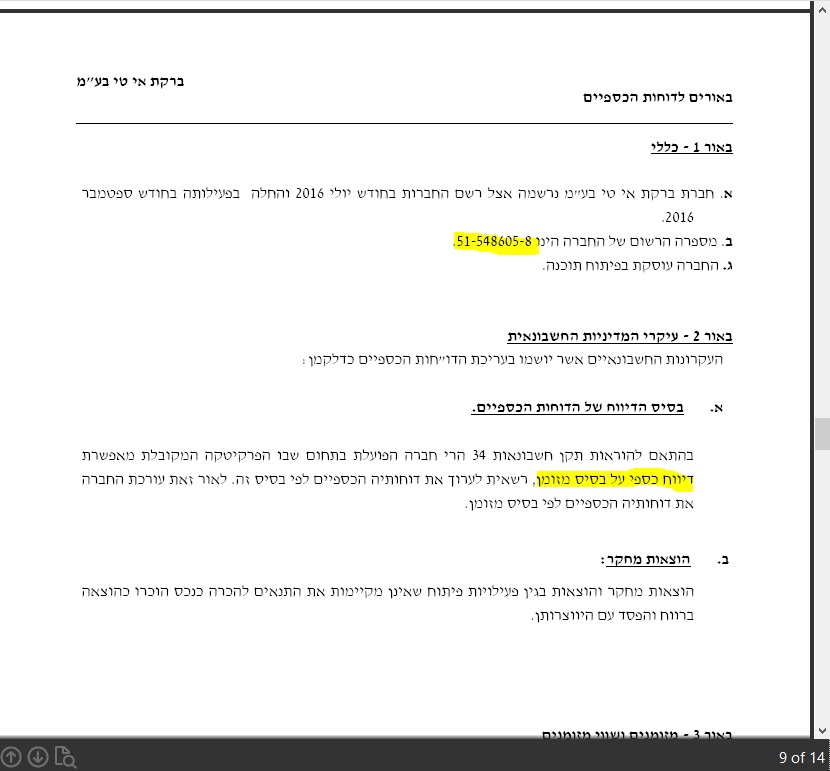
CPA Shoshana Weinberg confirms that the tax point of Bareket I.T Ltd follows section 29(1a) · liability arises upon the provision of the service, and the service is provided upon receipt of the consideration. Therefore a tax invoice is issued upon receipt of payment.
Open the confirmation (PDF, Hebrew) Tax AuthorityBookkeeping and withholding tax
A certificate of lawful bookkeeping and a withholding-tax certificate · in the name of Bareket I.T Ltd (515486058), valid, issued by the Tax Authority.
Open the confirmation (PDF, Hebrew) Bank confirmationBank account ownership
An ownership confirmation from the First International Bank of Israel (PAGI) · the payment account is registered in the name of Bareket I.T Ltd. Your payment goes to the company's own account.
Open the confirmation (PDF, Hebrew)What the CPA confirmation says
״מנפיקה החברה חשבונית מס ללקוחותיה בעת קבלת התמורה שהינו מועד נתינת השרות וקיום עסקה על פי דין ... החברה עורכת את דוחותיה הכספיים ואת דוח המס שלה לפי בסיס מזומן ובהתאם להוראות תקן חשבונאות 34.״
Unofficial translation“The company issues a tax invoice to its clients upon receipt of the consideration, which is the time the service is provided and a transaction exists by law ... the company prepares its financial statements and its tax return on a cash basis and in accordance with Accounting Standard 34.”
CPA Shoshana Weinberg · August 2025 · regarding Bareket I.T Ltd, company no. 515486058. Unofficial translation · the Hebrew original is binding.
The full legal detail · section by section
Here is the full explanation · who may report on a cash basis, what the turnover thresholds are, and which amendments shaped the picture. Open only if you wish. Law quotes appear in the Hebrew original with an unofficial translation.
What is a “cash basis” and what is an “accrual basis”
Cash basis: the VAT liability arises upon receipt of the consideration, and only on the amount actually received. The invoice is issued accordingly · at the time of payment.
Accrual basis: the liability arises upon the provision of the service or the delivery of the goods, even if payment has not yet been received. Here the invoice may be issued before payment.
The default for services under section 24 is a cash basis. For larger businesses the law points to an accrual basis · and still, at NETO the liability arises upon the provision of the service, which is the moment the consideration is received, as the company's CPA has confirmed.
Section 24 · services · liability upon receipt of the consideration
״בשירות חל החיוב במס עם קבלת התמורה ועל הסכום שהתקבל.״
Unofficial translation“In a service, the tax liability arises upon receipt of the consideration and on the amount received.”
This is the basic rule for services · a cash basis.
Section 22 · sale of goods · liability upon delivery
״במכר טובין חל החיוב במס עם מסירתם לקונה; נמסרו הטובין חלקים חלקים · חל החיוב על כל חלק...״
Unofficial translation“In a sale of goods, the tax liability arises upon their delivery to the buyer; if the goods were delivered in parts · the liability applies to each part...”
For goods the rule is an accrual basis (upon delivery), unlike the rule for services · hence the important distinction between the two.
Sections 29(1) and (1a) · exceptions and the tax point
29(1): in certain transactions (for example, the sale of goods by small dealers under a turnover threshold, per the items in Addendum A to the Income Tax Instructions) · the tax liability arises upon receipt of the consideration and on the amount received.
״בשירות שניתן על ידי עוסק שמחזור העסקאות שלו עולה על 15 מיליון שקלים חדשים בשנה וחלה עליו החובה לנהל פנקסי חשבונות לפי תוספת י״א להוראות מס הכנסה ("ניהול פנקסי חשבונות"), התשל״ג–1973 · יחול החיוב במס עם נתינת השירות...״
Unofficial translation“In a service provided by a dealer whose transaction turnover exceeds 15 million new shekels per year and who is required to keep account books under Addendum 11 to the Income Tax Instructions (Bookkeeping), 5733-1973 · the tax liability shall arise upon the provision of the service...”
This is the section on which NETO's tax point is based · the liability arises upon the provision of the service, which is the moment the consideration is received (CPA confirmation).
Section 46 · an invoice within 14 days of the tax point
״חשבונית תוצא תוך ארבעה עשר יום ממועד החיוב במס.״
Unofficial translation“An invoice shall be issued within fourteen days of the tax point.”
Once the liability has arisen (the payment was received) · a legal duty arises to issue an invoice within 14 days.
Section 47(a1) · the buyer shall not demand an invoice before payment
״הקונה לא ידרוש חשבונית מס ... לפני תשלום התמורה או חלקה · אם מועד החיוב במס בשל העסקה הוא עם קבלת התמורה ועל הסכום שהתקבל.״
Unofficial translation“The buyer shall not demand a tax invoice ... before payment of the consideration or part of it · where the tax point for the transaction arises upon receipt of the consideration and on the amount received.”
The provision (added in Amendment 42) was designed to prevent large clients from forcing a cash-basis dealer to issue an invoice before payment. For the binding text · see Nevo.
The amendments · 41 (2011), 42 (2012), 48 (2014)
Amendment 41 (5771-2011): anchored and regulated the tax points, including the case where amounts were paid on account of the consideration before the tax point.
Amendment 42 (5772-2012): added section 29(1a) (the tax point for services against a turnover threshold) and the protection in section 47(a1) · that the buyer shall not demand an invoice before payment.
Amendment 48 (5775-2014): extended the option to report VAT on a cash basis · among others to manufacturers and dealers in the recycling sectors, up to set turnover thresholds.
Members of the liberal professions, service providers and certain manufacturers/recycling dealers · are included in the cash-basis reporting arrangements, subject to the conditions and thresholds in the law and the regulations.
When does the tax point arise · as the law states
The rule for services in the Israeli VAT Law is a cash basis: liability arises upon receipt of the consideration. At NETO, the tax point is anchored in section 29(1a) · and the service is provided to the client upon receipt of payment. Below are the sections, each with a plain-language explanation alongside.
״בשירות חל החיוב במס עם קבלת התמורה ועל הסכום שהתקבל.״
Unofficial translation“In a service, the tax liability arises upon receipt of the consideration and on the amount received.”
Official documents are in Hebrew · the binding originals
Watch · how NETO works
A two-minute walkthrough · from signup to a legal payslip.
Cash-basis business · questions and answers
I paid and did not receive an invoice in advance · is that a mistake?
May a client demand a tax invoice before payment?
What is the difference between a pro-forma invoice and a tax invoice-receipt?
If I pay · when will I receive the invoice and the allocation number?
I need an invoice immediately · is there a solution?
On what basis does NETO operate this way?
Why does this arrangement exist at all?
Is it fully legal? Can I deduct the VAT?
Summary
NETO is a dealer that reports VAT on a cash basis. The tax point arises upon receipt of the payment · so a tax invoice-receipt is issued upon payment and not before. Before the payment you receive a pro-forma invoice or a payment demand. Moreover · the law (section 47(a1)) forbids the client to demand an invoice before paying, and immediately after the payment the dealer must issue the invoice by law. The mechanism is backed by an auditing CPA confirmation and Tax Authority certificates · NETO, an automated employment platform, manpower-contractor licence 1565, operating since 2016.
- Cash basis · the tax liability arises upon receipt of the payment (sections 24, 29(1a)).
- Document order · before · a pro-forma invoice. After · a tax invoice-receipt with an allocation number.
- Client protection · demanding an invoice before payment is forbidden (47(a1)); issuing it afterwards is mandatory (46).
- Invoice now · pay by credit card · the invoice arrives that very moment.
Paid but no invoice yet? Send us the details and we will handle it
Have a deposit confirmation? Send it and we will verify that the payment arrived, track it · and issue your tax invoice-receipt.
Cannot find an invoice that was already issued? Leave your details and we will send it again, retroactively as well.
Articles you may find useful
Everything you need to pay and receive an invoice with no headache · bank details, supplier setup and settling with freelancers.
Paid? Your invoice is already on its way
By law, the tax invoice-receipt is issued upon receipt of the payment · and with a credit card it arrives immediately, including the allocation number. Choose how to proceed.
When does the tax point arise · as the law states
The rule for services in the Israeli VAT Law is a cash basis: liability arises upon receipt of the consideration. At NETO, the tax point is anchored in section 29(1a) · and the service is provided to the client upon receipt of payment. Below are the sections, each with a plain-language explanation alongside.
״בשירות חל החיוב במס עם קבלת התמורה ועל הסכום שהתקבל.״
Unofficial translation“In a service, the tax liability arises upon receipt of the consideration and on the amount received.”
Official documents are in Hebrew · the binding originals
Why this page exists
This page makes the law accessible · it summarizes, explains and gives examples so it is clear and simple to understand. At the same time we insist on accuracy and authenticity · because in law every word and comma can matter.
Full transparency on adjustments: the statutory wording is quoted from the official source. The only differences are visual house-style ones and did not change the words of the law, the section numbers or the substantive punctuation. This is an unofficial translation · the binding text is the Hebrew original.
 YC
YCNETO · full site map
Every section, organized by topic. Browse the full hierarchy or jump straight in.
All pages by topic (97)
Accessibility
Adjust the site to your needs
A request about your data
Here you can ask to see the data we hold about you, correct it, delete it, withdraw consent you gave, or stop receiving our emails and alerts. We reply within 30 days, and handle removal requests within 7 business days. Privacy policy
Manpower Contractor License
Barkat I.T Ltd · trading as NETO · is a licensed manpower company (license 1565), supervised by the Israeli Ministry of Labor.
- License holder: Barkat I.T Ltd
- Company ID: 515486058
- License number: 1565 · Manpower contractor
- Valid until: 28.02.2029
- Address: 31 Sha'arei Teshuva, Modi'in Illit
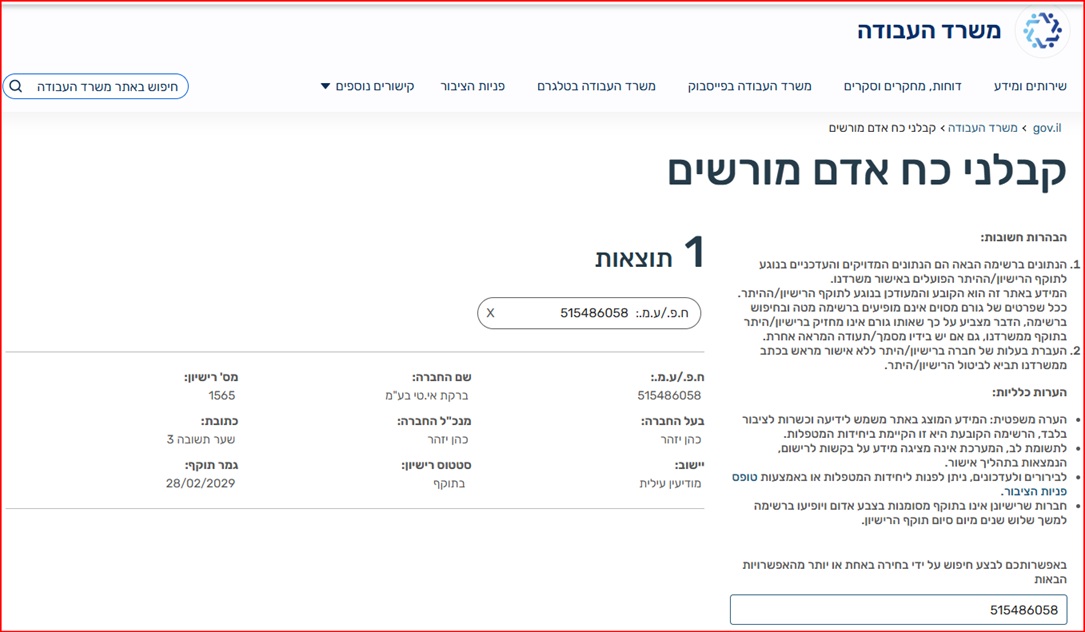 Verify the license on the Ministry of Labor website
Full details · Manpower contractor license page →
Verify the license on the Ministry of Labor website
Full details · Manpower contractor license page →