
Probation Period in Israel – The Complete Employer Guide 2026
A probation period lets an employer assess a new hire · but in Israel it is not a rights-free zone. This 2026 guide covers the norms and typical length, the employee's rights during the trial, the rules for lawful termination (hearing and advance notice), and how NETO lets you employ someone for a defined trial period without long-term commitment · as your Employer of Record.
AI Summary Smart overview of this page · click hereClick to read the page summary
A probation period in Israel is a framework for assessing a new hire · not an exemption from employee rights. Israeli law does not set a single universal fixed length for the general private sector · the length is typically defined in the employment contract or the applicable collective agreement, often the first several months. During probation the employee keeps full statutory rights: at least minimum wage, accruing social benefits, pension after the waiting period and labor-law protections. Termination during probation is possible but must follow due process · a hearing (shimua) where required, advance notice (or pay in lieu) under the Advance Notice for Dismissal and Resignation Law, and no dismissal for a prohibited or discriminatory reason; protected employees remain protected. NETO, a licensed manpower contractor (#1565), lets you employ a worker for a defined trial period as your Employer of Record · we manage the fixed-term contract and the rights, you get an invoice and the worker gets a payslip, with no long-term commitment. This is general information, not legal advice · verify details at Kol Zchut and the Ministry of Labor.
This summary is generated from the page content and the linked sources · full detail below. It is not legal advice.
Guide Summary
Everything you need to know about the probation period in Israel · the essential guide for every employer, in brief:
- No universal fixed length · set by contract or the applicable collective agreement.
- The employee keeps full statutory rights during probation.
- Termination needs due process · a hearing where required.
- Advance notice applies from day one and rises with seniority.
Rules depend on the contract, the applicable agreement and the circumstances · verify at Kol Zchut and the Ministry of Labor. This is general information, not legal advice.
Probation period in Israel 2026 · key points
What Is a Probation Period?
A probation period is the stretch at the start of employment in which the employer assesses a new employee's professional and personal fit before committing to a permanent role. It is important and useful · when the start of work is defined as a trial, employees tend to work hard to prove their value. If the employee turns out to fit, the natural next step is to bring them on for the long term and give them a sense of stability. If it becomes clear early on that it is not a match, parting ways is straightforward.
Crucially, a probation period in Israel is a framework for assessment · not an exemption from employee rights. Whatever length is agreed, the employee is entitled to the same statutory protections as any other employee. This guide is part of the wider picture of employee rights in Israel that every employer must uphold.
How Long Is the Probation Period? The Norms
Israeli law does not set a single universal fixed probation period for the general private sector. In practice, the length is defined in the employment contract or in the applicable collective agreement, and commonly runs for the first several months of employment. Some sectors and agreements set specific durations; others leave it to the parties.
Whatever length is agreed, it is important to understand what probation does · and does not · change: it is a period for mutual assessment, but it does not reduce the employee's statutory rights, and it does not remove the requirement to end employment lawfully. Verify any specific duration against the applicable agreement and the guidance on Kol Zchut.
Rights During the Probation Period
A probation period does not strip statutory rights. During the trial the employee is entitled to the same protections as any employee, including:
- At least the minimum wage and payment of wages on time under the Wage Protection Law
- Social benefits accrue · vacation, sick pay and recuperation eligibility build up with employment
- Pension contributions begin after the applicable waiting period · see pension contributions in Israel
- Labor-law protections apply · including protection from discrimination and, for protected employees, protection from dismissal
Termination Rules · Hearing and Advance Notice
An employer can end employment during probation · but not without due process. Ending employment lawfully generally requires:
Where required, the employee must be given a genuine opportunity to respond before a dismissal decision is made.
Notice applies from day one and increases with seniority under the Advance Notice for Dismissal and Resignation Law · give the notice or pay in lieu.
Dismissal may not be for a discriminatory or otherwise prohibited reason, and protected employees remain protected.

Protected Employees During Probation
Some employees enjoy special protection from dismissal that continues to apply during a probation period · for example during pregnancy and the birth and parenting period, and in other cases defined by law. For these employees, dismissal may require a permit from the Ministry of Labor and is subject to additional restrictions, even if the employment is still within the agreed trial.
Because these protections do not pause during probation, employers should treat probation dismissals with the same care as any other dismissal · confirming the employee is not in a protected category, following due process, and consulting a labor-law professional in edge cases.
Direct Hire vs a Trial Period Through NETO
Many employers want to assess a new hire before a permanent commitment. Doing it through a licensed manpower contractor gives a clear boundary while keeping the worker's rights fully in place:
| Criterion | Trial period · via NETO | Direct hire |
|---|---|---|
| Commitment beyond the period | None · a clear boundary | Exists from the start |
| Fixed-term contract | NETO defines it | You must prepare it |
| Payroll and employee rights | NETO handles it, in full | Your responsibility |
| Direct employer-employee relationship | Not during this period | From the start |
| How you pay | Against an invoice | Direct payslip |
| Relative burden | Digital · simple and clean | Higher · time and administration |
In every model, the worker keeps full statutory rights. Through NETO those rights are managed for you as the legal employer.
Employ for a Trial Period · The NETO EOR Solution
Defining a trial period, drafting a compliant fixed-term contract, running payroll and honouring every right · all of this takes time and expertise. Through NETO as your Employer of Record (EOR), a licensed manpower contractor (#1565), you can employ a worker for a defined trial period, and all employer obligations transfer to us:
For the period you choose · managing the fixed-term contract and the worker's rights.
Payslip, National Insurance and income tax withholding, and all social rights · handled for you.
No long-term commitment beyond the period you choose, and no direct employer-employee relationship with you during it.
The worker proves their fit · you decide whether to bring them on. Learn more about NETO's EOR in Israel.
Frequently Asked Questions
How long is the probation period in Israel?
Israeli law does not set a single universal fixed probation period for the general private sector. The length is typically defined in the employment contract or the applicable collective agreement, and often runs for the first several months. Whatever length is agreed, it does not reduce the employee's statutory rights.
Does an employee have rights during probation?
Yes. Probation does not strip statutory rights. The employee is entitled to at least minimum wage, accruing social benefits, pension contributions after the waiting period, and labor-law protections. Probation is a framework for assessment, not an exemption from rights.
Can an employer dismiss during probation?
An employer can end employment during probation, but not without due process: a hearing (shimua) where required, advance notice or pay in lieu, and no prohibited or discriminatory reason. Protected employees, such as during pregnancy, remain protected.
Is advance notice required when dismissing during probation?
Yes. Advance notice applies from the first day and increases with seniority under the Advance Notice for Dismissal and Resignation Law. The employer must give the notice period or pay in lieu. Verify the exact entitlement for the specific case at Kol Zchut.
Does probation affect severance pay?
Severance and other seniority-based rights accrue with continuous employment. Probation does not by itself cancel them · entitlement depends on the length and circumstances under the Severance Pay Law. Ongoing pension contributions under Section 14 can count toward the severance obligation.
How does NETO help with employing someone for a trial period?
Through NETO, a licensed manpower contractor (#1565), you can employ a worker for a defined trial period. NETO is the legal employer, manages the fixed-term contract and the worker's rights, issues you an invoice and gives the worker a payslip · with no long-term commitment beyond the period you choose and no direct employer-employee relationship with you during it.
Summary
A probation period in Israel is a framework for assessing a new hire · not an exemption from employee rights. There is no universal fixed length; it is set by the contract or the applicable collective agreement. Throughout the trial the employee keeps full statutory rights, and any termination must follow due process · a hearing where required, advance notice or pay in lieu, and no prohibited reason · with protected employees remaining protected.
For companies hiring in Israel, the cleanest way to trial a new hire without long-term commitment is through NETO as your Employer of Record. We are the legal employer for the period you choose, manage the fixed-term contract and all employee rights, and handle payroll and compliance. Contact us today to learn how we can simplify your Israeli employment.
Last updated: 09/07/2026 · rules depend on the contract, the applicable agreement and the circumstances · verify at Kol Zchut and the Ministry of Labor. General information, not legal advice.
Ready to Hire in Israel with Full Compliance?
Let NETO be the legal employer for the trial period · we handle the contract, payroll and employee rights, so you can focus on the fit. Register free for a payroll simulation, or ask us on WhatsApp.
The law requires 6% · at NETO it is 8.33%
The mandatory pension extension order obliges every employer to contribute 6% of salary to the severance component, and section 14 of the Severance Pay Law applies to that money automatically. NETO contributes the full severance component by default · 8.33% · so the ongoing contribution replaces severance pay in full and no top-up is due when the employment ends. An employer contributing less than 8.33% must top up severance at the end of the employment relationship.
A worker who declares they have no active pension fund, in a one-off engagement · there the contribution obligation begins only after six months of work. A worker with an active pension arrangement is entitled from day one, with contributions made retroactively after three months or at the end of the tax year, whichever is earlier.
General information · not legal advice. The binding text is the statute and the extension order themselves.
 YC
YCNETO · full site map
Every section, organized by topic. Browse the full hierarchy or jump straight in.
All pages by topic (97)
Accessibility
Adjust the site to your needs
A request about your data
Here you can ask to see the data we hold about you, correct it, delete it, withdraw consent you gave, or stop receiving our emails and alerts. We reply within 30 days, and handle removal requests within 7 business days. Privacy policy
Manpower Contractor License
Barkat I.T Ltd · trading as NETO · is a licensed manpower company (license 1565), supervised by the Israeli Ministry of Labor.
- License holder: Barkat I.T Ltd
- Company ID: 515486058
- License number: 1565 · Manpower contractor
- Valid until: 28.02.2029
- Address: 31 Sha'arei Teshuva, Modi'in Illit
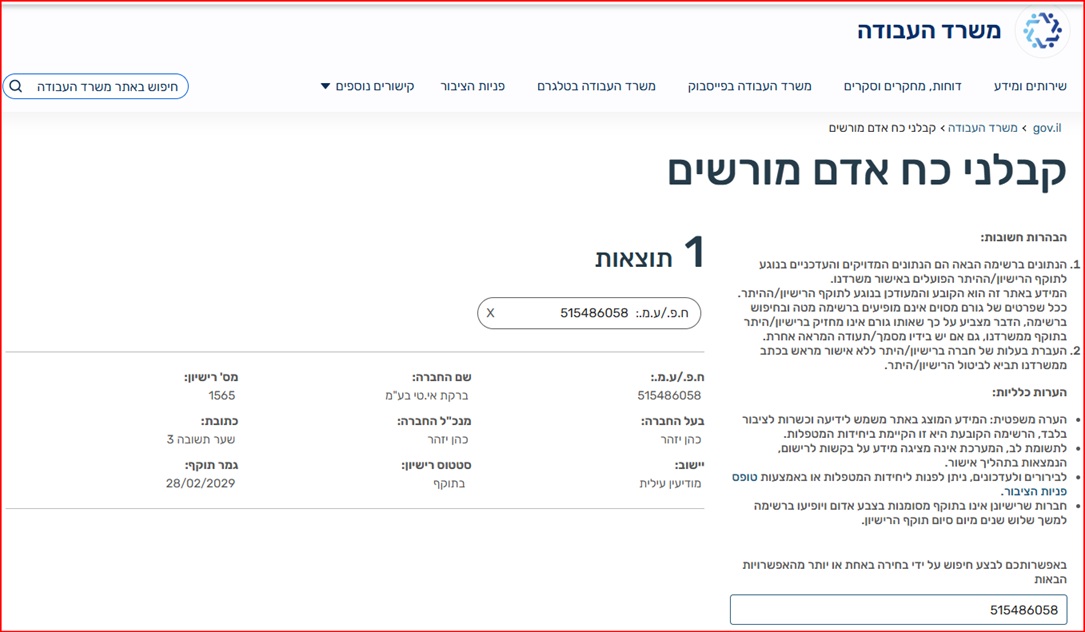 Verify the license on the Ministry of Labor website
Full details · Manpower contractor license page →
Verify the license on the Ministry of Labor website
Full details · Manpower contractor license page →