Employee Rights in IsraelThe 2026 guide · minimum wage, leave, pension & fair dismissal
Israeli labor law gives every employee a robust set of protections · from a ₪6,443.85 minimum wage and 125%/150% overtime to paid leave, sick days, pension contributions and a mandatory pre-dismissal hearing. This guide walks through each right, with worked examples you can check against a real payslip.
What are the mandatory employee rights in Israel?
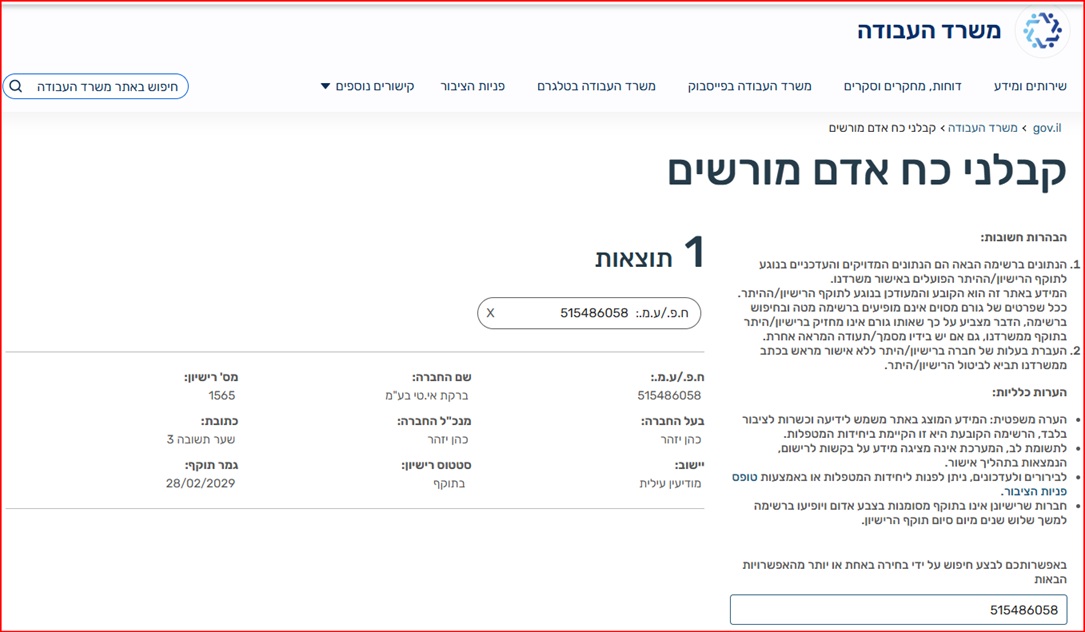
Every employee in Israel is entitled by law to a written employment agreement within 30 days, a minimum wage of ₪6,443.85 per month (₪35.40/hour for a 182-hour full-time month), overtime at 125%–150%, 16 annual leave days in the first 5 years, 18 sick days per year paid in tiers (0%, 50%, 100%), 9 paid public holidays, annual recreation pay (dmei havra'ah), travel reimbursement, pension contributions totalling 18.5% of salary, and a mandatory pre-dismissal hearing (shimua). NETO · licensed manpower contractor #1565, operating since 2016 · encodes all of these rights into its automated payroll.
 Employee rights in Israel · every entitlement, one guide
What's on this page
Overview of employee rights in Israel
All employee rights in Israel are enshrined in law. Like all developed countries, Israel ensures the welfare and rights of workers · and in most organizations, employees are the most valuable resource, both in importance and in payroll costs. For the full legal picture, see our guide to Israeli labor law · rights and employer obligations.
Today, when all information is available online, almost every employee is fully aware of their rights, and many labor lawyers help employees enforce them. The majority of employee lawsuits succeed · estimated at about 70% · even though employers are usually represented by more experienced attorneys. In some cases, violations are committed in good faith and out of ignorance, which does not exempt the employer from liability.
Minimum wage, leave, sick pay, pension and fair dismissal apply to every employee · full-time, part-time, or employed through an EOR.
About 70% of employee lawsuits succeed. Good-faith mistakes still leave the employer fully liable for fines and back pay.
Every right and obligation is mapped and encoded into NETO's payroll software · no corners cut, for employee or employer.
Employment agreement · within 30 days
By law, the employer must provide the employee with a written employment agreement within 30 days of the start date. The agreement describes the role, direct supervisor, working days and hours, salary, social benefits, and additional conditions.
The employment agreement is a binding document and must include all legally mandated information. Failure to provide it exposes the employer to penalties.
Working hours, rest & overtime
A full-time position is defined as 182 hours per month (42 hours per week). Every employee is entitled to a weekly rest day · usually Saturday. Under the Hours of Work and Rest Law, no employee may work more than 12 hours per day, including overtime.
- 125% · for the first 2 overtime hours per day
- 150% · from the 3rd overtime hour onward
- Maximum: 16 overtime hours per week (58 total hours/week)
Example · what 3 overtime hours are worth
Maya earns the minimum hourly wage of ₪35.40. One busy day she stays 3 extra hours. Her payslip for those hours should show:
- Overtime hours 1–2 at 125%: ₪35.40 × 1.25 = ₪44.25 each → ₪88.50
- Overtime hour 3 at 150%: ₪35.40 × 1.5 = ₪53.10
Total for the 3 extra hours: ₪141.60 · not ₪106.20 at the plain rate
If those hours appear at 100% on the payslip, the employer is underpaying · and the law is on Maya's side.
Annual leave
Every employee is entitled to paid annual leave, and the number of vacation days increases with seniority:
- Years 1–5: 16 vacation days per year (including the day of rest)
- Leave entitlement accrues monthly
- At least 7 consecutive days must be taken per year
- Upon termination: the employee is entitled to payment for all unused vacation days
Sick days · and how they're paid
Every employee accrues 18 sick days per year (1.5 days per month, up to a maximum of 90 days), subject to submission of a medical certificate. Payment is tiered:
| Sick day | Days used | Payment |
|---|---|---|
| Day 1 | 1 day | 0% · used but not paid |
| Days 2–3 | 2 days | 50% of daily salary |
| Day 4 onward | Per day | 100% of daily salary |
Example · a week of flu, day by day
Daniel is out sick Monday to Friday · 5 workdays · with a doctor's note. Say his daily salary is ₪400:
- Monday (day 1): ₪0 · the day is used but unpaid
- Tuesday + Wednesday (days 2–3): 50% × ₪400 = ₪200 each → ₪400
- Thursday + Friday (day 4 onward): 100% = ₪400 each → ₪800
Sick pay for the week: ₪1,200 of a ₪2,000 salary · 60%
Five of Daniel's 18 annual sick days are used. The longer the illness, the closer pay gets to 100% · that's exactly how the tiers are designed.
Public holidays
Every employee is entitled to payment for 9 public holidays per year (according to the Jewish, Muslim, or Christian calendar), provided:
- The employee has completed at least 3 months of work
- The holiday falls on a regular workday
- The employee worked the day before and after the holiday
An employee who works on a public holiday is entitled to 150% of regular pay.
Recreation pay (dmei havra'ah)
Recreation pay (dmei havra'ah) is paid once a year · usually in July or August · to employees who have completed at least one full year of employment. The amount is determined by a seniority table. Unpaid recreation pay from the last year of employment is settled upon termination.
Travel expense reimbursement
Every employee who uses public transportation to commute is entitled to reimbursement of travel expenses to and from work, provided the distance exceeds 500 meters. Read more about travel reimbursement →
Pension & severance · 18.5%
Under the mandatory pension extension order, every employer must make monthly pension contributions. The employer contributes 6.5% of the base salary to the pension fund, the employee contributes 6%, and the employer adds 6% for severance under Section 14 of the Severance Pay Law · a total of 18.5%.
Upon dismissal after one full year of employment, if the severance fund does not cover the full statutory amount, the employer must top it up to 8.33% of the last salary × years of service. If the employee has an active pension fund, contributions begin after 3 months; otherwise, after 6 months.
Pre-dismissal hearing (shimua)
Before dismissing an employee, the employer is legally required to hold a pre-dismissal hearing (shimua). The employer must notify the employee in advance, in writing, of the reasons for the planned dismissal, and give the employee a genuine opportunity to present their case.
Dismissal without a proper hearing may be considered unlawful termination, entitling the employee to additional compensation beyond regular severance. The full sequence is covered in our guide to the termination process in Israel.
Worked example · a new employee's first year
How the rights above play out on a real timeline · and on a real payslip.
Example · Dana starts a full-time job on January 1
- Day 1: accrual starts · 1.5 sick days and roughly 1.33 vacation days (16 ÷ 12) per month. Her salary may not be below ₪6,443.85 for a 182-hour month.
- Within 30 days: she must receive a written employment agreement · role, hours, salary, and benefits.
- After 3 months: she qualifies for paid public holidays; pension contributions begin now if she already has an active fund (otherwise after 6 months).
- After 6 months: about 9 sick days and 8 vacation days are already banked.
- After 12 months: first recreation payment (havra'a) in the July/August cycle, and · if dismissed · severance rights of 8.33% of the last salary per year of service, plus a shimua hearing before any decision.
Every milestone above is mandatory · none of it depends on the employer's goodwill
Example · checking a ₪10,000 payslip in 60 seconds
Omri earns ₪10,000 gross. The contributions section of his payslip should show:
- Employee pension deduction · 6%: ₪600
- Employer pension contribution · 6.5%: ₪650
- Employer severance contribution · 6%: ₪600
Total flowing into Omri's funds each month: ₪1,850 · 18.5% of salary
Missing or smaller numbers are a red flag worth raising · politely, and in writing.
Manage all employee rights · automatically
All employee rights and labor laws have been mapped and encoded into NETO's software. The system has no interests, does not cut corners, and enforces every right and obligation · of both the employee and the employer. Payroll, contributions, payslips, and legal compliance run automatically, so nothing is ever missed.
For employers, the cost is simple: a 5% commission on the invoice (pre-VAT, billed to the client) · no setup fees and no monthly minimums. NETO operates under manpower contractor license #1565, supervised by the Ministry of Labor, and has been running Israeli payroll since 2016. See what an employee really costs in our employer cost guide and how a compliant payslip is built in the Israel payroll guide.
Watch · how employers pay workers in Israel with NETO
Watch · in under 2 minutes, see how simple it is to pay a worker in Israel · with every right and benefit handled · through NETO.
Are you a freelancer or self-employed?
Get paid legally, receive a compliant payslip, and enjoy full social benefits · without opening a business file. NETO acts as your Employer of Record, handling everything from payroll to pension contributions, for a 5% commission on the invoice (pre-VAT, billed to the client).
Frequently asked questions
What is the minimum wage in Israel?
How many vacation days is an employee entitled to?
How is overtime paid in Israel?
How are sick days paid in Israel?
Is a pre-dismissal hearing (shimua) mandatory?
What pension contributions is the employer required to make?
When must an employment agreement be provided?
Are employees paid for public holidays?
Employee rights in Israel · at a glance
- Written agreement within 30 days of the start date · a binding, mandatory document.
- Minimum wage ₪6,443.85/month (₪35.40/hour) for a 182-hour, 42-hour-week position.
- Overtime at 125% for the first 2 hours and 150% from the 3rd · never plain rate.
- Paid time off · 16 vacation days (years 1–5), 18 sick days with 0/50/100% tiers, 9 public holidays, and annual havra'a.
- Pension & severance · 6% employee + 6.5% employer + 6% severance = 18.5%, with an 8.33% top-up rule on dismissal.
- Fair dismissal · a shimua hearing is mandatory before any termination decision.
Every right, paid in full · automatically
NETO's system manages payroll, contributions, payslips, and legal compliance · so you never miss a right or an obligation. Licensed manpower contractor #1565, operating since 2016, for a simple 5% commission on the invoice (pre-VAT, billed to the client).
Related guides on working & hiring in Israel
 Israeli Labor LawRights and employer obligations in one legal overview.Read more
 Hours of Work & Rest LawDaily limits, rest days, and overtime rules explained.Read more
 Wage Protection LawWhen salary must be paid and what late payment costs.Read more
Severance Pay in IsraelWho qualifies, how it's calculated, and Section 14.Read more
Wage Protection LawWhen salary must be paid and what late payment costs.Read more
Severance Pay in IsraelWho qualifies, how it's calculated, and Section 14.Read more
 Mandatory Benefits in IsraelEvery benefit an Israeli employer must provide.Read more
 Pension ContributionsThe 18.5% split and how pension funds work in Israel.Read more
 Termination Process in IsraelShimua, notice, and severance · step by step.Read more
 Travel ReimbursementCommuting costs the employer must cover, and when.Read more
 Employer Cost in IsraelWhat an employee really costs beyond gross salary.Read more
 Israel Payroll GuidePayslips, withholding, and reporting in Israel, explained.Read more
 Employer of Record in IsraelHire in Israel without a local entity · the full guide.Read more
 Temporary Employee RightsWhat temp and agency workers are entitled to.Read more