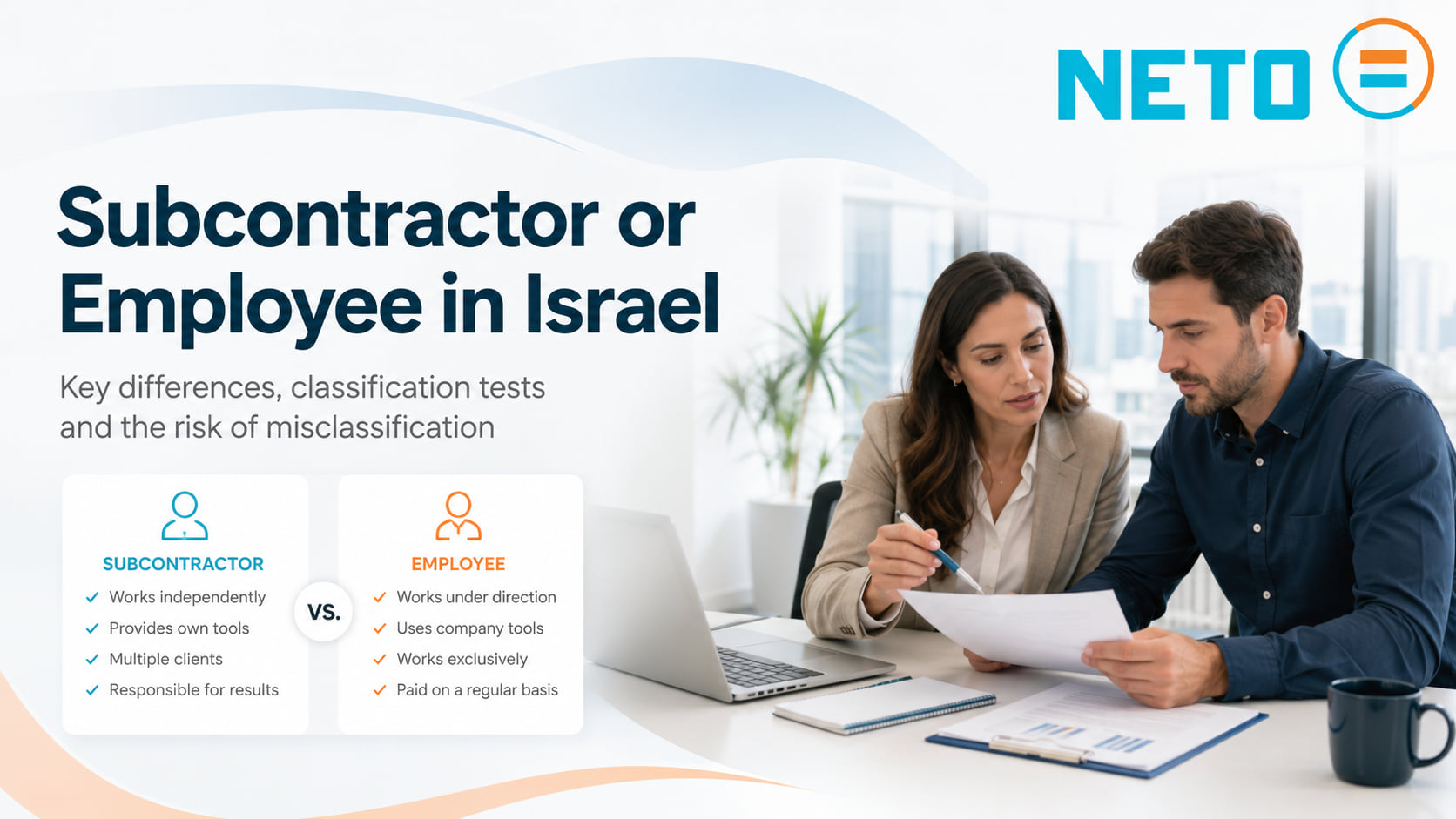
Hiring a Subcontractor vs an EmployeeThe difference, the classification tests, and the risk of misclassifying the working relationship
Deciding whether to work with an external person as an employee or as a subcontractor looks like a technicality, but it carries heavy consequences · misclassification exposes the employer to retroactive claims and fines. This page explains the difference, the Israeli labour court tests, and how NETO removes the risk with fully compliant employment.
✦ Smart brief · AI summary
Subcontractor vs employee is the decision point that determines legal exposure: an employer of an employee owes minimum wage, severance, recuperation pay, annual leave, sick days and pension contributions · while engaging a contractor seemingly avoids all of that. But the Israeli labour court classifies by the true nature of the relationship in practice, through the mixed test and the integration test, not by the contract or by the issuing of invoices. Misclassification exposes you to retroactive claims and fines. NETO's EOR model removes the risk · NETO is the official employer and bears the responsibility for labour-law compliance.
- Misclassification can lead to retroactive claims for social entitlements and to fines.
- The court applies the mixed test and does not rely only on the contract or an invoice.
- The integration test is the central criterion for determining an employer-employee relationship.
- A manpower contractor is limited to nine months of placement with the same de-facto employer.
- NETO's EOR model gives flexible engagement with full regulatory compliance.
- NETO · licensed manpower contractor, licence 1565, supervised by the Ministry of Labour.
- Why classification is critical for the business
- Labelled a contractor but really an employee
- How the labour court decides
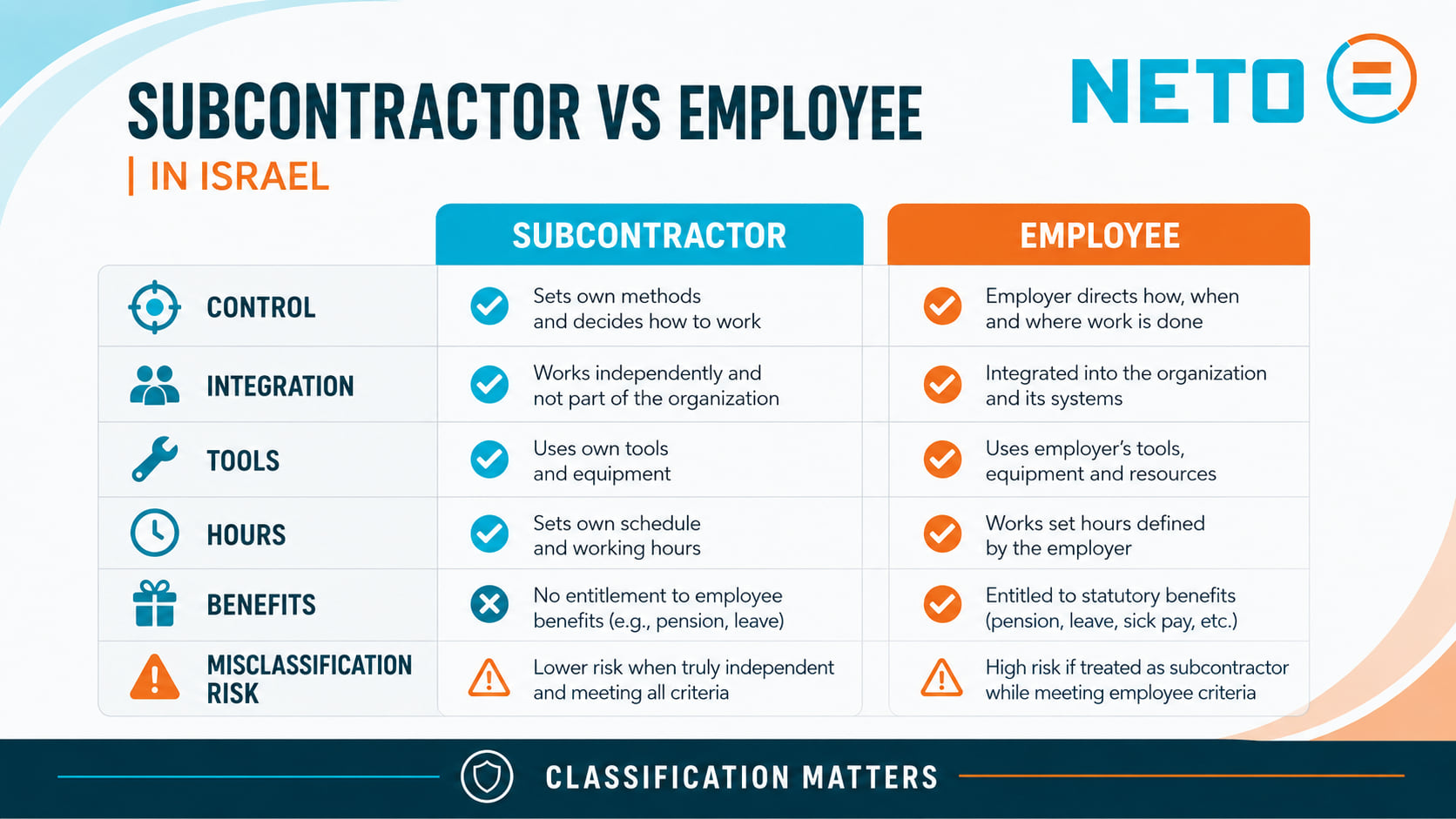
- The integration test · comparison table
- Does an invoice prove contractor status
- When it really is a subcontractor
- Types of contractors · services, manpower and sub
- Regulatory requirements and the nine-month limit
- The risks for the employer and the freelancer
- How to classify correctly · five steps
- How NETO removes the risk
- What the agreement must include, and when the line is crossed
- Questions and answers
- Summary and recommendations
Why the employee-or-contractor classification is so critical for the business
Many companies in Israel weigh how to work with external people · hire them as regular employees, or pay them as subcontractors. The decision looks technical, but in practice it carries substantial consequences for both sides. Classification affects almost every aspect of the engagement · an employer of an employee is bound by minimum wage, severance pay, recuperation pay, annual leave, sick days and pension contributions, as well as tax withholding and National Insurance contributions.
Engaging an independent contractor carries none of those obligations, which can look like significant savings. But here is the problem: if the labour court later rules that the person was in fact an employee, the employer may be required to pay all the social entitlements retroactively · on top of exposure to administrative and even criminal fines for violating labour laws.
- An employer who misclassifies can end up facing claims, fines and back payments.
- The service provider may lose social entitlements or run into tax complexity.
- The legal and practical tools make it possible to classify the working relationship correctly from the start.

What happens to someone labelled a contractor who is really an employee
A service provider classified as a subcontractor does not enjoy the social entitlements of a salaried employee. They must manage themselves as self-employed, open files with the tax authorities, report and issue invoices. The full responsibility for National Insurance and health insurance payments falls on them, with no employer contribution. Beyond that, there is no job security, and they must run an independent business with everything that involves · marketing, collections and bookkeeping.
For those who do not want, or are not able, to open a self-employed business, there is the option of issuing a one-time invoice through the NETO platform, with no need to open a self-employed tax file.
How the court decides whether someone is an employee or a contractor
There is no single unambiguous legal definition of the term employee. Instead, the Israeli labour court uses the mixed test, a combination of criteria. The relative weight of each criterion is set according to the circumstances of the specific case. The determination does not depend only on how the parties defined their relationship in the contract · see also the employee or self-employed test.
This means that even if the contract explicitly says the person is a contractor, the court will examine the reality on the ground. The contract is an indication, but it does not override the day-to-day conduct.

The integration test · and why it matters so much
The integration test is the central touchstone for determining an employer-employee relationship. The positive aspect examines whether the person is integrated into the organic activity of the business as an inseparable part of it · subject to managerial authority, receiving instructions, using the company's equipment and working fixed hours. The negative aspect examines whether the service provider has an independent business of their own that bears economic risks and rewards, serves other clients as well, and is not under close supervision. As reflected in labour court case law (in Hebrew), the two aspects together point to the true nature of the relationship.
| Criterion | Points to an employee | Points to a contractor |
|---|---|---|
| Supervision and control | Subject to direct instructions | Independent in execution |
| Equipment and tools | Uses the company's equipment | Provides own equipment |
| Working hours | Fixed and defined | Full flexibility |
| Other clients | Works with a single client only | Serves several clients |
| Business risk | No business risk | Bears risk and profit |
| Payment | Fixed monthly salary | Per project or deliverable |
* Table for illustration · no single criterion is decisive. The final classification is determined by the totality of the circumstances and the true nature of the engagement in practice.
Does a tax invoice prove contractor status?
The short answer is no. The fact that the service provider issues tax invoices does not prevent the labour court from ruling that an employer-employee relationship in fact existed. Issuing invoices is a purely technical detail · the classification is determined by the true nature of the relationship, not by the payment method or the documents submitted.
When it really is a subcontractor and not an employee
A genuine subcontractor is someone with real independence. They price their work per project or deliverable rather than per hour, manage their own time, bear business risk and reward, can employ others or substitute themselves, and work with several clients in parallel.
A practical example: a freelancer who takes on a project with a defined deliverable, clear milestones and payment on delivery is a subcontractor. By contrast, someone who comes to the office every day, receives tasks from a manager and uses the company's equipment is most likely an employee · even if they submit an invoice.

The difference between a service contractor, a manpower contractor and a subcontractor
A body that employs workers and places them with another company for a period of time. The workers are employees of the manpower contractor, and the receiving company is the de-facto employer · a triangular relationship.
In fields such as security, cleaning or catering · provides a complete, finished service through its own workers, under its own supervision and full responsibility. The workers are employees of the service contractor only.
An independent supplier who performs part of the work for a client, by providing a service or a deliverable · with no managerial subordination to the client.
According to a State Comptroller report (in Hebrew), employment through manpower contractors is a widespread phenomenon that requires close supervision.
Regulatory requirements and the nine-month limit
Manpower contractors, and service contractors in certain fields, must hold a licence from the Ministry of Labour. According to the Ministry of Labour website, a formal application must be filed with the required documents and a financial guarantee.
- The nine-month limit: a worker placed through a manpower contractor in a fixed role with the same de-facto employer for more than nine months · becomes a regular employee of the de-facto employer, unless otherwise permitted.
- Joint responsibility: the de-facto employer and the manpower contractor are jointly exposed for fulfilling the worker's rights · both parties can be sued.
For more, see manpower contractor licence and employing workers via a manpower agency.
Not sure how to classify · subcontractor or employee?
NETO acts as the official employer and bears the responsibility for labour-law compliance · you get flexible engagement without the risk of misclassification. Talk to us and we will work out together what fits you.
The risks of misclassification · for the employer and the freelancer
The main risk is retroactive entitlement claims. If the court rules that the person was an employee, the employer must pay all the entitlements that were not paid · severance pay, pension contributions, recuperation pay, annual leave and sick days, on top of exposure to administrative and even criminal fines.
Beyond that, there is the question of offsetting the surplus amounts paid at contractor rates · it is not always possible to offset the full sums, which can lead to a significant financial loss. Many businesses discover this only when it is too late.
A freelancer who works as a contractor but is in practice integrated as an employee ends up in a problematic position · they lose certainty about their rights in real time, depend on a single client, and must cope with tax and payment complexity. At the end of the engagement they may discover they have no severance or other entitlements.
On the other hand, they can later sue for recognition as an employee · which creates risk for both sides. That is exactly why it is important to classify correctly from the start.
How to classify correctly and remove the risk
The type of work, the length of the engagement, the required deliverable and the form of payment · per project or per hours.
Whether the service provider is integrated into the organic activity of the business, subject to authority and using company equipment · or running an independent business.
Supervision, equipment, hours, client exclusivity and business risk · do not rely only on the contract or the invoice.
A regular employee, a genuine subcontractor, or NETO's EOR model in which NETO is the official employer.
If an engagement with a contractor becomes permanent and dependent · revisit the classification and move to a compliant track.
Especially on tax, National Insurance or labour law · the binding wording is in the official gazette and in case law.
How NETO removes the risk · correct classification of the working relationship
The EOR model offered by the NETO platform solves the dilemma in a simple way. NETO acts as the worker's official employer and takes on all the administrative, legal and regulatory aspects. This means the receiving company does not need to worry about classification questions, social entitlements or regulatory compliance.
For a freelancer who wants to provide services without opening an independent business, NETO makes it possible to issue an invoice as a salaried employee · a solution that combines the flexibility of project work with the security of employee rights.
| Business need | How NETO helps |
|---|---|
| Classification uncertainty | Professional guidance and correct classification from the start |
| Administrative burden | Payroll, contributions and National Insurance in one system |
| Legal risk | NETO bears the responsibility for labour-law compliance |
| Temporary or project hiring | Flexible engagement while preserving rights |
| Working with foreign companies | An EOR solution tailored to the Israeli market |
What a services agreement must include · and when the line is crossed
A detailed services agreement is critical · it should make clear the nature of the service, the required deliverables, independence in execution, the absence of subordination and the absence of exclusivity. Payment should be per project or deliverable rather than fixed hours, and it is important to state explicitly that the parties do not regard themselves as being in an employer-employee relationship.
But remember · this is not a binding determination, only one element of the mixed test. Even if the title contractor appears in the agreement, if in practice the service provider is integrated into the business like an employee · that is the decisive criterion.
Red flags to watch for:
- The contractor works only with you and has no other clients.
- You set their working hours, assign daily tasks and supervise them like an employee.
- They use your equipment, sit in your office and take part in team meetings.
The central question: can this person substitute themselves? Do they carry genuine business risk? Are they truly independent, or simply an employee who submits an invoice?
What happens when a subcontractor turns into an employee along the way
Sometimes the engagement starts as a short project with a subcontractor, but over time it turns into a full working relationship. In such a case it is important to recognise the change and act accordingly · you can move the person to a salaried-employee track, or use an EOR solution like NETO that offers flexibility while staying compliant with the law. Deciding not to change the classification when reality has changed is a recipe for trouble · it is better to deal with the question up front than to discover it in the labour court.
Watch · how to employ workers through NETO
Two minutes that show exactly what happens · from sign-up to the payslip, before you commit.
Frequently asked questions · subcontractor vs employee
Can I label someone a contractor just because it suits me?
What happens if a contractor sues for recognition as an employee?
Does working through NETO solve the classification problem?
How long can someone be employed through a manpower contractor?
Does opening a self-employed tax file automatically make me a contractor?
What is the advantage of working with NETO compared to direct engagement?
Summary and recommendations · subcontractor vs employee
The classification between a subcontractor and an employee is determined by the reality in practice · who manages the work, how payment is made, whether there is subordination and business risk, and whether the engagement is one-off or ongoing. An invoice or a contract is not decisive · the court examines the substance of the relationship through the mixed test and the integration test. Misclassification exposes both sides, so it is important to classify correctly from the start. With manpower contractor licence 1565, NETO enables:
- An EOR model in which NETO is the official employer and bears the responsibility for labour-law compliance.
- Flexible engagement · temporary or project-based · with rights fully preserved.
- Payroll, contributions and National Insurance in one system, with no administrative burden.
- A legal invoice for the client · in Israel and abroad · without opening a business file.
The law requires 6% · at NETO it is 8.33%
The mandatory pension extension order obliges every employer to contribute 6% of salary to the severance component, and section 14 of the Severance Pay Law applies to that money automatically. NETO contributes the full severance component by default · 8.33% · so the ongoing contribution replaces severance pay in full and no top-up is due when the employment ends. An employer contributing less than 8.33% must top up severance at the end of the employment relationship.
A worker who declares they have no active pension fund, in a one-off engagement · there the contribution obligation begins only after six months of work. A worker with an active pension arrangement is entitled from day one, with contributions made retroactively after three months or at the end of the tax year, whichever is earlier.
General information · not legal advice. The binding text is the statute and the extension order themselves.