
Employee Pension Contributions
NETO's contribution guide · rates, the split and orderly management.
Read moreWe use essential cookies to make the site work. With your consent, we also use measurement and advertising cookies from Google and Microsoft to understand how the site is used, improve it and measure our advertising. We never sell your data.
You can change your choice at any time via “Cookie settings” at the bottom of every page.

Log in to your account, or sign up in a minute.
Pick whatever works for you · we're here.
Everything about NETO · transparent and available
Pick a convenient time · we'll confirm by phone/email
Pension insurance is one of the most important assets a salaried employee builds over the course of their career · savings for retirement age, and a safety net for loss of working capacity and for survivors. Here you'll find who is eligible, how much is contributed, what Section 14 means, and how to check that everything is correct on your payslip.
Pension insurance is a mandatory contribution for salaried employees in Israel since 2008. The rate is 18.5% of the determining salary, split between employee and employer contributions. The guide explains eligibility and when the obligation starts, how to check the contributions on your payslip, and what Section 14 means for severance. NETO manages pension contributions for the employees it employs.
Smart summary: pension insurance for salaried employees in Israel
Since 2008, Israel has had a mandatory pension insurance requirement for every salaried employee, regardless of employment scope. The minimum contribution rate is 18.5% of the determining salary · the employee contributes 6% and the employer 12.5% (of which 6.5% is a savings contribution and 6% is a severance contribution). The date contributions start depends on whether the employee already had active pension insurance beforehand, the employee has the right to choose the fund, and this right cannot be waived even in exchange for higher pay. Section 14 allows the severance obligation to be replaced with ongoing contributions. NETO manages the full contributions in an orderly and transparent way for the employees it employs · the employer's share is funded from the invoice the client pays, not from the employee's pocket.
Sources: Kol-Zchut · mandatory pension insurance · Israel Capital Market, Insurance and Savings Authority · NETO's pension contribution guide
Pension insurance is a combination of savings and insurance deposited every month from the employee's salary. It includes three main components: savings toward a retirement pension, insurance for loss of working capacity, and life insurance that provides a pension to survivors. Unlike ordinary savings, pension insurance benefits from significant tax advantages and from employer contributions that multiply the savings.
The importance of pension insurance stems from the fact that the old-age pension from the National Insurance Institute is not enough to live on with dignity. An employee who has not accumulated pension savings over their working years may find themselves at retirement age with a very low income. Despite its great importance, many employees are unfamiliar with their rights or don't know how to check whether their employer is actually depositing on their behalf as required.
A monthly retirement pension for life, alongside insurance coverage for loss of working capacity and for survivors · all under one framework.
Employer contributions and tax benefits make pension one of the most worthwhile long-term savings channels available.
The short answer is yes · every salaried employee is eligible. Since 2008, Israel has had a mandatory pension insurance requirement for every salaried employee, regardless of employment scope or type of work. The obligation applies to the employer and does not depend on the employee's consent · even a part-time employee, a temporary employee or an hourly employee is eligible. That said, when contributions start depends on whether the employee already had active pension insurance before starting the job. This is explained in detail on the Kol-Zchut website.
Eligibility begins from the first day of work. In practice, the first deposit is made after three months of work, but it retroactively includes the first three months as well · in the fourth month, the payslip will show a larger deposit covering the entire period.
An employee starting their first job, or who has no active pension insurance, will only begin accruing eligibility after six months of work. Once six months have passed, contributions are made regularly every month.
Common mistake · I left after 3 months and didn't receive contributions: An employee who leaves before completing three months of work may still be entitled to retroactive contributions, if they had active pension insurance when hired · in that case the employer must deposit the funds even if the employee has left. Many employers are unaware of this rule · it's worth demanding the deposits or contacting the authorities responsible for enforcing the right.
The minimum contribution rate set by law is 18.5% of the determining salary. The amount is split between the employee and the employer: the employee contributes 6% of their salary, and the employer contributes 12.5% · of which 6.5% goes to savings and 6% to severance pay.
| Component | Employee share | Employer share | Total |
|---|---|---|---|
| Savings contribution (pension savings) | 6% | 6.5% | 12.5% |
| Severance | — No employee deduction | 6% | 6% |
| Total contribution | 6% | 12.5% | 18.5% |
It's important to note these are minimum rates · in certain industries or workplaces with more favorable collective agreements, the rates may be higher.
Savings toward a retirement pension · includes both the employee's and the employer's deposits, aimed at building a fund that will provide monthly income after retirement.
A deposit that covers the employer's severance-pay obligation · instead of paying at the end of employment, the employer deposits monthly. Under Section 14, the deposit replaces the severance obligation.
Which salary is it calculated on? Not all salary components are included. The term insured salary (or determining salary) refers to the base on which contributions are calculated · usually base salary and fixed additions, but not necessarily overtime, one-time bonuses or expense reimbursements. An employee may receive a high gross salary while contributions are calculated on a lower amount · it's worth checking what the determining salary is on your payslip.
Checking your payslip is the simplest way to make sure your employer is meeting its obligations. Look for the following items on the payslip: employee pension deduction, employer savings contribution and employer severance contribution. Here are the four steps:
| Check | What to look for on the payslip | Correct value |
|---|---|---|
| 1 · Employee deduction | Line "Pension deduction" or "employee savings" | 6% of the determining salary |
| 2 · Employer savings contribution | Line "Employer savings contribution" | 6.5% of the determining salary |
| 3 · Employer severance contribution | Line "Employer severance contribution" | 6% of the determining salary |
| 4 · Fund name | Pension fund or provident fund details | The fund you chose |
If one of the components is missing or the amounts are lower than expected · contact your employer for clarification. Want to dig deeper into reading your payslip? See the guide How to read a payslip. A system like NETO lets employers manage contributions in an orderly and transparent way, so employees can see exactly what was deposited on their behalf.
NETO calculates and deposits the contributions automatically, issues a transparent payslip and handles reporting to the authorities · all under manpower contractor license 1565.
Section 14 of the Severance Pay Law allows an employer to determine that deposits to the severance component of the pension fund will replace its obligation to pay severance pay at the end of employment. In simple terms, instead of calculating severance based on the last salary multiplied by years of seniority, the employee receives what has accumulated in the fund.
The funds accrue returns over the years and belong to the employee · even if they resign, not only if they are dismissed.
If the salary rose significantly over the years, the accumulated severance may be lower than severance calculated on the last salary.
Section 14 does not apply automatically to every employee · it requires explicit agreement, usually as part of an individual employment contract or a collective agreement. Since 2008, most new employees are employed under Section 14 as part of the mandatory pension expansion order. Further information is available on NETO's employee clarification page.
Severance completion · when it's relevant: When an employer deposits 6% toward severance under Section 14, this is only partial coverage. Full severance pay amounts to 8.33% of monthly salary for each year of employment (one month's salary per year). The 2.33% difference is called severance completion · in many cases, when an employee is dismissed, the employer is required to make up the difference. If Section 14 was applied in full, the employee may not be entitled to completion.
The mandatory pension extension order obliges every employer to contribute 6% of salary to the severance component, and section 14 of the Severance Pay Law applies to that money automatically. NETO contributes the full severance component by default · 8.33% · so the ongoing contribution replaces severance pay in full and no top-up is due when the employment ends. An employer contributing less than 8.33% must top up severance at the end of the employment relationship.
A worker who declares they have no active pension fund, in a one-off engagement · there the contribution obligation begins only after six months of work. A worker with an active pension arrangement is entitled from day one, with contributions made retroactively after three months or at the end of the tax year, whichever is earlier.
General information · not legal advice. The binding text is the statute and the extension order themselves.
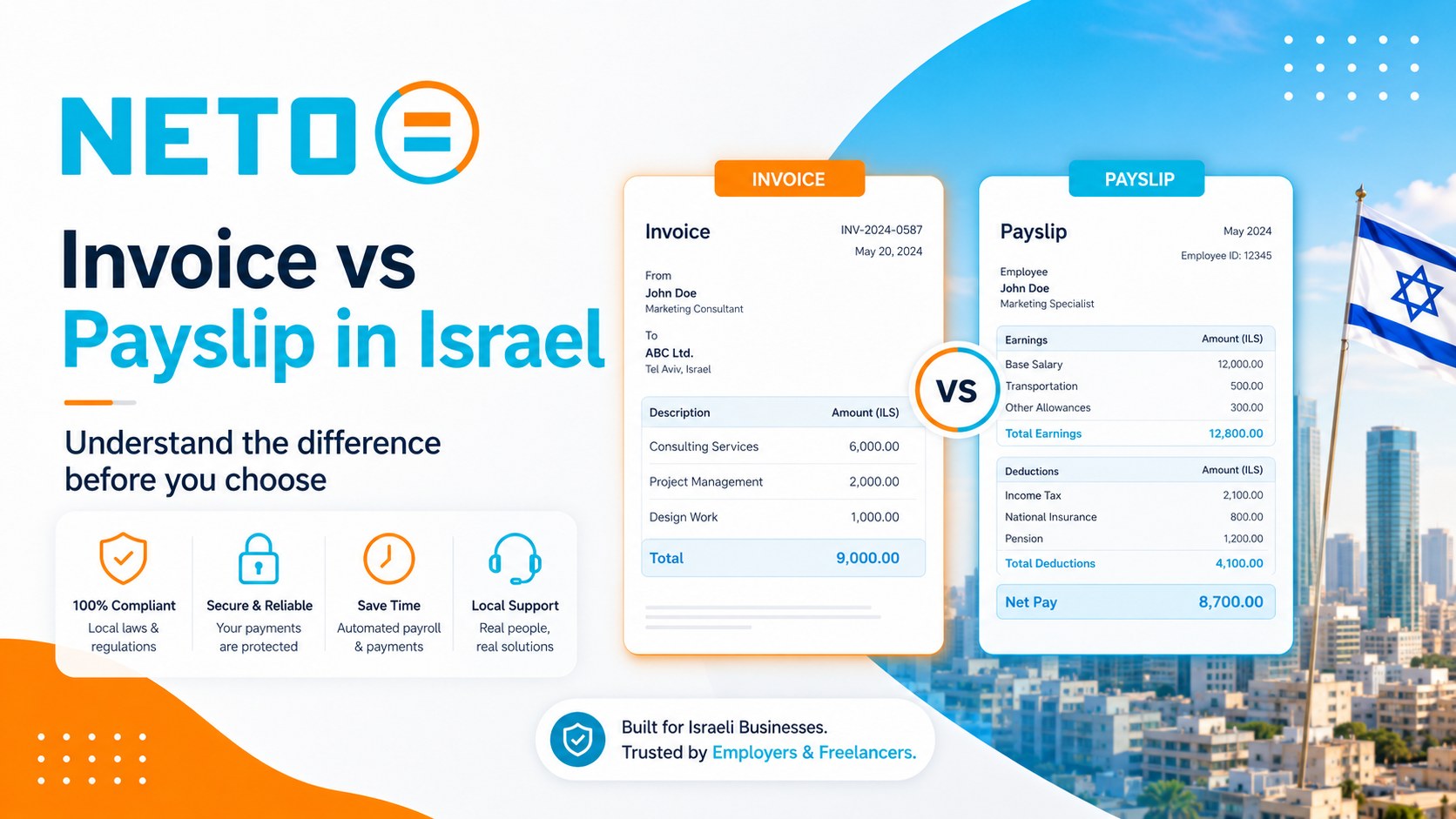
Suppose Danny started working on January 1st with a salary of ILS 10,000 and has active pension insurance from a previous job. In the first three months he won't see contributions on his payslip, but in April he'll see a double or triple deposit that retroactively covers January through April.
His regular monthly deposit: ILS 600 from the employee deduction, ILS 650 employer savings contribution, and ILS 600 employer severance contribution · a total of ILS 1,850 per month will be deposited into his pension fund. This example is general and illustrative only · actual amounts depend on the determining salary and the fund's terms.
A distinction should be made between retirement age and mandatory retirement age (67). An employee who has reached mandatory retirement age and continues working is still eligible for contributions in most cases · the main exception is someone already receiving a pension who also meets additional conditions.
Employer contributions toward savings and loss-of-working-capacity insurance are exempt from income tax up to a ceiling · the employee pays no tax on the amounts the employer deposits. In addition, the employee is entitled to a tax credit on their own contributions, which directly reduces their tax.
The first step · a written request to the employer demanding the deposits be arranged. If they refuse, a complaint can be filed with the Ministry of Labor's Regulation and Enforcement Administration, which is authorized to impose sanctions. In severe cases, you can also sue in the Labor Court.
The Capital Market, Insurance and Savings Authority at the Ministry of Finance supervises all pension bodies, provident funds and insurance companies · it sets rules for managing the funds, oversees returns and fees, and protects savers. Complaints about the fund itself are directed to it.
Yes · the employee has the full right to choose where the funds are deposited, and the employer may not force a particular fund. You can choose between a comprehensive pension fund, a provident fund or managers' insurance. If the employee doesn't choose, the employer may enroll them in a default fund · so it's recommended to choose actively.
A fund with accumulated money but no ongoing deposits. For the purpose of the rule on starting contributions for a new employee, an inactive pension may be considered "existing pension insurance" if it can be reactivated · but it may charge high management fees, so it's worth consolidating funds.
No. The law does not allow an employee to waive their right to pension contributions, even if they'd prefer to receive the money in cash. An employer who agrees to such a request is violating the law and is exposed to sanctions · the right exists to protect the employee at retirement age.
In some industries there are collective agreements with different rules · for example, employees of event halls and gardens enjoy a unique sector-specific arrangement suited to temporary and hourly work. These industries are still eligible, but the eligibility terms and contribution dates may differ.
NETO operates in Israel under manpower contractor license no. 1565 from the Ministry of Labor. For clients, this means payroll and pension management with orderly documentation, subject to a case-by-case review of the type of engagement and the required documents.

Managing pension contributions can be complex, especially for employers with multiple employees under different terms. NETO employs workers and manages their full contributions on their behalf · the system automatically calculates the required contributions, produces a transparent payslip and clear reports, and ensures compliance with legal requirements vis-à-vis the authorities and the funds.
For employees, working through an orderly system ensures full transparency regarding the deposits · instead of guessing or calculating manually, the employee sees exactly what was deposited on their behalf and where. The employer's share is funded from the invoice the client pays · not from the employee's pocket. This saves headaches and prevents unnecessary disputes.
An employer who wants to employ a worker or freelancer signs up in minutes · without setting up an internal payroll system and without unnecessary bureaucracy.
The system calculates the contributions (18.5% of the determining salary), deposits them into the fund the employee chose, and handles deductions and reporting.
The employee receives an orderly payslip that clearly shows the employee deduction, the employer's savings contribution and the employer's severance contribution · full transparency.
Yes, a part-time employee is entitled to pension contributions exactly like a full-time employee. Contributions are calculated as a percentage of actual salary, so an employee earning less will receive lower deposits in absolute terms, but at the same percentages.
Your savings funds remain in the fund and are entirely yours. As for the severance funds, the answer depends on whether Section 14 was applied and on the terms of the employment contract. In many cases the severance funds will also remain in the fund for your benefit.
By law, the employer must transfer the deposits to the fund by the 15th of the month following the month for which the salary is paid. A significant delay constitutes a violation that can be reported.
Withdrawing pension funds before retirement age involves high tax and loss of benefits, and is generally not recommended. In special cases such as a serious medical condition or high medical expenses, it may be possible to receive approval for early withdrawal.
A pension fund is a collective savings fund where returns and risks are shared among all savers. Managers' insurance is a personal insurance policy where the savings are linked to a chosen investment track. Each channel has advantages and disadvantages worth examining before choosing.
The answer depends on the definition of the determining salary in the employment contract or collective agreement. Overtime is usually not included in the insured salary, unless otherwise explicitly agreed.
Disclaimer: The information on this page is general and for explanatory purposes only · it does not constitute pension, tax or legal advice. The binding text is the wording of the law, the expansion orders and the pension regulations as published in the official record · for a specific case it's advisable to consult a professional. For questions · phone support at 08-976-1874.
NETO employs workers and manages pension contributions, deductions and a transparent payslip for them · all under manpower contractor license 1565. Start a quick signup, or talk to us on WhatsApp.
NETO's contribution guide · rates, the split and orderly management.
Read more
The pension mandate, the expansion order and eligibility · everything you need to know.
Read moreDecode every line on the payslip · deductions, contributions and what's correct.
Read more

How tax is calculated on the payslip, and its connection to pension benefits.
Read moreNETO's contribution guide · rates, the split and orderly management.
Read moreThe pension mandate, the expansion order and eligibility · everything you need to know.
Read moreDecode every line on the payslip · deductions, contributions and what's correct.
Read more YC
YCEvery section, organized by topic. Browse the full hierarchy or jump straight in.
Adjust the site to your needs
Here you can ask to see the data we hold about you, correct it, delete it, withdraw consent you gave, or stop receiving our emails and alerts. We reply within 30 days, and handle removal requests within 7 business days. Privacy policy
Barkat I.T Ltd · trading as NETO · is a licensed manpower company (license 1565), supervised by the Israeli Ministry of Labor.
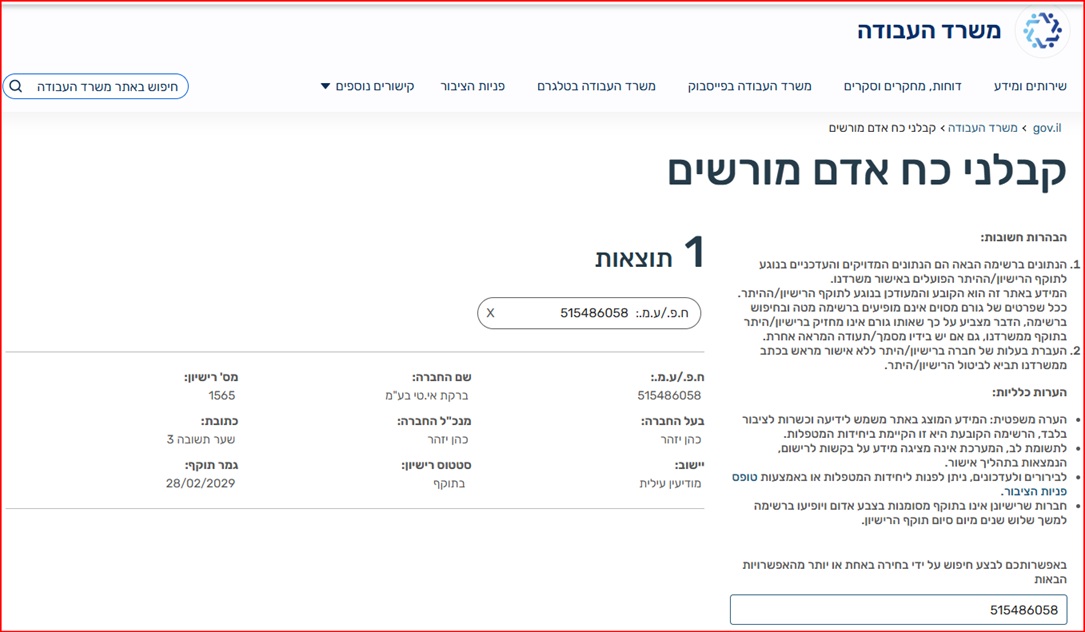 Verify the license on the Ministry of Labor website
Full details · Manpower contractor license page →
Verify the license on the Ministry of Labor website
Full details · Manpower contractor license page →