Freelancer vs Self-Employed (Osek) in Israel
Freelancer and self-employed are related but not identical · self-employed (Osek) is someone who registers a business file with the authorities, while freelancer describes the nature of the work. The important question is how you report and get paid · and in suitable cases you can work as a freelancer and receive a payslip through NETO, without opening a business file.
AI Summary Smart overview of this page · click hereClick to read the page summary
Freelancer and self-employed (Osek) are close, but not the same thing. In Israel, self-employed usually means someone who has registered a business file with the authorities · an exempt dealer (Osek Patur) or an authorized dealer (Osek Murshe) · and reports their income themselves. Freelancer describes the nature of the work: flexible, project-based, often for several clients. What really matters is how you report and get paid: through a business file, through an invoice, or through a payslip. Choosing the wrong route · for example labelling a worker a freelancer when an employer-employee relationship actually exists, or receiving income without documentation · creates real exposure with the Tax Authority and National Insurance. NETO, a licensed manpower contractor (#1565), offers a practical route in suitable cases: the client receives an invoice, and you receive a payslip with net pay and social rights, without opening a business file. NETO does not replace legal or accounting advice · always cross-check with official sources.
This summary is generated from the page content and the linked sources · full detail below. It is not legal or accounting advice.
Guide Summary
The common question: what is the difference between a freelancer and self-employed, and how do you choose a route? In brief:
- Self-employed = a registered business file · freelancer = the nature of the work.
- Check whether to open a business file, invoice, or take a payslip through NETO.
- Make sure income does not create surprises with tax and National Insurance.
- In suitable cases · the client is invoiced, you get a payslip and net pay.
Freelancer or Self-Employed · What Is the Real Difference?
Many people use the terms freelancer and self-employed interchangeably, but they are not the same thing. Self-employed (in Hebrew, "Osek") usually means someone who has registered a business file with the authorities · an exempt dealer (Osek Patur) or an authorized dealer (Osek Murshe) · and reports their own income. Freelancer, by contrast, describes the nature of the work: flexible, project-based work, often for several clients, without the structure of a permanent position.
The practical meaning: you can work as a freelancer without necessarily being a self-employed person who has opened a business file. The important question is how you report and get paid · through a business file, through an invoice, or through a payslip. NETO does not replace legal or accounting advice, but in suitable cases it offers a convenient operational route: the client receives an invoice, and the person doing the work receives a payslip and net pay to their account.
- Self-employed (Osek) · a registered business file and self-reporting to the authorities.
- Freelancer · a flexible way of working, not necessarily a business file.
- Decide by the reality in practice · who manages, how you are paid, one-off or ongoing.
What to Check Before Choosing a Route
Each route has pros and cons · the choice depends on the nature of the work, the scope of activity and the number of clients:
Decide whether it is right to open a business file, work with an invoice, or take a payslip through NETO.
Make sure the income does not create surprises with the Tax Authority or the National Insurance Institute.
Define the price, the scope of work, the payment date and responsibility in writing.
In suitable cases · the client receives an invoice and you get an orderly payslip.
Possible Payment Routes
The right choice depends on the nature of the work, the scope of activity and the number of clients:
- Payslip through NETO · without opening a file. In suitable cases NETO acts as the legal employer: the client receives an invoice and you receive a payslip and net pay, without opening a business file and without filing reports yourself. Especially suitable for side work, projects and activity that is not yet broad. See salary payment by invoice in Israel.
- Opening a business file · Osek Patur or Osek Murshe. Ongoing, broad activity with several clients can justify opening a business file. It involves registering with the authorities, ongoing reporting and bookkeeping · compare the cost and management time against the alternative.
- Receiving payment without documentation · not the right way. Receiving income without documentation and proper reporting, or a wrong classification of the engagement, can expose you to risk with the Tax Authority and National Insurance. Always keep to a lawful, documented route.
How to Proceed the Right Way · Step by Step
Put in writing the type of work, the length of the engagement and the required outcome · and check whether it is an employment relationship, self-employment, side work or a one-off service.
Choose a suitable route: business file, invoice, payslip or a NETO solution in suitable cases · and keep the agreement, payment confirmations and tax coordination.
If the engagement becomes permanent, dependent or broader · reassess the classification and the route, so it keeps matching reality.
Route Comparison Table
| Criterion | Payslip via NETO | Osek Patur | Osek Murshe |
|---|---|---|---|
| Opening a file with the authorities | Not required | Required | Required |
| Ongoing self-reporting | NETO reports | Basic | Full |
| Bookkeeping | Not required | Basic | Full + accountant |
| Payslip and employee rights | Yes | None | None |
| Suits side / one-off work | Very much | Less | Less |
| Suits broad, ongoing activity | Case by case | Partly | Yes |
* A general orientation table only · the choice depends on the nature of the work and the scope of activity. Not legal or accounting advice.
Quick Decision Helper · Which Route Suits Me?
If so, the route can be simpler. Check a one-time invoice or a payslip through NETO, without opening a file.
Ongoing subordination may indicate an employment relationship · check the classification before signing, so a "freelancer" is not in fact an employee.
Broad, ongoing activity can justify a business file · compare cost and management time against a payslip through NETO.
Official Sources · Cross-Check Before You Decide
It is worth cross-checking the information with official sources, especially when it comes to tax, National Insurance or labor law:
Classification, reporting and payment of tax on income. See the Israel Tax Authority.
Classification as self-employed or salaried, and the rights of the insured. See Bituach Leumi.
Labor law and supervision of manpower contractors. See the Ministry of Labor.
The NETO Route · Freelance Work, Employee Rights
In suitable cases, NETO lets you feel exactly like a freelancer · issuing invoices, working per project · while being defined as a salaried employee with a payslip and full social rights. You are our employee, and we handle the registration, reporting and payment. NETO charges a fee of about 5% of the invoice the client pays (before VAT) · so the fee comes from the client's invoice, not from your rights.
Work for your clients without opening a business file, without an accountant and without filing reports yourself.
You receive a payslip with National Insurance, pension and full social rights · just like a salaried employee.
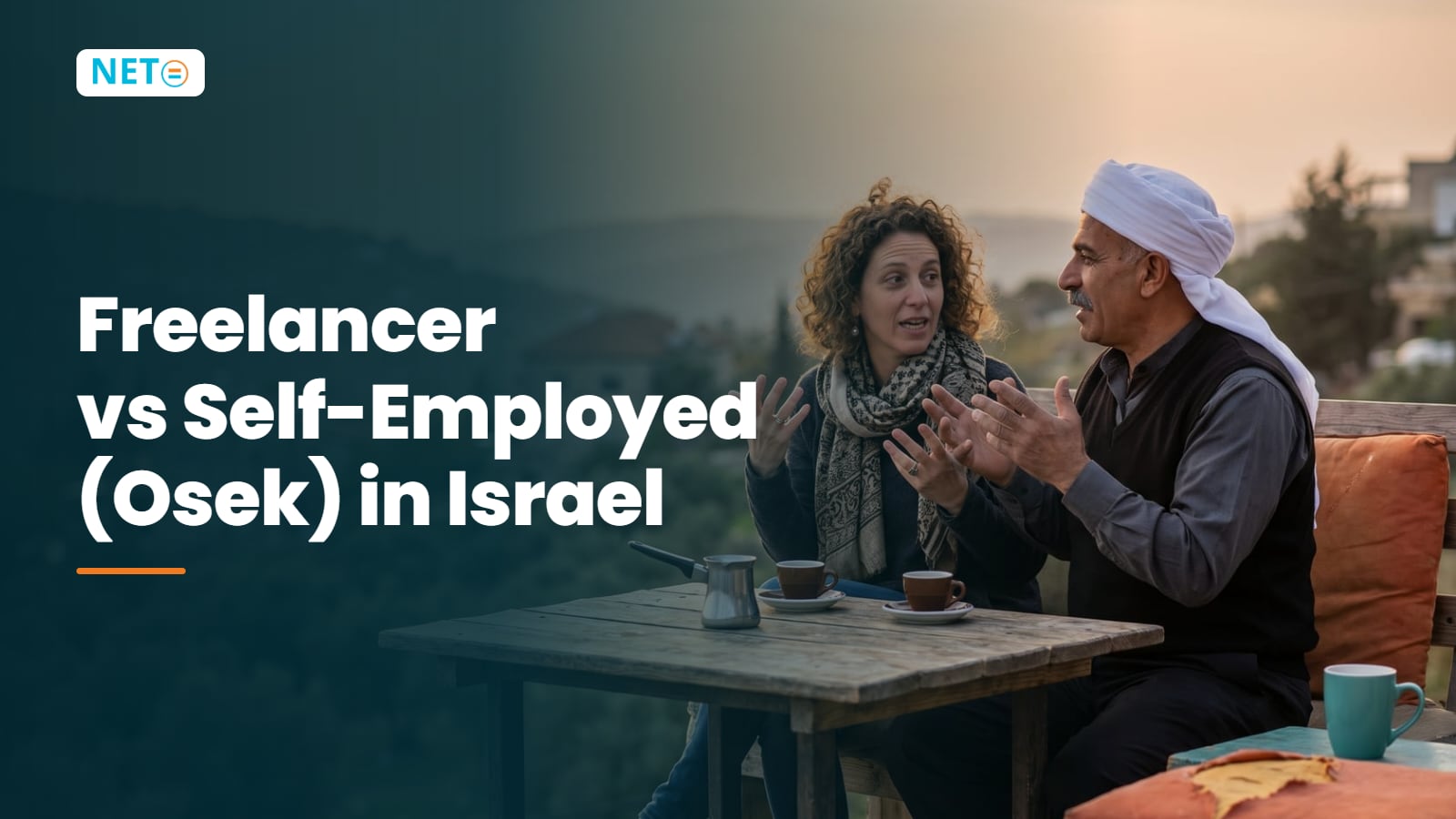
NETO is a licensed manpower contractor (#1565) supervised by the Ministry of Labor.
See our guide on how to start as a freelancer in Israel.
Watch · how you get paid through NETO
Two minutes that show exactly what happens from signup to payslip · before you commit to anything.
Frequently Asked Questions
What is the difference between a freelancer and self-employed (Osek) in Israel?
They are related but not identical. Self-employed (Osek) usually means someone who has registered a business file with the authorities (Osek Patur or Osek Murshe), while freelancer describes the nature of the work: flexible, project-based work. The practical question is how you report and get paid.
Does a freelancer have to open a business file (Osek)?
Not always. Ongoing and broad activity can justify opening a business file, but for a small project or side work it is worth also checking the invoice and payslip route through NETO, without opening a business file.
What is the main risk of choosing the wrong route?
The risk is choosing a route that does not fit the nature of the work: for example, calling someone a freelancer when an employer-employee relationship actually exists, or receiving income without proper documentation and reporting to the authorities.
How does NETO fit in?
NETO is a licensed manpower contractor (#1565) and, in suitable cases, enables an orderly route in which the client receives an invoice and the person doing the work receives a payslip and net pay to their account, without opening a business file. NETO does not replace legal or accounting advice.
What is the right way to check whether to register as self-employed?
Examine the nature of the work, the scope of activity, the number of clients and the degree of subordination, and cross-check against official sources: the Israel Tax Authority, the National Insurance Institute and the Ministry of Labor. The earlier you document, the easier it is to avoid classification and reporting mistakes.
I am salaried. Can I also freelance on the side?
Yes. Many people earn side income alongside a permanent job. It is important to ensure proper tax coordination and orderly reporting. Working through NETO lets you receive that income as a payslip with social rights, without opening a business file.
Summary
Freelancer or self-employed should be judged by the reality in practice: who manages the work, how payment is made, whether there are tax and National Insurance obligations, and whether the engagement is one-off or ongoing. The earlier you document, the easier it is to avoid classification and reporting mistakes.
Distinguish the nature of the work (freelancer) from the registration with the authorities (self-employed), choose a payment route that fits the engagement, and cross-check with the Tax Authority, National Insurance and the Ministry of Labor. In suitable cases, NETO lets you receive a payslip and net pay without opening a business file · for a fee of about 5% of the client's invoice (before VAT). Want to check which route fits you? Start with NETO or talk to us.
Last updated: 09/07/2026 · general information, correct for 2026 and updated periodically.
Work as a Freelancer · Without Opening a Business File
Let NETO invoice your client while you receive a payslip and full social rights. Register free for a payslip simulation, or ask us on WhatsApp.