
If you are making aliyah and your employer abroad wants to keep you, the usual obstacle is structural, not personal: once you live in Israel, your employer cannot simply keep paying you the way they did when you lived in the United States, and most companies do not want to open an Israeli entity for a single employee.
NETO solves this by becoming your legal employer in Israel. Your day-to-day work, your manager and your role stay exactly the same. NETO issues a tax invoice to your employer abroad, withholds Israeli income tax at source, contributes to your pension and severance, registers you with Israeli National Insurance, and issues you a full Israeli payslip. The fee is 5% of the invoice amount before VAT, paid out of the invoice, never charged to the worker.
This page is written for the stage before you fly, and it includes a section addressed to your employer, so you can forward it to them.
Who is reading this?
The answer changes what matters on this page. Choose one and you will land on the part written for you — the other part stays below, so you can read both.
Key points
- Your employer keeps you. They do not need an Israeli entity, an Israeli bank account, or an Israeli payroll department.
- You become a salaried employee in Israel with a payslip, pension, severance accrual and National Insurance.
- You do not open an osek and you do not become self-employed in Israel.
- Whether US Social Security and Medicare keep applying turns on who counts as your employer under US rules · a question of fact, not of paperwork. We set out the test below.
- Arranging this before you land avoids a gap in coverage and in income.
- The 5% fee comes out of the invoice your employer pays. It is never deducted from you.
The problem nobody warns you about
Aliyah checklists cover the flight, the teudat zehut, the bank account and the ulpan. They rarely cover the thing that pays for all of it.
Here is the situation a lot of olim find themselves in. You have a good job. Your employer likes you and is open to keeping you after the move. Then someone in their finance or legal team asks a reasonable question: what does it mean for us to have an employee living in Israel? And the answers they get back involve permanent establishment risk, foreign payroll registration, local labor law, and opening a subsidiary. For one person, that is almost never worth it.
At that point the conversation usually goes one of three ways. The employer lets you go. Or they ask you to become a contractor and invoice them, which pushes an entire tax and compliance burden onto you personally. Or somebody finds the structure described on this page, and nothing about your actual job has to change.
Before you fly · after you land
A realistic sequence. The point is that most of the work belongs in the first column, before you fly.
1 While you are still abroad
- Raise it with your employer early. Not as a request to keep your job, but as a solution you have already found. Most of the resistance you will meet is fear of complexity, so lead with the fact that there is nothing for them to open.
- Talk to us before you commit to a date. We will tell you honestly whether your role and contract fit this structure, and what will not work.
- Get your US tax position reviewed by a professional who handles US and Israeli tax together. This page is not a substitute for that, and the answer genuinely depends on your circumstances.
- Agree on the commercial terms. Your employer pays an invoice instead of running payroll. The number they see is not the number that used to land in your account, and it is much better to work that through now than in your first month here.
- Line up the paperwork that Israeli onboarding needs, while you still have easy access to US documents.
2 Once you land
- Open your Israeli bank account and get your teudat zehut. Salary needs somewhere to go.
- Complete Israeli onboarding with NETO and file the standard employee tax coordination forms.
- National Insurance registration. For a salaried employee this is handled through payroll rather than left to you.
- Your pension starts accruing under Israeli law, along with severance provisions.
- Your first Israeli payslip. From here you have local, documented, ongoing income in shekels, which matters for far more than tax.
Social Security and Medicare · what changes and what does not
This is the question American olim ask most, and it deserves a straight answer rather than a marketing one.
The United States taxes its citizens on worldwide income regardless of where they live, so moving to Israel does not end your US filing obligations. That much is not in dispute and nothing on this page changes it.
Where the structure does make a difference is Social Security and Medicare. The IRS position is that wages paid to US citizens and residents employed outside the United States are generally subject to Social Security and Medicare tax if the employer is an American employer. Under the arrangement described here your employer for Israeli employment purposes is an Israeli company, not an American one.
There is a second piece, and it cuts the other way. The United States has totalization agreements with a list of countries that coordinate social security coverage between the two systems. Israel is not on that list. There is no US and Israel totalization agreement, which means there is no certificate of coverage to rely on and no reciprocal crediting: time you work in Israel does not count toward US Social Security entitlement, and vice versa.
What we can tell you is the structure, accurately, so that you and a qualified professional can evaluate it against your own situation. If you are also weighing the self-employed route, the arithmetic there is different, and we cover it on our self-employment tax page.
Sources: IRS · Social Security and Medicare tax for US citizens employed abroad · SSA · International agreements. Checked September 2026.
How NETO works
Four moving parts. Only one of them is work you actually do.
1 You work
Same role, same team, same manager, same hours. Nothing about the work itself changes.
2 We invoice
NETO issues a tax invoice to your employer for the agreed amount. They pay one invoice, on their normal vendor terms.
3 We employ
Income tax withheld at source, pension and severance contributions, National Insurance, and the protections Israeli employment law gives salaried workers.
4 You are paid
A full Israeli payslip, in shekels, in your Israeli bank account, every month.
Your three options compared
| Route | Employer opens an Israeli entity | You become self-employed | Employed through NETO |
|---|---|---|---|
| What your employer does | Registers a company, sets up payroll, takes on Israeli labor law obligations | Pays your invoices as a vendor | Pays one invoice as a vendor |
| Setup time | Months | Weeks, and the work falls on you | Days |
| Who handles Israeli tax withholding | Their new entity | You, personally | NETO |
| Pension and severance | Yes | You arrange it yourself | Yes, under Israeli law |
| Israeli payslip | Yes | No | Yes |
| Employee protections under Israeli law | Yes | No | Yes |
| Bookkeeping burden on you | None | Ongoing | None |
| Realistic for one person | Rarely | Sometimes | Yes |
Questions people actually ask
Does my employer have to open a company in Israel?
Will my day-to-day job change?
Do I still have to file US taxes?
Is there a US and Israel totalization agreement?
How much does it cost, and who pays?
Should I set this up before or after I land?
What if I have more than one client, not one employer?
Is this actually legal, and who supervises it?
Related guides
For the employer
Your employee is moving to Israel. You do not have to open anything here.
This part is written for the company, not for the employee. Someone on your team is relocating to Israel and you would like to keep them. You can — without an Israeli entity, without foreign payroll, and without taking on Israeli employment obligations yourself.
No Israeli entity
You do not register a company, a branch or a representative office in Israel. NETO is the Israeli employer of record and carries the local employment relationship.
You pay an invoice
Instead of running foreign payroll, you receive a standard tax invoice from an Israeli company and pay it like any other vendor invoice.
Israeli obligations sit with us
Income tax withholding at source, pension and severance contributions, National Insurance and Israeli labor law compliance are ours, not yours.
Nothing changes operationally
The person keeps doing the same job, on the same team, reporting to the same manager. Day-to-day professional direction of the work stays with you; the employment relationship in Israel, and the employer obligations under Israeli law, sit with NETO.
Licensed and supervised
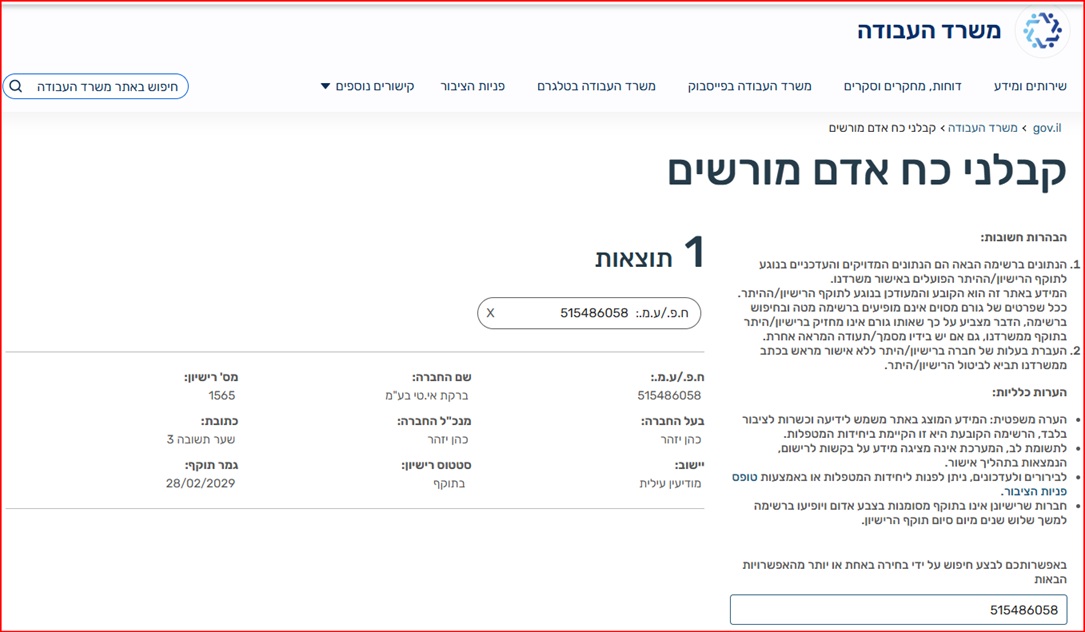
Employing workers on behalf of another company is a regulated activity in Israel and requires a license. NETO holds Israeli manpower contractor license 1565 and operates under the supervision of the Ministry of Labor. License number 1565 is public information and appears in the Ministry of Labor's public registry of licensed contractors.
Transparent cost
The fee is 5% of the invoice amount before VAT. It is part of the invoice you pay, and it is never charged to the employee.
Reading this for yourself rather than for a team member? The employee part is above.
About this guide
Written by the NETO team. NETO has been employing workers in Israel on behalf of clients in Israel and abroad since 2016, under Israeli manpower contractor license 1565, supervised by the Ministry of Labor. We handle the employment side of this arrangement every working day, which is why this page describes the structure in detail and refers tax questions to people qualified to answer them.
Last updated: September 2026.
Still have the job. Still moving. Let us make both work.
Tell us about your role and your employer, and we will tell you honestly whether this fits, before you commit to anything.
Start now · free registration